

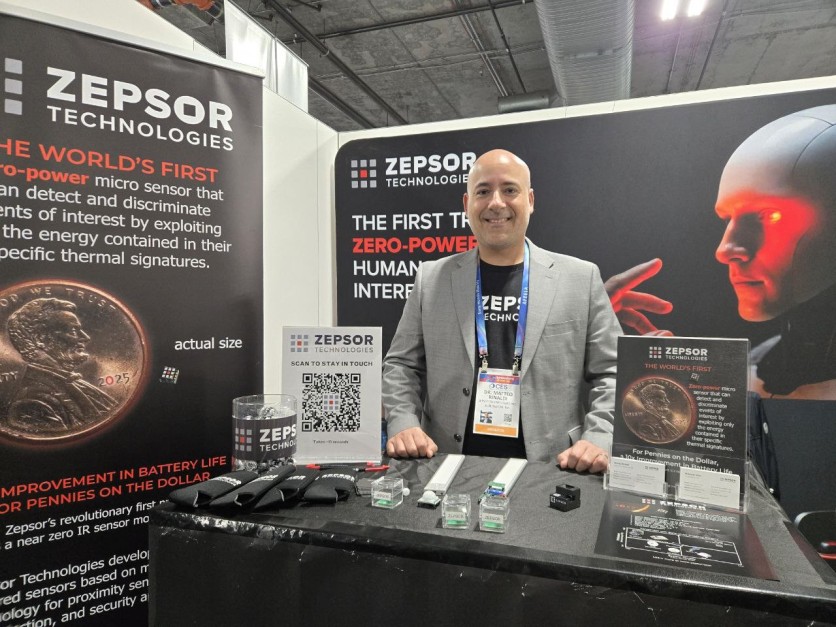
LAS VEGAS — In an era where "always-on" technology is the standard, the hidden cost of our connected world is the constant, silent drain on batteries and the electrical grid. At CES 2026, a groundbreaking innovation from Zepsor is promising to flip this paradigm on its head. The company has unveiled the world's first "zero-power presence sensor," a technology that allows machines to remain completely dormant until the very moment they are needed.
By replacing energy-hungry cameras and microphones with a tiny, mechanical masterpiece of physics, Zepsor is paving the way for a future where devices are truly "environmentally aware" without sacrificing battery life.
The Mechanism of Zero: How It Works
The core of Zepsor's innovation is a tiny mechanical switch. Unlike traditional sensors that require a constant flow of electricity to monitor their surroundings, Zepsor's switch is passive.
- Infrared Activation: The switch is engineered to respond specifically to the infrared radiation naturally emitted by the human body.
- Mechanical Intelligence: When a person enters the sensor's field, the heat from their body physically triggers the switch.
- The Powerless Interface: Because the trigger is mechanical and thermal rather than electrical, the interface consumes zero power while in standby mode.
- The Wake-Up Call: Once triggered, the switch completes a circuit that can "activate any kind of electronic device or machine."
This allows a machine to "respond to the environment where there is human presence" without the "power system standby" drain that currently plagues modern electronics.

Privacy by Design: Sensing without Surveillance
One of the most profound implications of Zepsor's technology is its inherent respect for privacy. In the current smart-home and industrial landscape, "presence detection" is often synonymous with cameras or microphones—devices that raise significant ethical and security concerns.
Zepsor offers a middle ground. By making a machine "aware of the environment without using cameras or microphones," Zepsor provides the utility of human-responsive tech without the invasive data collection. The machine doesn't "see" or "hear" you; it simply knows you are there because of the physical reality of your body's heat.
Extending the Horizon: Battery Life and Sustainability
The practical application of a zero-power sensor is most evident in battery-operated devices. By eliminating the standby power draw, Zepsor is capable of "extending battery lifetime significantly."
- Remote Security: Imagine a security camera in a remote location that only turns its power-intensive optics and transmitters on when a human is actually present, rather than constantly polling for motion.
- Smart Home Convenience: Smart mirrors, faucets, or lighting systems could remain completely "off" until the moment a user approaches, potentially extending their operational life between charges from weeks to years.
- Industrial Efficiency: In massive warehouses or factories, lighting and HVAC systems could be managed with pinpoint accuracy based on human presence, drastically reducing the energy footprint of large-scale facilities.
The Journey to the Main Stage
Zepsor's appearance at CES 2026 marks a major milestone in the company's evolution. While they participated in the previous year's show, their 2026 presence represents a leap from theoretical research to practical application.
- The DARPA Foundation: Much of the early development for this technology was supported by DARPA, which funded some of the company's foundational activities.
- From Redboards to Reality: At last year's CES, Zepsor was limited to "redboard demonstrations" and video presentations—essentially showing that the concept worked in a controlled lab setting.
- The 2026 Milestone: This year marks the "first ever life demonstration of this technology" in a finalized product form. The chip is no longer a prototype; it is "now ready to sample" to customers and partners.
Looking Toward 2027: Integration and Partnerships
As Zepsor moves from a demonstrator to a supplier, the focus is shifting toward large-scale integration.
When asked about the future for CES 2027, the company outlined an ambitious roadmap focused on OEM (Original Equipment Manufacturer) partnerships. "We should expect to see this chip integrated in some higher level... demonstration," a representative shared. This means that by next year, we may not just be seeing the Zepsor chip on a display stand, but inside the flagship products of major global brands.
Conclusion: The End of Standby
Zepsor is proving that the next great leap in technology isn't just about doing more—it's about doing it with less. By mastering the physics of a zero-power mechanical switch, they have solved one of the most persistent problems in the Internet of Things: the inefficiency of the "always-on" state.
As Zepsor begins sampling its chips to the world's leading manufacturers, we are standing on the threshold of a new era of "quiet" technology. It is a future where our machines are as efficient as they are intelligent, waking up only when we need them and remaining perfectly, powerlessly silent when we don't.
ⓒ 2026 TECHTIMES.com All rights reserved. Do not reproduce without permission.


