
Europe's cybersecurity environment in 2026 has entered a new phase where compliance is no longer advisory, optional, or primarily technical. It is now enforceable, measurable, and directly tied to operational continuity, budget allocation, supplier qualification, and executive accountability. This guide was produced by Echoworx, a provider of enterprise encrypted communications solutions designed to help organizations meet the practical requirements of modern regulatory frameworks by enabling secure, policy-driven, auditable encryption that works at scale without disrupting day-to-day business operations.
1) The 2026 Executive Reality: Cybersecurity Is Now a Governance and Market Access Requirement
For senior leadership, the most important shift in 2026 is that cybersecurity has become inseparable from corporate governance and market access. It is no longer treated as an IT improvement initiative with soft outcomes, but as a mandatory risk management discipline tied to enforceable obligations.
The reason this matters at C suite level is simple. The current regulatory climate forces leaders to treat security failures as business failures. A material incident can trigger regulatory scrutiny, customer contract risk, insurance problems, supply chain disruptions, reputational damage, and, in certain frameworks, direct consequences for management bodies that failed to provide oversight.
This is not a future scenario. It is the operating environment now. The board, executive team, and legal team's job is to ensure the company can maintain continuity, demonstrate control, and evidence compliance under pressure. That requires shifting from reactive security spending to a durable compliance architecture built into daily operations.
2) The Four Frameworks Executives Must Understand in One Unified View: NIS 2, KRITIS-DachG, DORA, and CER
One of the biggest mistakes leadership teams make is treating European regulations as separate compliance exercises. In 2026, these obligations function as a combined governance and resilience stack. They are interconnected, but each framework has a distinct purpose. Together, they reinforce the same direction of travel: stronger accountability, stronger resilience expectations, deeper third-party oversight, and higher consequences for failure.
NIS 2 raises the baseline for cybersecurity across a much wider portion of the economy. It formalizes requirements around cyber risk management, incident response, reporting discipline, and executive-level governance involvement.
KRITIS-DachG expands the resilience conversation beyond IT. Its emphasis is on physical resilience, continuity, and protection of essential services, forcing organizations to treat operational readiness as a national resilience requirement, not just an internal risk function.
DORA hardens digital operational resilience requirements within the financial sector and the ICT vendor ecosystems that support it. It turns third-party risk management into an auditable discipline and sharply increases leadership accountability, including personal liability at the board level.
CER reinforces resilience expectations for critical entities with a focus on physical and operational threats. The objective is sustained functionality under crisis conditions, not only the prevention of digital incidents.
For executives, the combined message is clear: regulators are no longer asking for "best efforts." They want consistent outcomes. Your controls must work repeatedly, across people, systems, suppliers, and real-world disruptions.
3) Compliance as a Budget Mandate: Predictable Costs Beat Unpredictable Consequences
Executive teams typically ask how much cybersecurity should cost. In 2026, the better question is how much uncertainty the business can afford.
Compliance spending is no longer optional overhead. It is increasingly a cost of participating in regulated markets, serving enterprise customers, and qualifying as a vendor in high-trust supply chains. Even organizations outside critical infrastructure are being pulled into compliance expectations indirectly through procurement clauses, supplier security questionnaires, and contractual risk terms.
From a budgeting perspective, the goal is not to spend more. The goal is to spend correctly. That means investing in controls that create repeatable and measurable compliance outcomes, rather than spending on security activities that produce little operational evidence.
High maturity compliance investment has three characteristics.
- It reduces operational disruption and exceptions.
- It provides audit-ready evidence as a normal byproduct of daily work.
- It improves resilience under stress conditions rather than assuming perfect circumstances.
This is where encrypted communications becomes a boardroom-relevant control. Email and document exchange are still the nervous system of business, especially for regulated industries. If an organization cannot reliably protect sensitive communications, it will struggle to prove compliance regardless of how advanced other controls appear.
4) Compliance as an Operational Mandate: A Control That Breaks Workflow Is a Failed Control
Operational leaders often experience security as friction. Executives must treat friction as a risk indicator.
The simplest truth in cybersecurity is that employees will route around obstacles. If security controls are too slow, too complex, or too unreliable, then staff will revert to consumer messaging apps, personal email, uncontrolled file transfers, and informal workarounds. Those workarounds create invisible exposure that grows quietly until a failure becomes public.
In 2026, regulators and auditors are not sympathetic to this reality. They interpret systemic workarounds as evidence that the organization did not implement practical risk management.
For leadership, operational security success is not measured by how strict a policy is. It is measured by whether the secure method becomes the default method because it is usable, reliable, and integrated.
This is why encrypted communications must be designed for real business conditions. It needs to work across mixed recipient environments, external partners, mobile devices, and time-sensitive workflows. It must protect information without turning every message into an IT ticket.
When executives fund controls, they must fund controls that can be adopted.
5) Compliance as a Liability Mandate: Management Accountability Has Real Teeth Now
In 2026, executive accountability is not an abstract risk. It is embedded into modern compliance frameworks through explicit governance expectations.
This changes the leadership posture in two ways.
First, cybersecurity can no longer be treated as something you "assign" to IT and forget about. Executives must be able to show they understood the risk, approved the approach, and governed the implementation. This is as much about defensible governance as it is about technical outcomes.
Second, leadership must ensure the organization can provide evidence of oversight. This includes defined accountability, risk acceptance decisions that are documented, and an operational security system that produces proof continuously.
A mature executive approach does not mean leadership is configuring security tools. It means leadership has built a structure where the organization can demonstrate it took reasonable, repeatable steps to prevent incidents, reduce impact, and maintain continuity.
Encryption is particularly relevant here because it can be governed through policy, measured through audit reporting, and integrated into compliance evidence. It provides practical proof that sensitive communication controls exist and are being applied.
6) The Resilience Shift: Why "Preventing Incidents" Is Not Enough in 2026
Executives naturally want prevention. Prevention is good. But resilience is the true regulatory outcome in 2026.
Resilience means the organization can continue operating through disruption, maintain essential processes, and control communication flows even when systems degrade, vendors fail, or core platforms go offline. It also means the organization can detect incidents earlier, contain them faster, and restore normal operations with minimal operational and reputational damage.
This shift matters because European regulators increasingly view "failure to continue service" as a governance breach, not just an operational inconvenience. Under frameworks like CER, resilience is measured by whether essential functions can still be delivered under crisis conditions, including when infrastructure is impaired. The organization must be able to prove that continuity planning is real, exercised, and supported by systems designed to sustain disruption.
Encrypted communications sit directly inside that resilience layer. During an incident, the organization still needs to send trusted messages, share documents securely, coordinate response, and communicate with customers, suppliers, and authorities. Encryption is not optional "when things are going well." Even under outage conditions, degraded operations, or partial system loss, sensitive communications are still required to remain protected. There is no acceptable fallback to insecure channels.
Resilience is not a document. It is a working capability.
7) The Hidden Compliance Failure: Email and Document Exchange Still Create the Biggest Gaps
Many organizations believe their security posture is strong because they invested in perimeter controls, endpoint tools, and awareness programs. Yet the largest recurring compliance gaps in regulated environments often come from communication.
- Sensitive documents are emailed to the wrong recipient.
- Confidential attachments are forwarded outside approved workflows.
- Executives share files over consumer apps because it is faster.
- Teams bypass secure portals because clients refuse to register accounts.
- Temporary employees use unmanaged accounts for "quick turnaround."
- Partners demand access by urgency rather than policy.
Every one of these behaviors becomes a compliance problem under the 2026 mandates, because regulators measure outcomes and risk control, not intentions.
Encrypted communications solve a very specific executive problem. It removes the need to rely on perfect employee behavior. When encryption is automated and policy-driven, the organization moves from "hoping people do the right thing" to "enforcing the right outcome."
That shift alone can reduce risk exposure dramatically.
8) Sovereign Encryption and Data Control: What It Actually Means for Leadership
In 2026, sovereignty is not marketing language. It is a governance requirement that affects procurement confidence and compliance defensibility.
For executives, sovereignty means control. Control over encryption keys, control over data access assumptions, control over where critical components operate, and control over proof that sensitive communications remain protected.
Sovereignty becomes important because Europe's trust environment is deeply jurisdiction-aware. Boards, regulators, and enterprise procurement teams increasingly ask where data lives, who can access it, and whether key control is independent.
A practical sovereignty posture includes the ability for an organization to control its own encryption keys, rotate them, revoke them, and separate them by policy. It includes strong segregation between customer environments. It also includes regional hosting options that reduce jurisdictional ambiguity and align with European trust expectations.
Executives should treat sovereignty as a risk reduction lever. It lowers exposure to third-party access concerns, reduces political uncertainty in cross-border scenarios, and strengthens internal confidence during audits or investigations.
9) Encryption That Scales: Why Automation Is the Only Real Answer
If leadership wants encryption to actually protect the organization, it must scale. Scaling means it works across thousands of employees, multiple domains, subsidiaries, and external partners.
Manual encryption does not scale. Manual certificate management does not scale. Manual exception handling does not scale. The compliance environment is too demanding, and the communication volume is too high.
Automation is what converts encryption from a specialist tool into a company-wide control.
When encryption is automated, certificates can be provisioned without burdening IT teams. Renewal cycles can be handled proactively. Policies can trigger encryption without relying on user judgment. Audit logs can be created as a natural output rather than a manual compliance exercise.
Automation also solves the adoption problem. When secure sending is simple and consistent, employees comply naturally. When it is complex, compliance becomes performative.
Executives should prioritize automation not because it is convenient, but because it creates repeatable compliance outcomes.
10) Auditability and Proof: The Executive Standard Is Evidence, Not Promises
The defining characteristic of modern compliance in Europe is that "proof" is now expected. This is not limited to the finance sector. The entire enterprise ecosystem is moving in that direction through contractual pressure, procurement scrutiny, and increasingly outcome-driven regulatory posture.
Executives must ensure their organization can answer questions like:
- How do we know sensitive communications were protected?
- How do we prove encryption was applied consistently?
- How do we demonstrate policy enforcement by department or risk level?
- How do we show that exceptions were identified and controlled?
- How do we provide evidence to customers or regulators quickly?
In 2026, controls that cannot produce evidence become liabilities. If you cannot prove you did it, it becomes difficult to claim you did it.
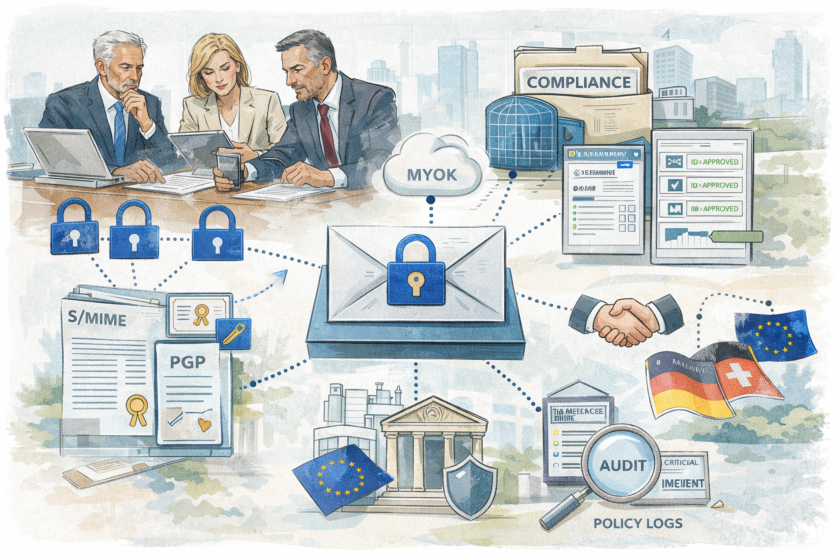
That is why modern encryption can no longer be a standalone tool running in isolation. It must be part of an integrated control system that produces real-time visibility. Encryption platforms that support APIs, directory synchronization, and SIEM and SOAR integration allow security teams to measure what is happening as it happens, not weeks later during an audit scramble.
When encryption systems provide reporting, audit trails, policy logs, and automated event feeds, leadership can transform compliance into something measurable and continuously verifiable. This reduces panic during audits, reduces friction during procurement, and strengthens confidence during incident response because proof is always available, not reconstructed after the fact.
11) Third Party Risk Under DORA: Vendor Relationships Have Become Compliance Obligations
DORA fundamentally changes the procurement environment for technology suppliers and service providers connected to financial entities. It does not only demands strong security. It demands strong oversight.
From an executive lens, this means two things.
First, the organization must treat its suppliers as part of its compliance posture. If a vendor introduces risk, that risk is not outsourced away. It returns through regulatory expectation.
Second, the organization must be able to demonstrate control over third-party dependencies. That includes service continuity expectations, incident readiness alignment, and visibility into operational behavior.
Encrypted communications sit directly inside this challenge because it is both a control and a dependency. If encryption fails, it affects confidential communication, transaction workflows, legal exchange, and incident coordination.
A resilient, encrypted communication layer that is auditable and policy-governed strengthens third-party risk posture because it keeps protection consistent even under disruption. It reduces exposure to human error, inconsistent handling across teams, and uncontrolled data exchange with suppliers and external stakeholders, while still producing the evidence trail executives need when regulators or customers ask: prove it.
For executive leadership, DORA demands supplier discipline. Encryption vendors that can support evidence and resilience reduce procurement friction.
12) KRITIS-DachG and CER: Continuity Requirements Elevate Security into Operations
KRITIS-DachG and CER reinforce a crucial shift. It is not enough to secure systems. Critical services must remain functional and reliable through disruption.
That means executives must align cybersecurity with operational resilience planning. Your security strategy must support continuity, not just prevention.
In practice, continuity depends on communication. During a disruption event, leadership needs reliable, secure messaging and document exchange across internal teams, suppliers, and authorities. If secure communication fails, the response becomes chaotic, and decision-making slows down, increasing the severity of impact.
This is why encrypted communications must be treated as part of continuity architecture, and not as a "nice to have" security control. It should remain usable, enforceable, and traceable even under stress, including during outages, degraded infrastructure, or partial system loss.
For that to be true, the solution itself must be built for disaster conditions. Resilience requires disaster recovery that is tested, not just defined in policy. Implementing a real-time encryption capability across two independent locations ensures that if one environment is disrupted, secure communication remains available through the other, with continuity designed into the system rather than patched in during a crisis.
This is especially relevant for sectors with public impact and regulated thresholds, where resilience is not just a business expectation but a societal requirement.
13) Management Readiness: What Boards and C-Suites Must Put in Place in 2026
In 2026, leadership readiness is measured by structure and capability, not by statements.
A mature executive posture includes several non-negotiables.
- Clear responsibility for security and compliance at the leadership level, with defined reporting and oversight.
- A risk management approach that translates legal obligations into operational controls.
- Security training and governance literacy within management bodies where required.
- Evidence that incident response is practiced and enforceable.
- Technology controls that reduce dependency on employee judgment.
- Systems that produce audit-ready proof continuously.
Executives must insist on controls that create stability. Stability means employees can do their job securely without needing to understand the underlying complexity. It also means leadership can demonstrate that risk management is real and consistently enforced.
Encrypted communications, when implemented as a policy-driven control with auditability, support leadership readiness because it provides visible outcomes, measurable enforcement, and repeatable evidence.
14) The Executive Implementation Blueprint: A Practical 2026 Roadmap
Leadership teams benefit from a clear roadmap that translates regulatory pressure into a structured action plan.
Start with classification and scope mapping. Determine which obligations apply to your organization based on sector, size, service criticality, and jurisdictional reach. Many compliance failures begin with incorrect assumptions about scope.
Then align governance and accountability. Ensure leadership oversight is formally defined. Establish who owns risk decisions, who owns compliance evidence, and who owns incident reporting pathways.
Next, implement controls that are operationally realistic. Focus on policy-driven enforcement in high-risk communication flows. Ensure encryption and secure sending can be deployed at scale without disrupting business.
Then, build evidence systems. Ensure audit logs, reporting, and proof of enforcement exist by design, not by manual effort.
Finally, test resilience. Run realistic operational readiness exercises that include secure communication during disruption, supplier coordination, and rapid compliance reporting.
This roadmap is how executives reduce uncertainty. It turns regulatory complexity into a governable program with measurable outcomes.
15) What "Good" Looks Like in 2026: The Executive Standard for Encrypted Communications
Executives should use a clear standard when evaluating encrypted communications and secure document exchange.
A 2026-ready approach typically includes:
- Policy-driven encryption that does not rely on employee decision-making
- Automation for certificate lifecycle and renewal to prevent failures
- Sovereign control elements that reduce third-party access uncertainty
- Regional trust alignment that strengthens procurement confidence
- Auditability and reporting designed for compliance evidence
- Workflow reliability across external recipients and real business scenarios
- Resilience support so communication remains controlled during disruption
This is what moves encryption from "technical feature" into "board-level control."
Conclusion: The 2026 Mandate Is Clear, Compliance Must Be Operational, Defensible, and Measurable
European cybersecurity compliance in 2026 is not a documentation exercise. It is a live operational standard tied to governance, resilience, procurement, and accountability. Regulations such as NIS 2, KRITIS-DachG, CER, and DORA are forcing organizations to prove they can prevent incidents where possible, contain incidents when they occur, and maintain continuity while producing evidence of control.
For senior leadership, the winning strategy is to treat cybersecurity compliance as a combined budget mandate, operational mandate, and liability mandate. Investments must be chosen for repeatable outcomes, not for theoretical strength. Controls must be adoptable, not merely strict. Evidence must be available by design, not assembled under pressure.
Encrypted communications play a decisive role in this environment because communication remains the pathway through which sensitive data moves every day. When encryption is sovereign, automated, auditable, and operationally seamless, it becomes a defensible compliance control that reduces risk exposure, strengthens resilience, and supports executive governance obligations.
In 2026, the organizations that succeed will be those that make compliance governable, measurable, and durable, not just those that talk about security.
ⓒ 2026 TECHTIMES.com All rights reserved. Do not reproduce without permission.


