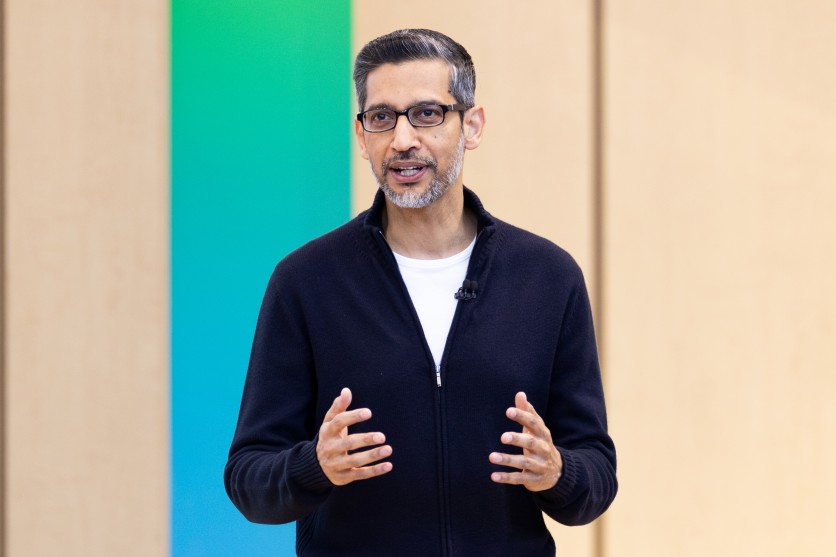
Google kicked off its annual developer conference Tuesday morning with a keynote at the Shoreline Amphitheatre in Mountain View, California that carried an unusually direct consequence for anyone who pays for Google AI: the company halved the entry price for its top-tier AI subscription and replaced daily prompt limits with a metering system that charges by computational cost rather than message count.
CEO Sundar Pichai opened the two-day Google I/O 2026 event, which runs through Wednesday, May 20, by noting it has been ten years since Google committed to making AI the center of its product strategy. The conference's answer to the question of whether that bet has paid off arrived in a wave of simultaneous launches across Gemini, Search, Gmail, YouTube, and hardware.
New $100 AI Ultra Plan Changes What Google AI Costs
The most immediately actionable announcement for Google's paying users is a restructuring of its subscription tiers. Google AI Ultra now starts at $100 per month — down from $250 — and is aimed at developers, technical leads, knowledge workers, and advanced creators. Google simultaneously lowered its previous $250 top tier to $200, keeping capabilities identical.
The $100 plan includes a 5x higher usage limit in the Gemini app than the existing $20 AI Pro tier, 20 terabytes of cloud storage, YouTube Premium, and — starting next week for US subscribers — beta access to Gemini Spark.
Alongside the price restructuring, Google announced that the Gemini app is moving away from daily prompt limits in favor of a "compute-used" model. Under that system, a simple text message consumes less of a subscriber's monthly allowance than a complex video-editing or coding request — a change Google describes as a fairer way to allocate access, though it also means heavy users of video or agentic features could exhaust their budget faster than they did under a flat daily limit. When a subscriber reaches their cap on flagship models, the system shifts them to the faster, lighter Gemini 3.5 Flash model. Google will also allow subscribers to buy additional credits on a pay-as-you-go basis.
Gemini Spark: A 24/7 Agent With a Permission Warning to Read
The conference's most-discussed announcement among developers was Gemini Spark, a persistent AI agent that monitors Gmail, Calendar, Google Tasks, and connected third-party apps in the background without requiring the user to open the Gemini app. Demonstrated live on stage, Spark drafted and sent emails via voice on macOS, prepared morning briefings, and handled multi-step scheduling tasks.
Spark runs on Google's Gemini 3.5 Flash model and the company's Antigravity 2.0 development platform, both of which Google made globally available Tuesday. Spark itself rolls out as a beta to trusted testers this week and to US Google AI Ultra subscribers — at both the $100 and $200 tiers — starting next week, with broader availability and third-party app integrations to follow.
Before Tuesday, a leaked onboarding screen from an early Gemini app beta had drawn scrutiny in developer communities. The screen disclosed that Spark "may do things like share your info or make purchases without asking," and instructed users to supervise the agent. Google has not published a Spark-specific privacy policy as of Tuesday's keynote. That disclosure arrives alongside an existing proposed class-action lawsuit, Thele v. Google LLC, filed in November 2025 in federal court in San Jose, which alleges Google secretly enabled Gemini across all Gmail, Chat, and Meet accounts in October 2025 without user consent. Google has not commented publicly on that case. Users considering enabling Spark can disable Gemini's access to Workspace apps through the Data and Privacy section of their Google Account settings.
Gemini Omni and 3.5 Flash: New Models Power the Ecosystem
Google announced two new model releases. Gemini 3.5 Flash is a general-purpose frontier model that Google says surpasses Gemini 3.1 Pro on coding, agentic, and multimodal benchmarks, runs at four times the output speed of comparable frontier models, and begins rolling out today to Gemini app users and developers via the Gemini API.
Gemini Omni is a separate, specialized model series built around creation. Its first release, Omni Flash, combines Gemini's reasoning with video generation: users can submit text, images, audio, or existing video clips and receive edited or newly generated video in return. Omni Flash is available starting Tuesday in the Gemini app, Google Flow, and YouTube Shorts. The model simulates physics — reproducing accurate behavior for gravity, collisions, and material properties in generated video — a capability Google demonstrated on stage.
Gemini App Redesign: Neural Expressive, Daily Brief, and Dialect Options
Google's Gemini app received a ground-up visual overhaul under a design language called Neural Expressive, rolling out Tuesday on Android, iOS, and web. The redesign replaces static text responses with fluid animations, haptic feedback, embedded video, interactive timelines, and expandable image panels.
A new feature called Daily Brief synthesizes each morning a prioritized summary of a user's day — drawing from Gmail, Calendar, and Tasks — and suggests next steps. Daily Brief launches Tuesday for AI Plus, Pro, and Ultra subscribers in the US. Docs Live, a forthcoming Workspace feature, lets users dictate documents in conversational speech, including false starts and corrections, and generates a finished Google Doc from the audio. Docs Live rolls out this summer for AI Pro and Ultra subscribers.
Google also announced the addition of regional dialect options for Gemini's voice responses, including, as one demonstration, a Liverpudlian accent.
Android XR Smart Glasses Confirmed for Fall From Four Hardware Partners
Google confirmed that the first Android XR smart glasses — the company's direct entry into the category that Meta has dominated with Ray-Ban smart glasses — will ship in fall 2026. The hardware arrives in two tiers: audio-only glasses with cameras, microphones, and speakers designed for all-day wear, and an optional in-lens display variant that delivers contextual information privately.
The initial devices are engineered by Samsung and Qualcomm, with eyewear frames designed by Gentle Monster and Warby Parker. XREAL is a fourth platform partner. Samsung's first collection of intelligent eyewear is expected to launch this fall, with pricing and additional specifications to follow. Android XR glasses are compatible with both Android phones and iPhone. Gemini 2.5 Pro powers real-time translation, navigation, messaging, and visual understanding through the glasses.
Google describes the category as "intelligent eyewear." The company has not disclosed what data retention policies will govern visual input captured by the glasses, whether footage will be used to train AI models, or what recourse users would have after a data breach — questions the UK Information Commissioner's Office has already posed formally to Meta regarding its competing product.
Search, Shopping, and SynthID
Google Search is now powered by Gemini 3.5 Flash, with a redesigned interface that expands as users type longer, conversational queries. AI Mode — Google's dedicated AI search experience — supports complex tasks including building custom dashboards and travel itineraries. A Universal Cart feature uses Gemini to find deals, track price histories, flag product incompatibilities, and apply payment card perks across multiple retailers; it arrives in the US this summer for Search and the Gemini app, with YouTube and Gmail integrations to follow. An Ask YouTube feature enables conversational search within the video platform and is available Tuesday for YouTube Premium subscribers in the US at youtube.com/new.
SynthID, Google's tool for flagging AI-generated content, is expanding to Chrome's right-click image menu and to Google Search, allowing users to check whether an image is AI-generated or an unaltered original. Nvidia and OpenAI have signed on to tag their generated content using the same standard.
By the Scale of It
Pichai opened the keynote with figures that frame the scope of what Google is building toward. The Gemini app now has 900 million monthly active users, roughly doubling from 400 million a year ago. Google processes more than 19 billion AI tokens per minute across its products. Alphabet has committed between $175 billion and $185 billion in capital expenditures for 2026 — nearly double the $91.4 billion it spent in 2025 — with the bulk directed toward AI compute infrastructure.
Google DeepMind CEO Demis Hassabis took the stage Tuesday to address the company's work on long-horizon agentic tasks and said Alphabet believes artificial general intelligence is "just a few years away" — a characterization that reflects the company's internal confidence but is not a technical milestone with a defined industry-standard date.
Google I/O 2026 continues through Wednesday, May 20, with developer sessions on Android 17, the Antigravity 2.0 agentic platform, and the Googlebook — Google's new Gemini-centric laptop platform launching this fall on hardware from Acer, ASUS, Dell, HP, and Lenovo. ChromeOS continues to operate, particularly in education and budget markets; Googlebook is a new premium category, not a replacement.
ⓒ 2026 TECHTIMES.com All rights reserved. Do not reproduce without permission.


