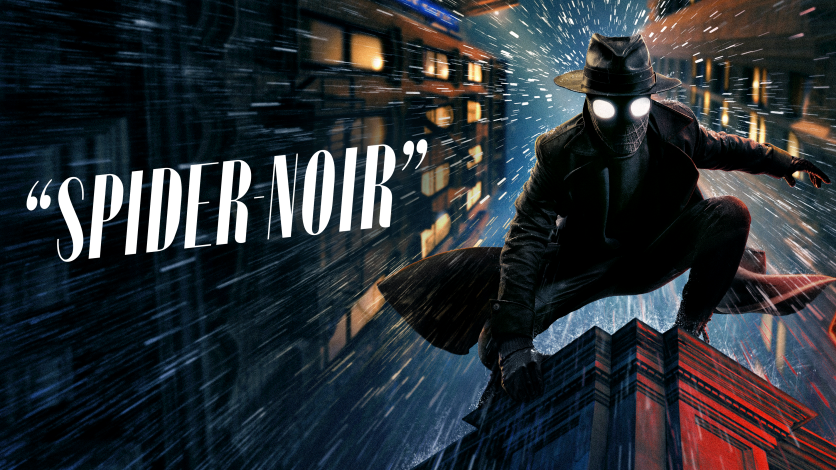
Nicolas Cage's long-awaited live-action debut as a television lead arrives today, and early critics have made their verdict clear. Spider-Noir, the eight-episode Prime Video and MGM+ series set in Depression-era New York, earned a 90% score on Rotten Tomatoes across 40 pre-premiere reviews — one of the strongest opening tallies for any live-action Spider-Man property — while carrying a Metacritic score of 71. The full marathon is airing on MGM+ today, May 25; the global Prime Video release for audiences in more than 240 countries drops Wednesday, May 27.
The series follows Ben Reilly, a washed-up private investigator in 1933 New York who once protected the city as a masked vigilante known as "The Spider," before personal tragedy drove him to retire. The premise hews closely enough to the original 2009 Marvel Comics Spider-Man Noir run by David Hine and Fabrice Sapolsky to feel faithful, while departing freely enough to stand alone. Where the comic's origin involved a mystical spider-god idol, the series grounds Reilly's abilities in a biological framework: a spider-venom neurological interaction that — as it turns out — draws on real peptide chemistry.
Nicolas Cage Brings "70% Bogart, 30% Bugs Bunny" to Marvel
Cage, who previously voiced the character in Sony Pictures Animation's Academy Award-winning Spider-Man: Into the Spider-Verse, described his live-action approach to Esquire as "70 percent Bogart and 30 percent Bugs Bunny" — a combination that critics are largely calling either inspired or distracting, depending on which outlet you read. The Wrap called it one of the year's best television shows, with critic Bob Strauss writing it delivers "all television should be this much, well-done fun." IndieWire's Ben Travers noted the performance carries "echoes of Face/Off, Bad Lieutenant: Port of Call — New Orleans, and Ghost Rider." The Hollywood Reporter's Daniel Fienberg was more measured, arguing the story is "frustratingly dull" and that Cage "sleeps through the first half of the series." Variety's Aramide Tinubu called it a "lackluster, repetitive retelling" despite conceding the show is visually striking.
Brendan Gleeson plays Silvermane, the season's primary villain: an Irish crime boss whose casual menace Movieweb's Mark Keizer described as "thickened by poor upbringing." Lamorne Morris brings warmth and a running Cage-impression gag as journalist Robbie Robertson, while Li Jun Li, as nightclub owner Cat Hardy, drew the sharpest supporting-cast notices — Geek Vibes Nation's M.N. Miller wrote that she delivers "an award-worthy performance."
The series marks the first live-action Spider-Man television production since the CBS Amazing Spider-Man aired from 1977 to 1979, ending a gap of nearly five decades.
What Spider Venom Actually Does to the Human Nervous System
The show's biological premise is more plausible than most superhero origin stories, and the gap between "this exists" and "this enhances rather than paralyzes" is narrower than it sounds.
Spider venoms contain over a thousand unique bioactive peptides per species. Their primary molecular targets are voltage-gated ion channels — specifically sodium channels (NaV), potassium channels (KV), and calcium channels (CaV). The best-studied family is the inhibitory cysteine knot peptide group, which binds to the voltage-sensor domains of NaV channels and modifies the gating thresholds that determine when a neuron fires.
In toxicological doses, this modification causes paralysis or death. But the relevant research question — the one the show implicitly dramatizes — is what happens at sub-toxic, selective concentrations.
The most directly relevant real compound is Pn3a, isolated from the South American tarantula Pamphobeteus nigricolor. Published in 2017 in Nature Scientific Reports, the research established that Pn3a inhibits NaV1.7 — the sodium channel subtype most associated with pain signaling — with extraordinary selectivity, at concentrations 40 to 1,000 times lower than those required to affect other NaV subtypes. NaV1.7 is expressed heavily in nociceptive neurons: the sensory cells that relay pain and touch information from the peripheral nervous system to the brain.
The fictional enhancement direction the show implies is essentially the mirror image of Pn3a's mechanism. Where Pn3a blocks NaV1.7 to reduce pain signaling, a hypothetical agonist peptide at the same channel — no such compound currently exists — could, in theory, lower the detection threshold for touch and vibration, amplify signal-to-noise in fast-conducting sensory fibers, and accelerate reflex arc timing by reducing synaptic latency in motor circuits. Taken together: heightened tactile discrimination, faster reaction time, and a plausible biological basis for the "spider-sense" the show depicts as micro-vibration awareness rather than supernatural prescience.
The wall-adhesion element is handled more conservatively. Rather than implying Reilly's hands and feet generate biological adhesion — which would require protein-engineered nanoscale structures decades ahead of 1930s science — the series presents him as an aging hero whose powers have diminished and who now relies primarily on mechanical web technology.
Should You Watch Spider-Noir in Black and White or Color?
This is the question critics have been most divided on, and it carries a genuine epistemological dimension the production team built in deliberately.
Spider-Noir is the first streaming series to release all episodes simultaneously in two distinct visual formats: an Authentic Black and White version and a True-Hue Full Color version. Unlike Mad Max: Fury Road's later-released chrome edition or Godzilla Minus One's black-and-white reissue — both post-production color-stripped conversions — Spider-Noir was photographed and processed for both formats simultaneously. Cinematographer Darran Tiernan built the lighting and contrast ratios to optimize for monochromatic shadow work without sacrificing the saturation required for a vivid color presentation.
Showrunner Oren Uziel told Esquire the color version was "intentionally made to look like a black-and-white film that's been kind of colorized" — deliberately evoking the Technicolor palette of 1930s Dick Tracy-era comic strips rather than the look of a contemporary color drama. Cage, also speaking to Esquire, framed the choice generationally: "The truth is, they both work and they're beautiful for different reasons. I think teenage viewers will appreciate the colour," while also wanting them to have the option to experience the noir aesthetic in its intended monochrome form, potentially drawing them toward classic cinema as a result.
Critics landed on both sides. The Daily Beast's Nick Schager argued black and white is "unquestionably the only way to go," given that the show was crafted for "maximum chiaroscuro boldness." Screen Rant's Felipe Rangel agreed. Consequence's Liz Shannon Miller suggested color as the marginally better single-watch choice. The Hollywood Reporter's Daniel Fienberg was the most skeptical, arguing that cinematography optimized simultaneously for both formats "hasn't really been optimized for anything."
The deeper philosophical case for black and white is one the series has actually earned. Hard-boiled noir as a genre emerged in the 1920s and 1930s partly as a formal rejection of classical detective fiction's omniscient rationalism — the Holmes-style puzzle-box resolution where the detective sees everything and explains all. Noir detectives do not solve cases; they survive the truth. Watching in black and white means accepting the detective's epistemically limited perspective: incomplete information, moral shadow, no god-view. Watching in color is choosing the audience's privileged omniscience. The choice the show offers its viewers is not merely aesthetic. It is a question about how you want to know things.
Period Forensics and the 1930s Detective Tradition
The 1930s New York setting gives Spider-Noir an unusually rich forensic-historical backdrop. The series's timeline places it at a genuine inflection point in investigative science, when systematic rationalism was beginning to displace intuitive detective work as the dominant mode of criminal investigation.
By 1933, Edmond Locard's exchange principle — every contact leaves a trace — had been formally articulated (1929) and was spreading through European and American forensic practice. The nascent use of systematic cross-referencing and filing that predated computing was in full swing; Bertillon anthropometric records were still partially in use in some jurisdictions. Latent fingerprint development using silver nitrate paper was a contemporaneous technique. The show sits, in other words, at the exact moment the genre it belongs to was being invented — not as a stylistic retrospective but as a period document.
Frequently Asked Questions
Should you watch Spider-Noir in black and white or color?
The series was photographed and processed simultaneously for both formats, so neither is a degraded conversion of the other. Most critics favor the black-and-white version for viewers drawn to the noir aesthetic, citing its optimized shadow work and chiaroscuro contrast. The color version, intentionally styled to evoke 1930s Technicolor comic strips rather than modern color television, is the production team's recommendation for younger audiences coming from the animated Spider-Verse films.
Is Spider-Noir connected to the Spider-Verse movies?
The only connection is that Nicolas Cage plays a version of the Spider-Man Noir character in both. Showrunner Oren Uziel has confirmed the live-action series is set in a completely separate alternate universe from the animated films and is a standalone adaptation of the original 2009 Marvel Comics Spider-Man Noir run. Prior knowledge of the animated franchise is not required.
When does Spider-Noir premiere on Prime Video?
The full eight-episode season is available globally on Prime Video beginning Wednesday, May 27, 2026. In the United States, it premiered earlier on MGM+'s linear broadcast channel on May 25. Both formats — black and white and full color — are available from launch.
How is Nicolas Cage's performance in Spider-Noir?
Cage's performance has divided critics more than the show itself. The majority, including reviewers at The Cosmic Circus, The Wrap, and Discussing Film, call it one of the best performances of his career. A minority, including Hollywood Reporter's Daniel Fienberg, argue his theatrical choices work against the show's emotional grounding in its early episodes. Cage described his own approach as "70 percent Bogart and 30 percent Bugs Bunny."
ⓒ 2026 TECHTIMES.com All rights reserved. Do not reproduce without permission.


