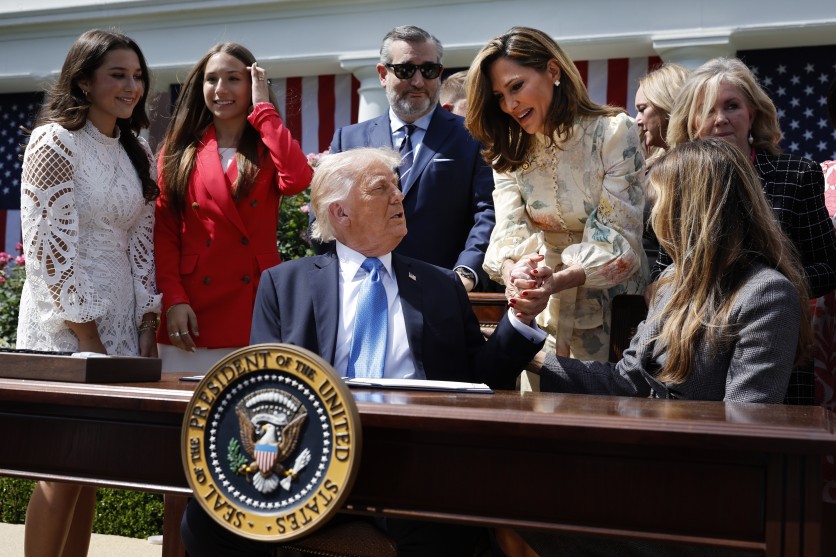
Federal prosecutors in Brooklyn unsealed criminal charges on May 20, 2026, against two unconnected men — Cornelius Shannon, 51, of Hasbrouck Heights, New Jersey, and Arturo Hernandez, 20, of Bedias, Texas — each accused of using AI tools to generate and distribute deepfake pornography without the consent of the women depicted. The arrests mark some of the earliest major criminal prosecutions under the Take It Down Act, the federal statute that made nonconsensual intimate imagery — including AI-generated content — a criminal offense when President Trump signed it into law on May 19, 2025.
The charges arrive one day after the Federal Trade Commission formally activated the law's civil enforcement provisions, giving victims a federal right to demand platform removal of such images within 48 hours. Together, the arrests and the FTC's enforcement launch represent the most concentrated week of action under the one-year-old law since it was enacted.
"This case makes clear that posting deepfake pornography is not a victimless crime," U.S. Attorney Joseph Nocella Jr. said in a statement on May 20.
Shannon Allegedly Published 360 Albums Targeting 90 Named Women
According to court filings, Shannon operated an account on an adult image- and video-sharing platform and published at least 360 albums containing AI-generated deepfake pornography depicting approximately 90 different female victims since May 19, 2025 — the day the Take It Down Act was signed. The content, which prosecutors say featured female politicians, musicians, and singers, was viewed millions of times. Shannon was arrested in New Jersey and appeared the same day before U.S. Magistrate Judge Peggy Cross-Goldenberg in Brooklyn.
Hernandez is accused of publishing approximately 113 albums on a separate website, collectively depicting around 50 identifiable female victims — including women who were not public figures. Prosecutors said the victims included recent high school graduates. His content was viewed nearly a million times. The albums allegedly began with non-explicit images of real, identifiable women that morphed into AI-generated depictions of those same individuals nude or engaged in sexually explicit acts.
FBI Assistant Director in Charge James C. Barnacle Jr. described the conduct as predatory: "The use of this emerging technology to victimize individuals is not innovative — it is criminal and will be pursued with the full force of the law."
If convicted, each defendant faces up to two years in federal prison.
Take It Down Act: What the Law Requires
The Take It Down Act — formally the Tools to Address Known Exploitation by Immobilizing Technological Deepfakes on Websites and Networks Act — is the first major federal law in the United States to directly address AI-generated sexual exploitation. It makes it a federal crime to knowingly publish or threaten to publish nonconsensual intimate imagery, whether the images are authentic or entirely AI-generated. Penalties reach up to two years' imprisonment for offenses involving adult victims and up to three years when minors are depicted.
The law, introduced by Senators Ted Cruz (R-TX) and Amy Klobuchar (D-MN) with bipartisan support, passed the House 409 to 2 on April 28, 2025, before being signed by President Trump. In addition to its criminal provisions, the law requires covered platforms — social media services, video and image hosts, messaging apps, and gaming platforms — to establish a removal process and take down flagged content within 48 hours of a valid request. The Federal Trade Commission enforces that civil requirement. Beginning May 19, 2026, exactly one year after the law was signed, the FTC's civil enforcement authority became active, and the agency immediately sent warning letters to 12 companies offering "nudify" tools, citing noncompliance, and notified Snapchat and TikTok directly of their obligations.
Platforms that fail to remove content within 48 hours face civil penalties of $53,088 per violation.
Criminal Enforcement: A Pattern Taking Shape
Shannon and Hernandez are not the first defendants prosecuted under the Take It Down Act. In April 2026, James Strahler II of Ohio became the first person convicted under the law, pleading guilty to cyberstalking, producing obscene visual representations of child sexual abuse, and publishing digital forgeries. Prosecutors said Strahler used more than 100 AI models to generate and distribute sexualized images of at least six adult women and children, including creating content using the faces of minors in his community.
In March 2026, two teenage boys in Lancaster, Pennsylvania received probation after creating explicit AI images of female classmates at a private school.
The same month, three teenagers in Tennessee filed a federal class-action lawsuit against Elon Musk's xAI, alleging the company's Grok AI tool was used to generate sexually explicit images from real photographs of them. The lawsuit, filed in the Northern District of California, claims Grok was released without adequate safeguards and seeks $150,000 per violation. An analysis by the Center for Countering Digital Hate found that Grok produced more than 23,000 sexualized images of children during an 11-day window in late December 2025 and early January 2026.
How Deep the Problem Runs
The scale of the enforcement actions reflects the scope of the underlying harm. Research consistently shows that between 96 and 98 percent of all deepfake content online consists of nonconsensual intimate imagery, and 99 to 100 percent of victims in deepfake pornography are female. Deepfake videos grew an estimated 550 percent between 2019 and 2023, and the tools to create them are now free, widely available, and require no technical expertise.
For victims, the damage extends well beyond the moment of discovery. Content replicated across platforms, embedded in private messaging groups, or re-uploaded after a takedown can prove nearly impossible to remove entirely. The Take It Down Act's 48-hour removal mandate applies to "known identical copies" as well as the originally flagged content — but platforms must build the infrastructure to find and scrub those copies, a technical challenge that the law's compliance requirements are designed to force.
Civil Liberties Groups Flag Removal Risks
The Take It Down Act passed with near-unanimous bipartisan support, but civil liberties organizations have raised sustained concerns about its design. The Electronic Frontier Foundation argued that the takedown provision applies to a broader category of content than the law's own narrower definitions, and that unlike the Digital Millennium Copyright Act — the existing framework for copyright takedowns — the law requires no statement under penalty of perjury from a person filing a removal request, contains no penalty for bad-faith claims, and provides no counter-notice mechanism for a person whose content is wrongly removed.
Becca Branum, director of the Center for Democracy and Technology's Free Expression Project, told CyberScoop that the $53,088-per-violation penalty structure creates an incentive for platforms to remove anything that arrives through the complaint pipeline, regardless of whether it is genuine nonconsensual intimate imagery. "If you think there's any given post where if you ask an attorney, 'Is it worth $53,000 for me to keep this post up,' the answer is always going to be take it down," Branum said.
Research published in May 2026 by TechPolicy.Press found that on two major monitored platforms, the supply of and demand for deepfake pornography actually increased after the Take It Down Act's passage — the opposite of the deterrent effect its architects intended. The study's authors noted that the law's publicity may have introduced new users to deepfake communities, and that meaningful takedown requests on those platforms remained rare.
What Victims Can Do Now
Any person depicted in a nonconsensual intimate image — whether real or AI-generated — can now file a removal request with any covered platform under the Take It Down Act. No platform account is required. The request must be in writing, identify the content, and include a good-faith statement that it was published without consent. The platform is required to respond within 48 hours and provide a tracking number.
The FTC operates a complaint portal at TakeItDown.ftc.gov for victims who believe a platform has failed to comply. Parents and authorized representatives may file on behalf of minors.
Victims in states with their own deepfake laws — including California, Texas, Virginia, Illinois, and Georgia, among at least 46 states that have enacted relevant legislation — may have additional remedies available beyond federal law.
Frequently Asked Questions
What is the Take It Down Act and what does it criminalize?
The Take It Down Act is a federal law signed in May 2025 that makes it a federal crime to knowingly publish or threaten to publish nonconsensual intimate imagery, including AI-generated deepfakes depicting real people. It also requires covered online platforms to remove flagged content within 48 hours of a valid removal request, with the Federal Trade Commission authorized to impose civil penalties of $53,088 per violation for platforms that fail to comply.
What are the penalties for violating the Take It Down Act?
Anyone convicted of publishing nonconsensual intimate imagery under the Take It Down Act faces up to two years in federal prison for offenses involving adult victims and up to three years when minors are depicted. The FTC can also impose civil penalties of $53,088 per violation against platforms that fail to remove flagged content within 48 hours, with no cap on the total number of violations.
How do I report deepfake pornography under the Take It Down Act?
To report a platform that has failed to remove nonconsensual intimate images within 48 hours of a valid request, file a complaint with the FTC at TakeItDown.ftc.gov. To report a suspected criminal violation — someone who has published or threatened to publish deepfake or nonconsensual imagery — contact the FBI through the Internet Crime Complaint Center at ic3.gov or call 1-800-CALL-FBI.
Can AI-generated nude images of real people be illegal under federal law?
Yes. The Take It Down Act explicitly covers AI-generated content, including deepfakes and digitally synthesized images that were never based on any real photograph of the victim in an intimate context. The law does not require that the underlying image be authentic — creating and publishing a realistic AI-generated nude image of an identifiable real person without their consent is a federal crime under the statute.
ⓒ 2026 TECHTIMES.com All rights reserved. Do not reproduce without permission.


