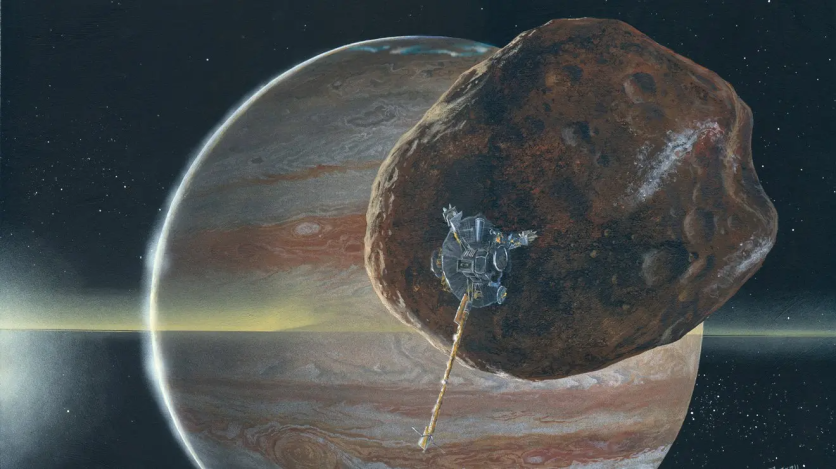
A new study published in The Astrophysical Journal has traced six chemically distinct families of the Solar System's oldest meteorites to a single ring-shaped dust trap just beyond Jupiter's orbit — and for the first time, computer simulations align precisely with what laboratory analyses of those meteorites have found. The work, led by researchers at Germany's Max Planck Institute for Solar System Research (MPS), rewrites a critical chapter of Solar System formation science: not only did this dust trap exist, it churned out successive generations of fundamentally different planetary building blocks over roughly two million years.
The study, by first author and MPS doctoral researcher Nerea Gurrutxaga together with Joanna Drążkowska, Vignesh Vaikundaraman, and MPS Director Thorsten Kleine, was published May 22, 2026. Its core finding challenges a long-standing assumption in planet formation research: that the rings and pressure structures in early stellar disks were one-shot factories. The dust trap beyond Jupiter, the simulations show, was nothing of the sort.
"Different types of planetesimals apparently formed in the same region of the early dust and gas disk, only at different times," said Drążkowska, who heads the Lise Meitner Group on planet formation at MPS. "The region just outside Jupiter's orbit offered excellent conditions for this."
How Jupiter Created Solar System's Best Factory
About 4.6 billion years ago, the young Sun was wrapped in a massive rotating disk of gas and dust. As Jupiter formed and consumed the material near its orbit, it carved an annular gap in that disk — and in doing so created an unintended side effect on the outer edge: a ring of elevated gas pressure. That pressure ring acted as a gravitational net for drifting particles, trapping dust and pebbles in one location for millions of years.
Scientists had known that these so-called "dust traps" could produce planetesimals — the kilometer-scale rocky bodies that eventually collide and merge into planets and asteroids. What had never been convincingly demonstrated was whether a single dust trap could keep producing different kinds of bodies over an extended period. The new simulations show it could, and that Jupiter's gravitational influence was the mechanism that kept refreshing the trap's composition over time.
The simulations, which track both microscopic particle collisions and the large-scale movement of material across the entire protoplanetary disk, covered a window from roughly two to four million years after the Solar System's formation — the period when carbonaceous chondrites are known from laboratory work to have formed.
Jupiter as Sorting Machine for Solar System Formation
The key to the dust trap's productivity was how Jupiter filtered what reached it. The gas giant acted as a stronger barrier for large, sturdy particles — clumps of heat-processed material called chondrules and refractory inclusions, which had formed early in the Solar System's history — than for the smaller, fragile dust grains that dominated later supply streams. As millions of years passed and the broader disk evolved, the balance of incoming material shifted.
"For our simulations, it was crucial to model the behavior and interaction of both materials on both small and large scales," said Gurrutxaga, whose two-dimensional Monte Carlo simulation tracked fine-grained fragile dust and sturdier heat-processed clumps as separate components simultaneously.
In the simulations' first 500,000 years, the proportion of crumbly matrix material initially dropped before climbing again over the following million years. Then, near the end of the modeled period, two sharply distinct populations of planetesimals emerged: one made almost entirely of fragile matrix-rich material, another dominated by robust inclusions. That sequence maps directly onto the six recognized groups of carbonaceous chondrites, each with a different ratio of fine-grained dust to inclusion material and a different formation age.
Meteorites as Records of Solar System Formation History
Carbonaceous chondrites have puzzled researchers for decades. They are among the most chemically primitive rocks ever found — some crumble at a touch, others are dense and inclusion-rich — and all are believed to have formed outside Jupiter's orbit during roughly the same era. Why they differ so dramatically in structure and composition despite sharing the same apparent birthplace and time window was one of the field's long-standing open questions.
"For the first time, we have succeeded in accurately reproducing the results of laboratory studies of meteorites using computer simulations of the early Solar System," said Kleine. "The meteorites serve, so to speak, as a touchstone for theories of planetary formation."
The six groups — designated CO, CV, CM, Tagish Lake (ungrouped), CI, and CR — each correspond to a different generation of planetesimals that formed when the dust trap's composition happened to favor a particular mixture. The same location, the same pressure ring, the same general mechanism — but time-varying inputs from the broader Solar System disk produced distinct outputs with each new wave of planetesimal formation.
This also means that the carbonaceous-versus-non-carbonaceous split in meteorite chemistry — long one of planetary science's thorniest classification puzzles — now has a more concrete physical explanation. Objects that accreted inside Jupiter's orbit were shaped by different conditions from those assembled through this time-varying filter on the outside.
Read more: Space Archaeology: Ancient Meteorite Found on Earth Gives Clues to the Origins of Our Solar System
What Role Did Jupiter Play in Planet Formation?
The findings extend the implications beyond carbonaceous chondrites. The researchers suggest that the dust trap was active at even earlier epochs — potentially generating iron meteorites with carbonaceous isotopic signatures and other enigmatic classes of space rocks that predate the window modeled in the study. The paper explicitly identifies differentiated meteorites — samples of earlier, melted planetary bodies — as showing similar isotopic variability to the chondrites, implying that pressure bumps were the dominant birthplace for planetesimals across the Solar System's early history, not just in a single late window.
"There is strong evidence that dust traps were the preferred birthplace of planetesimals in our Solar System," said Drążkowska.
For researchers studying planet formation around other stars, the result carries a direct implication: the ring structures visible in young stellar disks — now routinely imaged by telescopes such as ALMA — are not passive features. They are active multi-generational factories, and the diversity of planetary materials in any given system may be as much a product of when those rings formed and how long they operated as it is of which elements were available.
Museums Hold 4.6-Billion-Year Production Records
The practical consequence for anyone who has ever examined a meteorite in a museum display case is this: those rocks are not random debris from random collisions. They are, the new model confirms, dated production receipts from a single factory zone in a specific orbital band, whose output shifted predictably over two million years as its raw material supply changed.
That alignment between a computer model and a physical rock, achieved for the first time in this study, is what the MPS team means when they describe the meteorites as a "touchstone" for planetary formation theory. The lab and the simulation agree. Decades of accumulated meteorite analysis and cutting-edge computational modeling now point to the same address: just past Jupiter's shoulder, roughly 4.6 billion years ago.
Frequently Asked Questions
What is a planetesimal?
A planetesimal is a kilometer-scale rocky or icy body that formed in the early Solar System from collisions and accretion of smaller dust grains and pebbles within the protoplanetary disk. Planetesimals are the intermediate stage between dust and fully formed planets, and most of today's asteroids and the parent bodies of meteorites are either intact planetesimals or their fragments.
Where do meteorites come from?
Most meteorites are fragments of asteroids — rocky bodies that formed in the early Solar System and were never incorporated into a planet. The new MPS study adds precision to this picture: carbonaceous chondrites, among the most primitive meteorite types, likely originate from a single long-lived dust trap just beyond Jupiter's orbit, where distinct families of planetesimals formed sequentially over roughly two million years.
What are carbonaceous chondrites?
Carbonaceous chondrites are a class of stony meteorites rich in carbon and among the most chemically unaltered rocks in the Solar System, preserving material from its earliest days. Scientists divide them into six compositional groups — including CO, CV, CM, CI, CR, and the ungrouped Tagish Lake type — based on their age and the ratio of fine-grained matrix material to embedded heat-processed inclusions. The new MPS study explains this diversity as the product of time-varying inputs to a single dust trap beyond Jupiter's orbit.
How did Jupiter shape solar system formation?
Jupiter's formation carved a gap in the early Solar System's gas and dust disk, creating a ring of elevated pressure on its outer edge that trapped drifting material for millions of years. Because Jupiter acted as a stronger barrier for large particles than for smaller dust grains, the composition of material reaching this pressure ring shifted over time. That shifting supply produced successive generations of planetesimals with different chemical makeups — ultimately generating the six groups of carbonaceous chondrites now found in meteorite collections around the world.
ⓒ 2026 TECHTIMES.com All rights reserved. Do not reproduce without permission.


