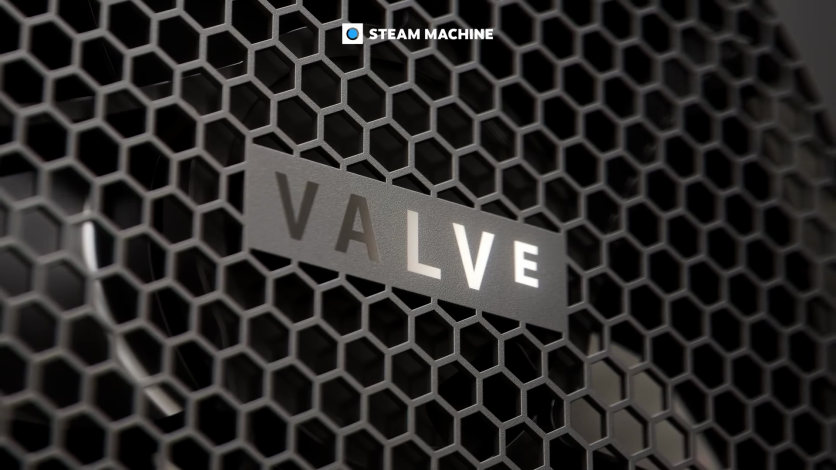
Valve's long-delayed Steam Machine has cleared its most significant pre-launch technical milestone, appearing in the official Khronos Group Vulkan 1.4 conformant products database on May 23, 2026 — a step hardware makers typically complete in the final weeks before announcing a release date. The listing, filed under the name "AMD Steam Machine," reveals the console's hardware fingerprint in detail for the first time through an official channel: an AMD Navi 33 GPU running the open-source Mesa/RADV driver, a custom AMD processor designated "AMD Custom CPU 1772," and Valve's own Neptune Linux kernel branch — the same software foundation that powers the Steam Deck. No launch date has been announced.
The certification confirms that the Steam Machine's graphics driver stack has passed Vulkan CTS version 1.4.5.3, the mandatory compatibility test suite managed by the Khronos Group. For developers, that means the hardware behaves predictably with the Vulkan API — the graphical backbone of Linux gaming. For prospective buyers, it signals that Valve has moved past the software development phase and into final hardware validation. What the listing does not confirm is a price, a shelf date, or any guarantee that the games a buyer already owns will actually run.
That last point matters more than the certification itself for many consumers. More than 680 of the 1,136 games on Steam that require anti-cheat software remain unplayable on SteamOS, according to crowd-sourced database Are We Anti-Cheat Yet. Three of the biggest titles driving that gap — Valorant, the entire Call of Duty franchise, and EA's Battlefield lineup — are incompatible because their respective anti-cheat systems (Riot Vanguard, RICOCHET, and EA Javelin) do not support Linux. Prospective buyers who count those titles among their regular rotation will need to check their library against the SteamOS compatibility list before deciding whether to wait for the Steam Machine or buy elsewhere.
Steam Machine Specs Confirmed by Vulkan Listing
The Khronos database entry provides the most complete official hardware profile of the Steam Machine released to date. The GPU family is identified as RADV_NAVI33, pointing to AMD's Navi 33 architecture — the same chip family used in the RX 7600-series desktop and mobile GPUs, built on the RDNA 3 process. The processor is listed as "AMD Custom CPU 1772," consistent with earlier reporting that Valve is using a Zen 4-based custom chip co-developed with AMD, similar in approach to the custom APU inside the Steam Deck. Valve's official November 2025 announcement described the machine as offering six times the compute performance of the Steam Deck, with a 28-compute-unit GPU at 110W TDP and 8GB of GDDR6 VRAM.
The operating system fingerprint in the listing — Linux 6.16.12-valve6-1-neptune-616 — matches the kernel version released in SteamOS Beta 3.85 in mid-May 2026. That alignment matters because it means the Steam Machine was certified running production-track software rather than a bespoke test build. As Igor's Lab noted, the combination of Navi 33, Mesa/RADV, and the Neptune Linux branch represents a carefully coordinated SteamOS stack rather than a driver assembled at the last minute. The conformance was submitted under the Software Freedom Conservancy organization, which handles Khronos membership for the X.Org open-source graphics infrastructure.
What SteamOS Vulkan Compatibility Means for Developers
Vulkan conformance certification is a prerequisite, not a performance guarantee. Passing the Khronos CTS means the driver stack correctly implements the Vulkan 1.4 specification — it does not benchmark frame rates, measure load times, or validate in-game visual quality. What it gives game developers is assurance that Vulkan API calls will behave as documented on the Steam Machine's specific hardware-and-software combination, reducing the risk of platform-specific rendering bugs.
For developers already shipping titles on Steam Deck, the certification means the porting path to Steam Machine is well-understood. SteamOS's Proton compatibility layer — which translates Windows game executables to run on Linux — has been refining that pipeline since the Steam Deck launched in 2022, and the Steam Machine shares the same Neptune kernel environment. Valve's Verified Games program, detailed at GDC 2026, requires certified titles to maintain at least 30 frames per second at 1080p and to be fully playable with a controller.
What games can't you play on the Steam Machine?
The anti-cheat gap is the Steam Machine's most consequential buyer-facing limitation, and the Vulkan certification does nothing to narrow it. The incompatibility is not a driver failure — it is a structural mismatch between kernel-level anti-cheat software built for the Windows security model and the Linux kernel's fundamentally different permission architecture.
Titles currently unplayable on SteamOS due to incompatible anti-cheat systems include Valorant and League of Legends (Riot's Vanguard), every current Call of Duty title including Black Ops 7 (Activision's RICOCHET), Battlefield 6 and all EA Sports titles (EA's Javelin), and Grand Theft Auto V Online. Valve has worked with Epic Games' Easy Anti-Cheat and Wellspring's BattlEye to enable Linux/Proton support for titles using those systems — including Counter-Strike 2, Dota 2, and Rainbow Six Siege — but developer opt-in is required even for compatible solutions.
Valve told Eurogamer it expects the Steam Machine's larger, living-room audience to give publishers stronger commercial incentives to enable anti-cheat on SteamOS than the Steam Deck has provided so far. The company said it hopes "the launch of Machine will change the equation around anti-cheat support and increase its support." GamingOnLinux noted, however, that realizing that outcome requires the Steam Machine to achieve meaningfully higher adoption than the Steam Deck, which represents roughly 3% of the Steam user base — a threshold that has not moved major publishers yet.
RAM Shortage Keeps Price and Launch Date Unannounced
Despite clearing the Vulkan milestone, the Steam Machine still has no confirmed price or release date. Valve first acknowledged the problem in February 2026, writing in an official FAQ that "the memory and storage shortages you've likely heard about across the industry have rapidly increased since then," forcing the company to revisit its schedule and pricing. The company's stated goal was to ship all three hardware products — the Steam Machine, Steam Frame VR headset, and Steam Controller — in the first half of 2026. The Steam Controller launched May 4, 2026 at $99. The Steam Machine and Steam Frame remain unannounced.
Hardware insider Brad Lynch reported in late April 2026 that internal pricing targets for the Steam Machine had risen sharply after the RAM shortage deepened, describing it as "the most affected" of Valve's three hardware products. A separate hardware insider, Moore's Law Is Dead, estimated in early May 2026 that the Steam Machine could land between $600 and $650 — significantly below the $950–$1,070 range that appeared in the source code of Czech retailer Smarty in January. Neither figure is an official Valve price. Valve confirmed to Polygon that the Steam Controller launched early precisely because it does not require the scarce memory and storage components still constraining the Steam Machine.
For comparison, the PlayStation 5 disc edition retails at $499, the Xbox Series X at $649 in its current configuration, and the PS5 Pro at approximately $699. A Steam Machine priced above any of those requires a buyer who values open PC-library access, the SteamOS ecosystem, and the potential for Windows dual-boot over the guaranteed game library available on dedicated consoles.
Frequently Asked Questions
When is the Steam Machine release date?
Valve has confirmed the Steam Machine will ship in 2026 but has not announced a specific launch date or price. The company originally targeted the first half of 2026, but a global RAM and storage shortage pushed back the pricing announcement. The May 23 Vulkan 1.4 certification is one of the final known technical steps before launch, suggesting a date announcement could come soon — though Vulkan listings are not a reliable predictor of exact timing.
What games can't you play on the Steam Machine?
Major titles that currently cannot run on SteamOS include Valorant, League of Legends, all Call of Duty games, Battlefield 6, all EA Sports titles, and GTA V Online. These titles use kernel-level anti-cheat systems — Riot Vanguard, RICOCHET, and EA Javelin — that are incompatible with the Linux kernel. Valve hopes the Steam Machine's larger audience will incentivize publishers to enable Linux support, but no publisher commitments have been announced.
How much will the Steam Machine cost?
Valve has not officially announced a price. The closest figures come from hardware insiders and retailer leaks: insider Moore's Law Is Dead estimated $600–$650 in May 2026, while a Czech retailer's source code in January 2026 listed $950 for the 512GB model and $1,070 for the 1TB version. The RAM shortage that delayed the launch has also driven up component costs, making the final price higher than Valve originally planned.
What does Vulkan 1.4 certification mean for the Steam Machine?
Vulkan 1.4 conformance certification means the Steam Machine's AMD Navi 33 GPU and Mesa/RADV driver stack have passed the Khronos Group's mandatory compatibility test suite. It guarantees developers that the hardware behaves predictably with the Vulkan graphics API but does not benchmark real-world frame rates or confirm game compatibility. It is one of the last technical steps hardware makers complete before announcing a product launch.
ⓒ 2026 TECHTIMES.com All rights reserved. Do not reproduce without permission.


