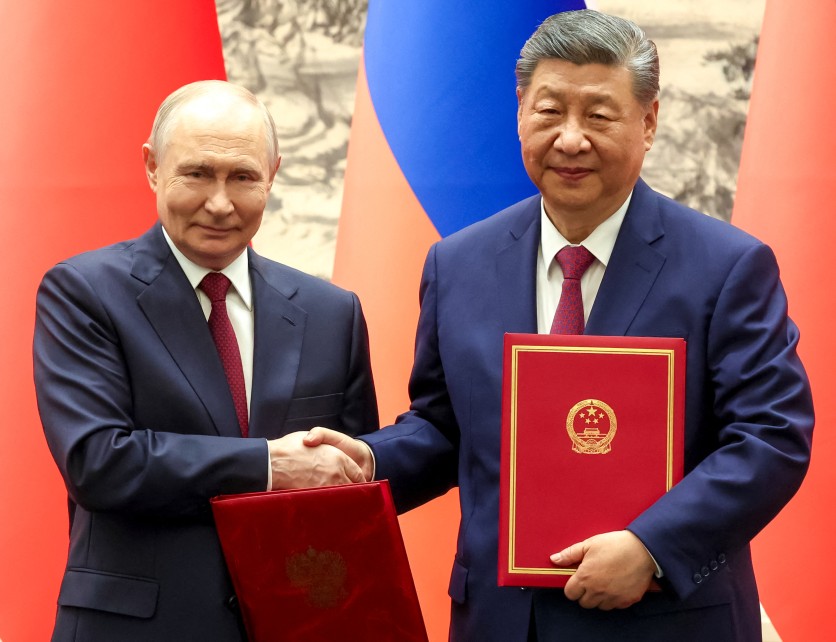
China's State Administration for Market Regulation (SAMR) and Russia's Federal Antimonopoly Service (FAS) signed a bilateral antitrust cooperation memorandum on May 25 — three days before this article ran — formalizing a joint framework for information sharing and coordinated enforcement across technology sectors that include artificial intelligence, digital platforms, and semiconductors. The signing, by SAMR Minister Luo Wen and FAS head Maksim Shaskolsky, came ten days after the May 14–15 Trump-Xi summit in Beijing, which closed with competing official readouts and left the legal status of antitrust investigations targeting Nvidia and Qualcomm unresolved.
For US chip companies — and the investors who hold them — the implications are direct. China already has active antitrust proceedings involving Nvidia and Qualcomm. Russia's FAS has a documented history of pursuing US technology companies in its own jurisdiction, including Apple and Google. What the May 25 memorandum creates is a formal channel for those two agencies to share information and coordinate action on the same targets simultaneously.
What the China-Russia Antitrust Memorandum Actually Does
The agreement, which covers the 2026–2027 period, establishes channels for exchanging information on antitrust matters, unfair competition, and advertising, while explicitly enabling coordination on specific enforcement cases and cross-border issues. Cooperation memoranda between regulators are routine diplomatic instruments, and dozens exist across jurisdictions worldwide. What distinguishes this one is its sector scope — AI, digital platforms, and semiconductors — and its timing.
SAMR Director Luo Wen stated in late 2024 that foreign-related antitrust enforcement would be strengthened "steadily and prudently" in strategically important sectors. The FAS agreement formalizes a coordination layer around that stated priority.
Read more: Beijing Presses Washington to Honor Summit Deal as Nvidia and Qualcomm Probe Status Stays Unresolved
Nvidia and Qualcomm Probes Remain Legally Open
The backdrop against which the memorandum arrives matters enormously. China launched a formal antitrust investigation into Nvidia in December 2024, alleging that the company's $6.9 billion acquisition of Mellanox Technologies violated conditions attached to SAMR's 2020 conditional approval. SAMR issued a preliminary finding in September 2025 that Nvidia had in fact violated those conditions and announced it would continue the investigation.
A separate probe into Qualcomm was announced in October 2025, targeting the company's SAMR antitrust investigation acquisition of Israeli automotive chip designer Autotalks — a deal finalized in June 2025. Qualcomm shares fell more than 5% on the announcement day. The company generates a substantial portion of its global revenue from customers headquartered in China, making any enforcement action at the maximum statutory rate a significant financial event. Nvidia shares dropped roughly 2% on the day its probe became public, erasing tens of billions in market value.
The US side publicly stated at the May 14–15 Trump-Xi summit that China agreed to suspend antitrust investigations into Nvidia, Qualcomm, and Intel. China's Ministry of Commerce, in a May 20 briefing, confirmed that "various investigations into US companies in the semiconductor supply chain" would be terminated — but did not name specific companies or cases. Analysis of the MOFCOM statement noted that Beijing confirmed terminating antitrust and anti-dumping investigations but described the chip probes only as those that "likely include" the Nvidia and Qualcomm cases. That language is not the same as a named, bilateral confirmation. Until SAMR publishes a formal case closure for each proceeding, no chipmaker or investor has an authoritative bilateral answer. No such notice had appeared as of publication.
How China Uses Antitrust Law as Regulatory Statecraft
The framing of China's SAMR actions as normal competition enforcement misses what US lawmakers and independent analysts have documented. The Congressional Research Service concluded that Beijing has used antitrust reviews "to scuttle strategic US semiconductor deals and set both confidential and public conditions on US and foreign semiconductor firms' operations in China." Those conditions have included requirements for Nvidia to allow Chinese customers, distributors, and original equipment manufacturers to purchase one year's supply of its graphics processing units — a supply guarantee that directly conflicts with US export control goals.
"It's potentially very worrisome that China might be using its antitrust authority to further non-antitrust outcomes," Bill Baer, a visiting fellow at the Brookings Institution's Center for Technology Innovation, said when the Nvidia probe was announced. The same Congressional Research Service analysis describes how Beijing previously blocked Qualcomm's $44 billion bid for NXP Semiconductors — a decision widely understood at the time as a geopolitical move rather than a competition determination. Qualcomm was subsequently forced to pay NXP $2 billion in termination compensation.
Linghao Bao, a senior analyst at consulting firm Trivium China, described the strategy when the Nvidia probe launched: "I think Beijing is trying to collect bargaining chips before Trump comes into the White House. They're preparing for some tough negotiations ahead."
How Does SAMR Regulate US Semiconductor Companies?
Under China's Anti-Monopoly Law, companies with a major presence in China must obtain SAMR approval for mergers and acquisitions even when neither the buyer nor the acquisition target is Chinese. SAMR's review can impose behavioral conditions on the parties — conditions whose compliance is subject to ongoing monitoring and can become the basis for future enforcement actions. The Nvidia probe is a direct example: SAMR approved the Mellanox acquisition in 2020 with conditions, then opened an investigation four years later alleging those conditions were violated.
Russia's FAS Track Record Against US Tech
Russia's Federal Antimonopoly Service has its own documented history of pursuing US technology companies operating in the Russian market. The agency fined Apple more than $13 million for antitrust violations related to in-app payment practices, with Apple paying the fine in January 2024. The FAS has also pursued proceedings against Google related to video hosting market dominance and data storage requirements. While Russian-market enforcement has limited direct effect on US companies that have already reduced or suspended Russia operations, the memorandum's coordination mechanism runs in both directions — and the FAS has the legal infrastructure and institutional willingness to act on cases that SAMR flags.
China Antitrust AI Regulation Accelerates in 2026
The semiconductor provisions of the new agreement sit within a broader Chinese regulatory expansion. SAMR issued six conditional clearances and two prohibitions in fiscal year 2025 — a level of intervention not seen since China's merger control regime began, according to Slaughter and May's annual China antitrust review. The agency is simultaneously preparing a pipeline of new rules covering monopolistic agreements, digital platform oversight, and government-related restrictions on competition, according to MLex's analysis of the agency's December 2025 priorities statement.
Beijing's broader posture on foreign-related enforcement was summarized by Zhong Gang, executive director of the Competition Law Research Institute at East China University of Political Science and Law: the regulator's "vision to prioritize foreign-related antitrust enforcement is mainly to ensure economic security and stability amid rising trade protectionism globally."
China and Russia have both been accelerating domestic regulatory frameworks for digital platforms and AI while simultaneously pushing back against Western platform dominance in their respective markets. The formalization of a coordination channel between the two regulators extends that parallel agenda into a shared one.
What US Chip Companies and Investors Need to Watch
The memorandum does not require SAMR and FAS to act in lockstep, and the practical depth of cooperation will depend on how the mechanism is actually used. What it does create is formal infrastructure for coordinated timing of investigations, exchange of case information, and potential simultaneous enforcement pressure in two jurisdictions against the same targets.
For Nvidia and Qualcomm, the most consequential near-term question remains whether SAMR will publish formal case closure notices — the only authoritative signal that the summit's claimed probe suspension is real and bilateral. Beijing confirmed "various investigations" would end; Washington said China agreed to suspend three specific cases. Those are not the same sentence. Until SAMR issues a formal closure, the legal exposure is unchanged and the new Russia coordination channel is simply an additional variable that previously did not exist.
For companies planning acquisitions with a China nexus, the May 25 memorandum is a signal that Beijing is simultaneously building out its regulatory alliances in the technology sector — not winding them down — even while engaging diplomatically with Washington. A coordination mechanism that could route enforcement information to Moscow adds a dimension to China's antitrust toolkit that no prior diplomatic engagement had to account for.
Frequently Asked Questions
What is China's antitrust probe into Nvidia about?
China's SAMR launched a formal investigation into Nvidia in December 2024, alleging the company violated conditions attached to SAMR's 2020 conditional approval of Nvidia's $6.9 billion acquisition of Mellanox Technologies. SAMR issued a preliminary finding in September 2025 that Nvidia had in fact breached those conditions and announced it would continue the investigation. No formal closure notice has been published.
Is Qualcomm being investigated by China?
Yes. SAMR announced a separate antitrust probe into Qualcomm in October 2025, targeting the company's acquisition of Israeli automotive chip designer Autotalks — a deal finalized in June 2025. SAMR alleged the acquisition violated China's Anti-Monopoly Law's notification requirements for concentrations of undertakings. The probe remains legally open.
How does China use antitrust law against US companies?
China's Anti-Monopoly Law requires SAMR approval for mergers and acquisitions involving companies with a significant China presence, even when neither party is Chinese. SAMR can impose behavioral conditions on approved deals, monitor compliance, and launch investigations if it determines those conditions were violated. The Congressional Research Service has documented how China has used this framework to extract supply guarantees, impose interoperability requirements, and challenge US export control policy — conditions that go well beyond standard competition enforcement.
What did the China-Russia antitrust MOU signed May 25 actually create?
The 2026–2027 memorandum signed by SAMR and Russia's Federal Antimonopoly Service establishes formal channels for exchanging information on antitrust, unfair competition, and advertising matters, and explicitly enables coordination on specific enforcement cases. It is not a joint enforcement order — but it gives both agencies the institutional infrastructure to share case information and potentially time actions against the same targets.
ⓒ 2026 TECHTIMES.com All rights reserved. Do not reproduce without permission.


