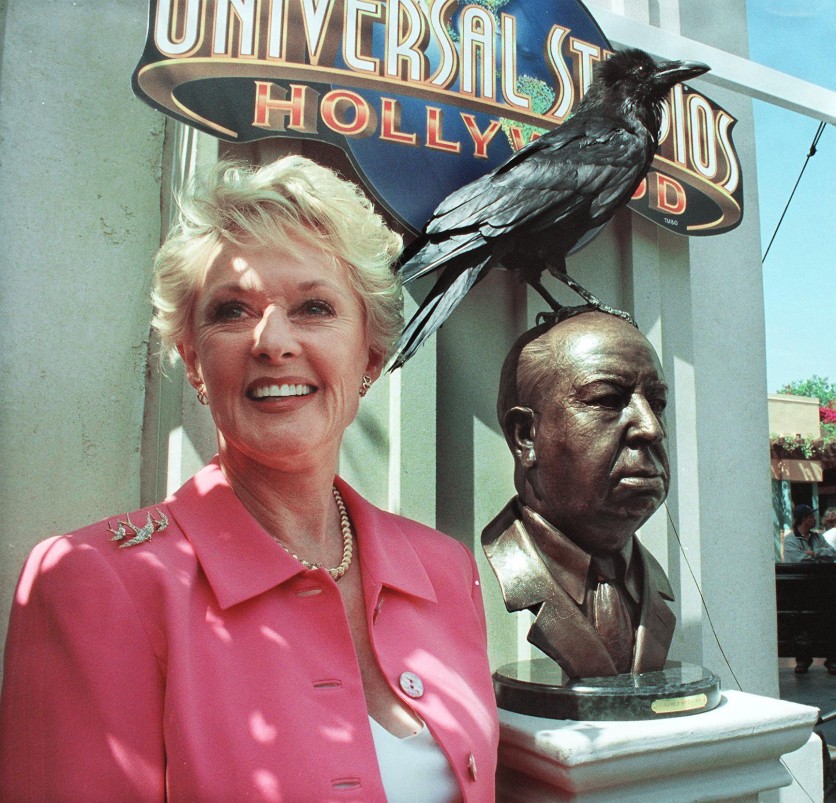
Emmy-winning actress Sarah Snook is set to lead a prestige limited series adaptation of The Birds, a project now actively being pitched to networks and streamers by Universal International Studios and Heyday Television. The show — which draws more from Daphne du Maurier's original 1952 short story rather than Alfred Hitchcock's 1963 film — frames its coordinated avian attacks not as inexplicable horror but as a direct consequence of ecological collapse and climate change, grounding its central nightmare in science that is already playing out in the Alaskan wilderness.
Snook, who won a Primetime Emmy Award for her portrayal of Shiv Roy in HBO's Succession and received a Golden Globe nomination for the 2026 Peacock thriller All Her Fault, plays Myra Massey, a traveling magistrate who returns to her isolated Alaskan hometown for a routine presumptive-death hearing. She expects a cold case. Instead she finds her childhood friend's bullet-ridden body, and as she steps outside her judicial role to investigate, the surrounding wildlife turns hostile. Tom Spezialy — a native of Anchorage, Alaska, and executive producer of The Leftovers and HBO's Emmy-winning Watchmen — is writing the series. David Heyman, whose Heyday Television previously produced the 2024 Peacock limited series Apples Never Fall, is producing.
From Cold War Allegory to Climate Science
Du Maurier's original story was published in her 1952 collection The Apple Tree and is set in her home county of Cornwall, England, shortly after World War II. A farm laborer named Nat Hocken watches the wind shift overnight and, coinciding with that change, finds birds beginning to mass and attack. For decades, literary scholars read the text as a Cold War allegory: the birds arrive from the east, strike in coordinated waves, and resist all human response. The BBC's radio broadcasts of the story in the early 1950s amplified precisely that anxiety among listeners who remembered the Blitz and feared what might come next. Du Maurier herself never explained her birds, because explanation would have collapsed the allegory.
The new series is making a different and more pointed argument. Where du Maurier's birds were inexplicable by design, Spezialy's writers' room — per Heyday development head Sue Gibbs, speaking at a SXSW London panel last June — is building the aggression from measurable ecological causes: habitat destruction, food-chain failure, and climate-induced species stress. "We're going back to the source material, the Daphne du Maurier novella and using that as inspiration," Gibbs said. "And at its heart, it's looking at when nature turns on you; with climate change that is very timely." The production moves the setting from Cornwall to Alaska — a choice that turns out to have extraordinary scientific resonance.
Alaska Seabird Die-Off: What the Science Already Shows
The choice of Alaska as the series' setting is the single most scientifically accurate decision the production has made, because Alaska is not a backdrop: it is a live ecological emergency. A marine heatwave known as "the Blob," spanning 2014 to 2016 and directly linked by researchers to human-caused climate change, raised ocean temperatures in the Northeast Pacific by up to 3 degrees Celsius above average. The event triggered what a study published in December 2024 in the journal Science identified as the largest single-species wildlife die-off in modern history.
The casualties were common murres — large black-and-white seabirds, roughly penguin-like in appearance, that dive as deep as 200 meters to forage for fish. Alaska was home to approximately 8 million of them, comprising roughly one-quarter of the species' global population. The heatwave's effect on murres was catastrophic: as Pacific cod populations plunged by approximately 80 percent between 2013 and 2017, the murres starved. By the study's estimates, some 4 million birds died across 13 monitored colonies in the Gulf of Alaska and Bering Sea — a toll roughly 15 times greater than the number of seabirds killed in the Exxon Valdez oil spill. Heather Renner, the study's lead author and a supervisory wildlife biologist at the Alaska Maritime National Wildlife Refuge, described the finding as "a gut punch." A decade later, the murre population shows no signs of recovery, suggesting the ecosystem may have shifted to a permanently different state.
The collapse has extended beyond murres. In Unalaska, a remote community in the Aleutian Islands where common ravens were once so abundant they were known for raiding pickup trucks and scavenging near dumpsters, the 2024 Christmas Bird Count found only three ravens — down from a typical count of around 200. The precise cause of the raven decline has not been established; scientists have not ruled out connections to the broader ecosystem disruption, and local researchers have also flagged highly pathogenic avian flu as a possible factor.
How Stress Hormones Build the Bridge From Real Science to Horror
The show's implicit scientific mechanism — the one that might actually connect Alaska's real ecological collapse to the fiction of coordinated lethal attacks — lies in avian endocrinology. Corticosterone, the primary stress hormone in birds, governs what behavioral ecologists call the fight-or-flight axis. Under normal conditions, it spikes briefly during danger and returns to baseline. Under chronic food deprivation and habitat stress, it stays elevated in a state researchers term allostatic overload. In that state, birds become measurably bolder, more aggressive toward competitors, and less deterred by predators — or people.
This is not speculative. Research published in April 2026 in the journal Hormones & Behavior by Morgan Benowitz-Fredericks at Bucknell University found that elevated corticosterone levels in black-legged kittiwake chicks pushed the birds toward extreme aggression, including killing their siblings. The same hormone that, in mild urban form, makes a gull bold enough to snatch a sandwich from a beach visitor operates, under chronic ecological stress, as a reliable driver of expanded aggressive behavior. In healthy populations, this dial stays low. In collapsed food webs, it rises — and stays risen.
The series is extrapolating this real mechanism to a hypothetical extreme: what if a whole avian population, subjected to sufficient ecological trauma, crossed a behavioral threshold that has never been observed? The corticosterone cascade is documented science. The population-wide lethal magnitude — the coordinated multi-species attack — is where ecology ends and horror begins. The gap between those two points is precisely where the show lives.
Snook, Spezialy, and What Changes From Hitchcock
Beyond the ecological frame, the series makes a deliberate structural departure from Hitchcock's adaptation. Where Tippi Hedren's Melanie Daniels in the 1963 film is a passive socialite overwhelmed by events, Snook's Myra Massey is a traveling magistrate — a figure of institutional authority who, when forced outside that role, has to rely entirely on herself. Per the official synopsis, "no one is coming to her rescue." The production explicitly characterized this as an inversion of the original film's lead dynamic, replacing vulnerability with self-sufficiency.
Spezialy is personally connected to the material in ways that go beyond professional interest. Born and raised in Anchorage, he set the series in his home state — a decision that anchors the show's ecological premise in lived geographic knowledge. His previous credits include writing and producing roles on The Leftovers, Watchmen, and Desperate Housewives, as well as co-creating Ash vs. Evil Dead. Jennifer Gabler Rawlings of Omni Artists also serves as an executive producer.
Universal International Studios' involvement carries its own layer of continuity: the studio's film sibling, Universal Pictures, produced Hitchcock's 1963 original. Heyday Television previously collaborated with UIS on Apples Never Fall.
What Du Maurier Understood That the Science Has Now Caught Up To
There is something worth pausing on in what Spezialy's adaptation is doing to its source text. Du Maurier wrote a story about nature turning on humanity without explanation, in a tradition of British post-war uncanny fiction where the countryside becomes subtly hostile. Her birds were threatening precisely because they could not be explained — because reasoning and technology proved useless against them. Contemporary ecocritical scholars have noted that the story's allegorical flexibility, its resistance to a single fixed meaning, is part of what has made it last.
The new series is closing that interpretive gap — but rather than diminishing the story's power, the choice may amplify it. The argument the show is making is that the world has caught up to du Maurier's nightmare: that nature does not need to be inexplicable to turn on humans, because humanity has already given it measurable, documented, scientifically peer-reviewed reasons to be under catastrophic stress. The real Alaska, right now, is a place where half the murres are gone, where ravens have vanished from communities that considered them a constant presence, and where the sea has shifted to a new equilibrium that may no longer support the bird populations it once did. The allegory and the science have converged. That convergence is the show's central argument — and, to the writers' credit, they did not have to invent any of it.
No network or streamer has attached to the project. The package is currently being shopped to buyers.
Frequently Asked Questions
Is The Birds limited series a remake of Hitchcock's 1963 movie?
Not exactly. The production deliberately goes back to Daphne du Maurier's original 1952 short story rather than adapting Hitchcock's film. The setting moves from Cornwall (du Maurier) and Bodega Bay, California (Hitchcock) to Alaska, and the story adds a murder mystery that does not exist in either the story or the film.
What is The Birds TV series about?
The show follows Myra Massey, a traveling magistrate played by Sarah Snook, who returns to her isolated Alaskan hometown expecting a routine death hearing and instead discovers her childhood friend has been murdered. As she investigates outside her official role, coordinated bird attacks begin — framed in the series as a consequence of ecological collapse and climate change rather than supernatural menace.
What does real science say about bird aggression and climate stress?
Documented ecological events in Alaska provide the series' scientific foundation: a 2014–2016 marine heatwave wiped out approximately 4 million common murres — the largest single-species wildlife die-off in modern history, according to a December 2024 study in the journal Science. Separately, research published in 2026 confirmed that elevated corticosterone, the primary avian stress hormone, drives measurably increased aggression in food-stressed seabirds. The series extrapolates this documented mechanism to a hypothetical lethal extreme.
Who is writing and producing The Birds limited series?
Tom Spezialy, an Anchorage-born writer and executive producer whose credits include The Leftovers and HBO's Watchmen, is writing the series. David Heyman produces through Heyday Television, with Universal International Studios as the studio partner. Sarah Snook also serves as an executive producer alongside Jennifer Gabler Rawlings.
ⓒ 2026 TECHTIMES.com All rights reserved. Do not reproduce without permission.


