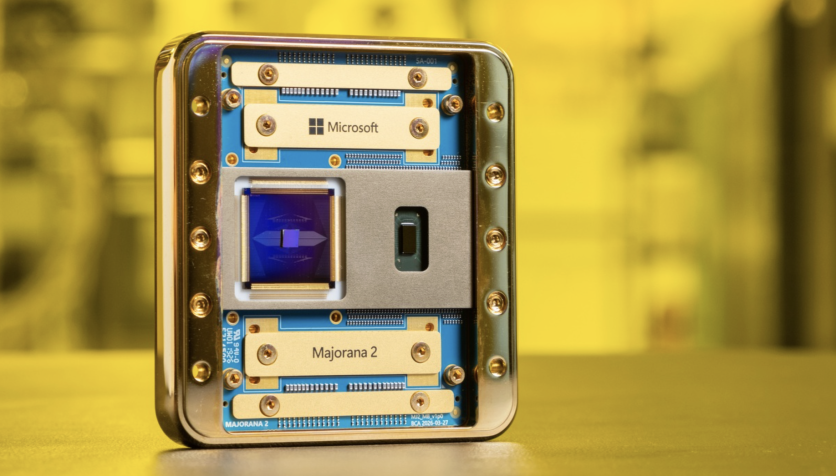
Quantum computing's fault tolerance race took four concrete steps in the first week of June 2026, as Microsoft, the Dutch firm QuiX Quantum, and a Japan-Denmark photonics alliance each tackled a different obstacle between today's fragile machines and a computer that can fix its own errors faster than they pile up. On June 2, at its Build conference, Microsoft reported that its Majorana 2 chip held a qubit's quantum state for a mean of 20 seconds; the next day, QuiX installed a control unit that reacts to single photons in about 150 nanoseconds; and in Tokyo, three companies signed a deal to mass-produce the optical hardware that cold-atom machines depend on. For anyone tracking when quantum computers might break encryption or speed drug discovery, the week's signal is that the industry has shifted its attention from raw qubit counts to qubit reliability — the metric that actually gates useful computation.
None of these results delivers a useful quantum computer, and the companies say so plainly. Every device described here is a prototype or a single subsystem, and even the most aggressive published roadmaps point to the end of the decade before a commercially valuable machine could exist. What changed in early June is the credibility of the path, not the arrival of the destination.
Logical Qubits, Not Physical Qubits, Decide When Quantum Gets Useful
Qubits are easily destroyed. A stray vibration, a flicker of heat, or even the act of reading one out can collapse the quantum state it holds, an error called decoherence. To compute reliably, a machine must combine many error-prone "physical" qubits into a smaller number of resilient "logical" qubits and run quantum error correction to catch and repair mistakes mid-calculation. IBM, which calls this the threshold for a fault-tolerant quantum computer, describes fault tolerance as the line separating experimental devices from systems that can solve commercially valuable problems.
The reference point the June news builds on dates to September 2024, when Microsoft and Quantinuum created 12 logical qubits on Quantinuum's 56-qubit H2 trapped-ion system. Entangled together, those logical qubits showed a circuit error rate near 0.0011, roughly one error in 1,000 operations and about 22 times better than the underlying physical qubits. That demonstration ran on hardware Quantinuum had just upgraded when its H2 system reached 56 all-to-all-connected qubits. Logical qubits, in other words, already exist; the open problem is that there are too few of them and their error rates remain too high for sustained useful work.
Swapping Aluminum for Lead Stretched Microsoft's Qubit Lifetime to 20 Seconds
The week's most consequential hardware claim came from Microsoft's Majorana 2 processor. The company reported topological qubit lifetimes exceeding 20 seconds, with some measurements reaching a minute, against earlier "parity" lifetimes of roughly one to 12 milliseconds. Microsoft attributes the more than 1,000-fold gain to two engineering changes: replacing aluminum with lead as the superconductor in the chip's hybrid stack, and redesigning the semiconductor portion using indium arsenide and indium arsenide antimonide grown on a gallium antimonide substrate.
The mechanism behind that jump is specific. Microsoft's qubits are built from structures called tetrons — pairs of superconducting nanowires designed to host exotic states known as Majorana zero modes at their ends. Information is stored in the parity of the electrons, whether an even or odd number are present, and operations are performed by measuring that parity rather than by directly steering the quantum state, yielding digital 0-or-1 outputs that double as error-correction data. Lead provides a substantially larger superconducting gap than aluminum, which makes it harder for environmental disturbances to kick the system into an error state. Microsoft reported that this "topological gap" more than doubled to about 70 microelectronvolts, from roughly 30, and that parity-switching times now exceed typical qubit-operation times by more than seven orders of magnitude — meaning millions of operations could run before a parity error is expected. The tradeoff is that the lead-based stack took years to engineer around competing material constraints, and the device characterized in the paper is a small multi-tetron prototype, not a processor.
That distinction matters because Microsoft's topological approach remains contested. After its 2025 Majorana 1 announcement drew skepticism over the evidence for Majorana modes, the new paper emphasizes engineering progress over re-proving the physics, and Microsoft notes the work is not yet peer-reviewed. Technical fellow Chetan Nayak framed the effort as building "the transistor for the quantum age" and said the results let Microsoft halve its timeline to target a scalable quantum computer by 2029. Independent physicists are still divided on whether the underlying states behave as claimed.
How Does Feed-Forward Control Make a Photonic Quantum Computer Universal?
A different bottleneck — speed of reaction — is what QuiX Quantum addressed on June 3 with the first installation of its Feed-Forward Control Unit, or FFCU. Photonic quantum computers encode information in single photons racing through optical circuits, which makes "measurement-based" computing — where the outcome of one measurement determines the next operation — exceptionally demanding on timing. The FFCU converts single-photon detector signals into control actions on photonic chips with a reported latency of about 150 nanoseconds from detector input to settled output voltage.
Andrew Roos, QuiX's vice president of R&D, anchored the figure in physics: in 150 nanoseconds, light travels only about 30 meters in telecom fiber, and that is the entire window in which the system must detect, decide, and reconfigure the optical path. The unit reaches that speed by pairing two FPGA modules over a high-speed, low-latency bus with a custom analog front-end, driving Mach-Zehnder interferometers across 32 inputs and 32 outputs. Because fast feed-forward is a prerequisite for universality in measurement-based architectures, the installation is a system-engineering milestone — a control-electronics piece of the full photonic stack — rather than a record-setting qubit result. CEO Stefan Hengesbach said universal photonic quantum computing "requires a complete system stack that can generate, route, measure and control photons in real time."
Yaqumo, NKT Photonics, Hamamatsu Target the Optical Supply Chain for Cold-Atom Machines
On June 3 in Tokyo, at the Danish ambassador's residence, Yaqumo, NKT Photonics, and Hamamatsu Photonics signed a memorandum of understanding to develop and industrialize the optical components underpinning cold-atom, or neutral-atom, quantum computers. The three companies divide the work by specialty: Yaqumo is building a scalable ytterbium-based neutral-atom architecture, NKT Photonics supplies advanced fiber-laser systems, and Hamamatsu contributes ultra-sensitive imaging capable of detecting signals down to a single photon. Their stated goal is to convert the laboratory-bespoke optical subsystems used to trap, cool, manipulate, and read out atoms into standardized, multi-function modules backed by a global supply chain.
The deal's significance is structural rather than a single benchmark. Cold-atom machines need high-performance optics at every stage of operation, and the industrialization of integrated "optical engine" modules has become a gating factor for scaling the technology beyond the lab. The MoU is positioned as a private-sector implementation of a 2025 Japan-Denmark intergovernmental agreement on quantum science, and the signing was attended by Japan's Ministry of Economy, Trade and Industry alongside the Danish ambassador to Japan — a sign that quantum's path now runs through supply-chain logistics, not only through processor design.
IBM's Relay-BP Decoder Runs Error Correction on Off-the-Shelf Chips
The June hardware moves sit on top of IBM's recent work on the classical side of error correction, where the challenge is decoding errors fast and cheaply enough to keep up with a running quantum computer. IBM's Relay-BP decoder, detailed in 2025, is a decoder for quantum low-density parity-check codes that the company reports is more accurate than prior leading methods while remaining compact enough to fit on a field-programmable gate array. In its framework for large-scale fault tolerance, IBM describes Relay-BP as achieving a roughly 5x-to-10x reduction over other leading decoders and shows it does not require large high-performance-computing resources to run — a key step toward real-time decoding on commodity hardware. IBM continues to target a large-scale, fault-tolerant machine, code-named Starling, by 2029, and says it expects narrower quantum advantage sooner.
The reason a decoder matters as much as a qubit is that fault tolerance is an end-to-end system property. A logical qubit is only as good as the classical hardware reading its error syndromes; if the decoder lags behind the quantum processor, undecoded errors accumulate and the computation fails. Compact, FPGA-ready decoding is therefore the connective tissue that lets the qubit advances from Microsoft, QuiX, and the cold-atom camp translate into machines that can actually correct themselves.
👉 Read more:
Why Quantum Computing Will Transform Technology: Experts Explain the Future Impact
What Fault-Tolerant Quantum Computing Could Eventually Unlock
The long-term payoff is real but conditional. A genuinely fault-tolerant machine could run Shor's algorithm to break the RSA encryption that protects much of the internet, simulate molecules to accelerate drug and materials discovery, and crack optimization problems beyond classical reach. Each of those depends on far more — and far more reliable — logical qubits than anyone has yet demonstrated. The build-out is visible in capital as well as physics: IonQ opened a new R&D lab in Boulder, Colorado on May 12, 2026, to design and test the semiconductor ion-trap chips behind its trapped-ion systems, with its first quantum computer there slated for installation later this year.
For now, the accurate summary is the modest one the companies themselves offer. Early June 2026 produced sturdier qubits at Microsoft, faster control electronics at QuiX, a more serious optical supply chain through the Japan-Denmark alliance, and decoders that run on ordinary chips at IBM — real engineering progress toward fault tolerance, on roadmaps that still point to 2029 at the earliest for the first commercially meaningful machines.
Frequently Asked Questions
What is fault tolerance in quantum computing?
Fault tolerance is the ability of a quantum computer to detect and correct its own errors faster than they accumulate, using error correction across many physical qubits to build reliable logical qubits. It is widely regarded as the threshold a machine must cross before it can solve commercially valuable problems rather than just run experiments.
What did Microsoft announce about Majorana 2?
At its June 2, 2026 Build conference, Microsoft reported that its Majorana 2 topological chip held a qubit's quantum state for a mean of 20 seconds, more than 1,000 times longer than its earlier devices, after swapping aluminum for lead in the chip's superconductor. Microsoft said the result lets it target a scalable quantum computer by 2029, though the device is a small prototype and the work is not yet peer-reviewed.
When will quantum computers be able to break encryption?
No existing quantum computer can break standard encryption such as RSA, because doing so requires far more reliable logical qubits than have been demonstrated. Leading roadmaps from companies like IBM and Microsoft point to large-scale, fault-tolerant systems around 2029 at the earliest, and breaking widely used encryption would likely require capabilities beyond even those first machines.
What is a logical qubit versus a physical qubit?
A physical qubit is a single piece of quantum hardware that is easily disrupted by noise, while a logical qubit is a more reliable qubit built from many physical qubits using error correction. The number and error rate of logical qubits, not the raw count of physical qubits, determine whether a quantum computer can perform useful, sustained computation.
ⓒ 2026 TECHTIMES.com All rights reserved. Do not reproduce without permission.


