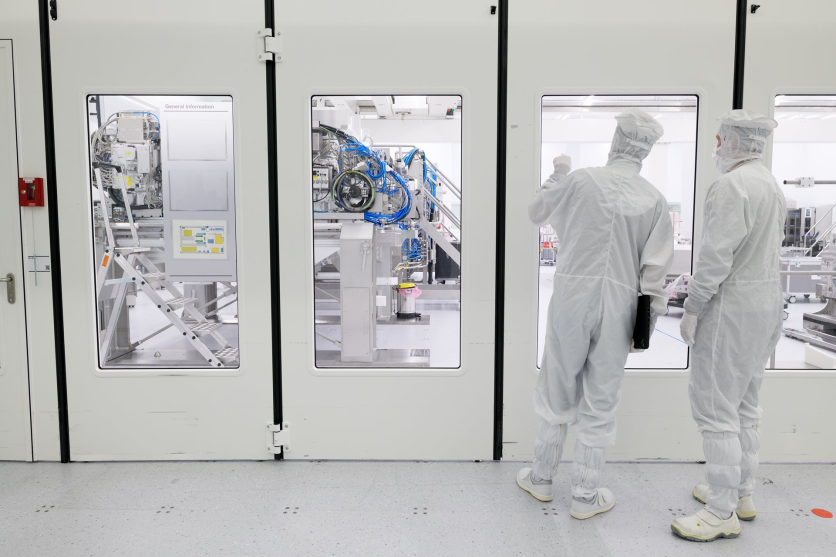
ASML, the Dutch company that makes every extreme ultraviolet lithography machine on the planet, surged another 5.81% on Monday after Elon Musk declared it "arguably the greatest company in Europe" and confirmed he will appear virtually at the chipmaker's private annual technology conference on Tuesday and Wednesday. The endorsement came days after ASML crossed $674 billion in market capitalization — a level no European company has ever reached — and pushed the stock to a fresh high, compounding gains that have reached approximately 60% since January. Every advanced AI chip made by TSMC, Samsung, and Intel passes through an ASML scanner; there is no alternative supplier. That makes today's surge not just a market story, but a signal of how tightly concentrated the global infrastructure for artificial intelligence has become.
EUV Monopoly: Why ASML Stock Sits at Every Advanced Chip's Chokepoint
ASML holds a complete monopoly on extreme ultraviolet lithography — the only manufacturing process capable of printing the circuit patterns required for sub-7-nanometer chips. The company achieved this position by solving a physics problem no other organization has cracked at commercial scale: generating light at a wavelength of 13.5 nanometers, far shorter than the 193-nanometer light used in older deep ultraviolet systems, and short enough to etch features roughly 15 times finer.
The machine does this through what amounts to a controlled miniature star. Inside each ASML scanner, 50,000 microscopic molten tin droplets per second are fired into a vacuum chamber and struck by a two-pulse 30-kilowatt CO2 laser system built by German firm TRUMPF. The first pulse flattens each droplet into a thin disc; the second heats it to approximately 220,000 degrees Celsius — about 40 times hotter than the surface of the sun — converting it into plasma that radiates EUV light. Because EUV photons are absorbed by air and glass alike, the entire optical path operates in vacuum, using only mirrors. The precision optics, built by Carl Zeiss SMT, must be aligned to tolerances measured in fractions of a nanometer. EUV lithography explained
TSMC, Samsung, and Intel need these machines at every advanced node. Every chip shipped inside an iPhone, an Nvidia GPU, or a hyperscaler server has touched an ASML scanner. The company's €38.8 billion order backlog — the size of a small nation's annual output — reflects demand years into the future. ASML $674B record and order backlog
Why ASML Stock Can Rise: JPMorgan Sees 110 Machines Per Year Without New Buildings
The immediate trigger for ASML's record-breaking week was a pair of near-simultaneous analyst upgrades that argued the market had underestimated how many machines ASML can ship. JPMorgan analyst Sandeep Deshpande raised his price target to €1,900 from €1,515 and maintained an Overweight rating, arguing that ASML can deliver more than 110 low numerical aperture EUV systems annually without adding new building space — well above the roughly 90-unit ceiling that had become the market's working assumption.
Morgan Stanley raised its target to €1,660 from €1,400 on the same day, citing new disclosures from ASML's April annual general meeting. At that gathering, ASML executives outlined a major expansion at the Brainport Industries Campus in Eindhoven, with construction scheduled to begin in the third quarter of 2026. Morgan Stanley cautioned that the campus expansion needs to function as the first phase of a sustained, multi-phase buildout if ASML is to address long-term capacity constraints. Bank of America separately raised its target to €1,921 from €1,710 on June 4, citing strong long-term growth visibility and EUV capacity expansion.
South Korea's SK Hynix had already underlined the magnitude of demand. On March 24, the memory chipmaker filed a regulatory disclosure committing 11.95 trillion won — approximately $7.97 billion — to EUV equipment purchases from ASML by the end of 2027. It was the largest single EUV order ever publicly disclosed by any customer in ASML's history. Bernstein analyst David Dao estimated the deal covers roughly 30 machines, and ING analyst Marc Hesselink noted it contained a deliberate "pull-in element" designed to lock down ASML supply ahead of competitors. SK Hynix $8B ASML EUV order
Read more: Dutch Chip Maker Warns: Geopolitical Risks, US Export Restrictions Cast Shadow on Business Growth
Terafab Chip Factory: Why Musk's $55 Billion Project Needs ASML's Machines
Musk's impact on ASML's stock today stems from a project he unveiled at an Austin event on March 22, 2026: Terafab, a joint venture between SpaceX, Tesla, and Intel planned for a site near Giga Texas. The facility would manufacture chips for AI, robotics, and space applications, targeting 2-nanometer-class production using Intel's 14A process node. Intel joined the project in April. By May 2026, a Texas regulatory filing had put the cost at a minimum of $55 billion — making it one of the most expensive semiconductor projects ever proposed on American soil, with potential expansion costs reaching $119 billion.
There is no path to 2nm chip production that does not require ASML equipment. A modern leading-edge logic fab requires between 80 and 100 deep ultraviolet plus EUV lithography scanners to support capacity of 20,000 to 30,000 wafer starts per month. At Terafab's proposed scale, the equipment procurement pipeline represents a potential multi-billion-dollar order stream for ASML.
ASML CEO Christophe Fouquet confirmed in May that he had spoken directly with Musk, telling Reuters that the entrepreneur is "very serious" about the project. The CEO also warned that AI demand will leave the global semiconductor industry supply-constrained for the foreseeable future. Musk is scheduled to join Fouquet on Tuesday for a virtual fireside chat at ASML's annual employee technology conference in Den Bosch, the Netherlands — an internal event closed to the public. ASML CEO Terafab talks confirmed
Employee Boycott: ASML Workers Reject Musk Invitation on Inclusivity Grounds
The invitation has not gone over well inside ASML. After news of the Musk appearance was circulated internally, a wave of employee criticism surfaced on Viva Engage, ASML's internal communications platform. Workers objected that giving Musk a prominent speaking slot was incompatible with the company's stated commitment to an inclusive work environment. Some employees announced they would boycott the conference session featuring Musk, or the conference entirely. The backlash was first reported by Eindhovens Dagblad and confirmed by ASML to NL Times and Bloomberg on June 7. ASML employee backlash over Musk
ASML responded by defending the invitation on purely industrial grounds. "The invitation to Elon Musk took place in the context of the Terafab project, which is highly relevant to the semiconductor industry," a spokesperson said, per NL Times. The company separately stated that it was "committed to an inclusive work environment in which everyone feels valued and respected, can fully contribute, and is free to express his or her opinion."
The conflict illustrates the tension now embedded in ASML's commercial position: the company's monopoly means it cannot decline business from the world's most controversial technology figure without consequences for shareholders, and cannot embrace it without consequences for employees.
Read more: China's Invasion Could Result to Sudden Shutoff of Chip Machines in Taiwan, Tech Minister Says
How EUV Lithography Works: Tin Plasma at Forty Times the Sun's Temperature
The technical reason ASML's monopoly has proven nearly impossible to replicate is the machine's stacked dependency on simultaneous breakthroughs in laser physics, vacuum optics, and precision mechatronics. Each EUV scanner contains more than 100,000 parts. The tin-droplet plasma source alone synchronizes droplet generation at 50,000 cycles per second with laser pulse timing measured in picoseconds. TRUMPF's CO2 laser for the light source is the most powerful pulsed industrial laser in commercial production. Zeiss's EUV mirrors must rank among the smoothest surfaces manufactured anywhere — surface irregularities would scatter and lose the precious photons.
The jump from low numerical aperture to high numerical aperture EUV — the generation now entering production as ASML's EXE:5000 system — sharpens the minimum feature size from approximately 13nm to below 8nm by increasing the lens aperture from 0.33 to 0.55. The EXE:5000 is the machine Intel installed in preparation for its 14A node, the process Terafab would use. These High-NA systems carry an estimated price above $380 million each. The High-NA generation compounds ASML's advantage: the engineering investment required to replicate even the low-NA system is measured in decades; the High-NA system extends that gap further.
In February 2026, ASML announced that its researchers had demonstrated a light source consistently producing 1,000 watts of EUV output — a milestone the company said would enable a 50% increase in chip throughput per machine by around 2030. The upgraded system replaces the current two-pulse tin droplet process with a three-pulse method, firing 100,000 droplets per second rather than 50,000, to sustain the higher power levels. That single development, if it delivers at production scale, would be equivalent to adding roughly half a new ASML machine to every scanner currently installed across the world's leading-edge fabs. ASML 1,000-watt EUV breakthrough
ASML Stock Risks: Valuation, China Revenue Loss, and the MATCH Act
The record valuation does not reflect a unanimous verdict. Morningstar moved to a Sell rating on ASML in May 2026, citing a price-to-earnings ratio that it judged as incorporating too much of the company's long-term upside. Seeking Alpha analysts have flagged a forward P/E near 38 to 40 times as leaving little margin of safety for investors entering at current levels. TSMC, ASML's single largest customer, publicly complained at a semiconductor industry event about the price of ASML's High-NA EUV systems, which carry a list price near €350 million. The complaint — highly unusual between two companies that depend on each other for survival — was interpreted by analysts at Asia Times as a sign that ASML is finally learning to exercise the pricing power its monopoly position confers after years of restraint.
The company also faces a revenue cliff in China. ASML's China system sales fell from 36% of quarterly revenue in the fourth quarter of 2025 to 19% in the first quarter of 2026, as export controls progressively restricted which equipment could be shipped to Chinese customers. The pending MATCH Act, introduced in the US Congress in April 2026 with bipartisan backing, would go further: it would ban ASML's remaining deep ultraviolet equipment sales to China and require allied governments, including the Netherlands, to align their export controls with US standards within 150 days or face sanctions. The Dutch government has pushed back, with Prime Minister Dick Schoof raising ASML's situation directly during White House meetings. If the MATCH Act passes, analysts have estimated it could remove approximately 17% of ASML's revenue. MATCH Act chip export controls and ASML
ASML's stock has climbed approximately 60% since January, a substantial gain but one that has trailed the broader semiconductor sector, which has run far hotter on direct AI chip exposure. The company currently sits well below the trillion-dollar thresholds cleared by several US chip firms.
Competitors Emerge: Substrate and xLight Challenge ASML's EUV Monopoly
A handful of challengers have attracted significant capital to develop alternatives to ASML's lithography architecture, none of them yet close to displacing EUV in high-volume advanced production.
Substrate, a San Francisco-based startup backed by Peter Thiel's Founders Fund and the CIA-linked investment firm In-Q-Tel, raised $100 million at a $1 billion valuation in October 2025 and emerged from stealth with claims that its particle-accelerator X-ray lithography system can produce chips at 2nm-class resolution. The company's approach differs fundamentally from ASML's: rather than using the 13.5-nanometer EUV wavelength, Substrate's system targets even shorter-wavelength X-rays, which in principle allow still-narrower features. Unlike conventional equipment makers, Substrate has said it plans to offer its technology as a foundry service rather than sell equipment — a model that, if it works, would route around ASML's position entirely.
xLight, a startup led by Pat Gelsinger — the former Intel CEO — is developing free-electron laser technology that it argues can dramatically cut the cost of generating EUV light. The company received $150 million in federal funding through the CHIPS and Science Act in June 2026 to build a prototype at the Albany NanoTech Complex in New York. Canon has also been shipping commercial nanoimprint lithography tools since 2024, with pricing well below ASML's EUV systems, though limited to specialty nodes.
ASML's own response to these challengers has been to accelerate its light source program. The company's February 2026 announcement of a 1,000-watt EUV source represents a targeted investment in the precise bottleneck — throughput — that newer competitors have identified as ASML's most vulnerable engineering constraint. Every watt of additional EUV power translates to more wafer starts per hour without requiring a new scanner, making the existing installed base more competitive against future alternatives.
What Is EUV Lithography and Why Does Every Advanced AI Chip Depend on It?
For investors and readers less familiar with the underlying technology, the significance of ASML's position reduces to one fact: there is no other way to manufacture the chips that run large AI models at commercial scale. The sub-7nm transistor densities required for Nvidia's GPU-class accelerators, TSMC's leading Apple chips, and SK Hynix's high bandwidth memory for AI data centers are physically impossible to produce without extreme ultraviolet lithography. The 13.5-nanometer wavelength is short enough to print features that 193-nanometer deep ultraviolet light cannot resolve, and no alternative manufacturing process has reached commercial scale production at leading-edge nodes.
This is why a Dutch company employing roughly 44,000 people has become worth more than HSBC and Roche combined, and why analysts now spend significant research effort estimating not whether ASML will grow, but how fast it can build machines. The answer to that question — shaped by the Brainport Campus construction timeline, the 1,000-watt light source roadmap, and the order backlog that already exceeds €38 billion — will determine how quickly the world can produce the AI chips everyone is racing to deploy.
Frequently Asked Questions
Why is ASML stock going up today?
ASML shares rose 5.81% on June 8, 2026, after Elon Musk publicly described ASML as "arguably the greatest company in Europe" and confirmed he would appear virtually at the chipmaker's private annual technology conference on June 9–10 to discuss Terafab, the $55 billion SpaceX-Tesla chip fabrication project planned for Texas. The endorsement reinforced attention on ASML's role as the only equipment supplier that can manufacture chips at the 2nm-class node Terafab intends to use.
Is ASML a monopoly?
ASML is the sole manufacturer of extreme ultraviolet lithography machines, the equipment required to print circuit patterns smaller than 7 nanometers. No other company produces commercial EUV systems at volume; Canon and Nikon compete only in older deep ultraviolet segments. Every leading-edge chip produced anywhere in the world — for AI, smartphones, or data centers — passes through an ASML scanner at some point in fabrication.
What is Terafab and why does it matter to ASML?
Terafab is a joint venture announced in March 2026 by Elon Musk's SpaceX and Tesla, with Intel joining in April, to build a semiconductor fabrication facility in Texas with a confirmed cost of at least $55 billion. Because Terafab targets 2nm-class chip production using Intel's 14A process, it has no viable path to production that bypasses ASML equipment. A fab at the scale Musk has described would represent one of the largest potential single-site customers ASML has ever served.
What risks could bring ASML stock down?
The main risks are valuation — Morningstar issued a Sell rating in May 2026 at current price levels — a continuing decline in China revenue as export controls tighten, and the proposed MATCH Act in the US Congress, which if passed could ban ASML's remaining deep ultraviolet equipment sales to China and cost the company an estimated 17% of revenue. High customer concentration is also a structural risk: if TSMC, Samsung, or Intel significantly reduce capital expenditure, ASML order flow slows sharply.
ⓒ 2026 TECHTIMES.com All rights reserved. Do not reproduce without permission.


