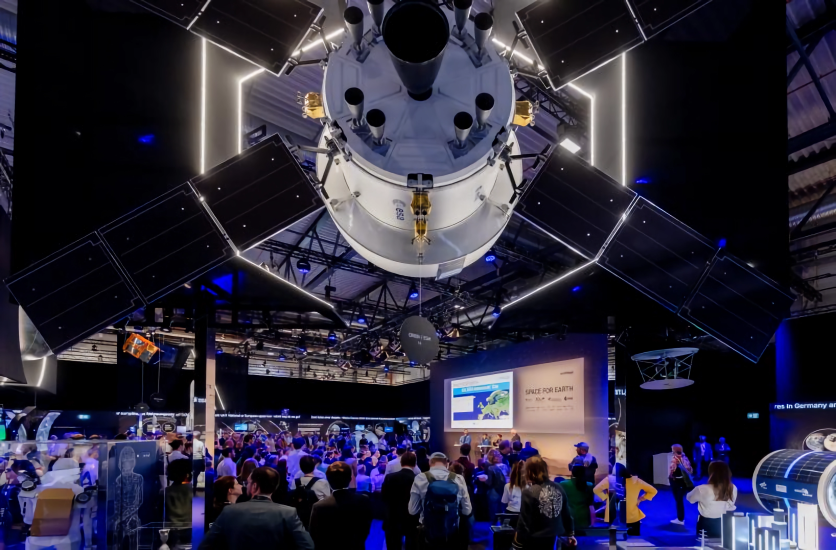
The ILA Berlin Air Show opened Wednesday at Berlin ExpoCenter Airport (BER) with a landmark that rewrites European defense history: nine years after France and Germany unveiled a shared vision for the continent's most powerful fighter jet, that vision is over. Chancellor Friedrich Merz announced at ILA's opening ceremony that Germany and France have formally ended the crewed aircraft component of the Future Combat Air System (FCAS) program — the same stage where the partnership was born in 2018. The €100 billion project, Europe's most ambitious defense collaboration since the Eurofighter, could not survive the industrial rivalry it was built on.
Every NATO ally with an aging Eurofighter Typhoon or Rafale fleet — and every defense ministry watching Europe scramble to rearm — now needs to know what Berlin does next. Three paths are open: join the UK-Italy-Japan Global Combat Air Programme (GCAP), order more F-35As, or back eight German companies that launched a new consortium, called Team Gen 6, at ILA this week. The choice will define Europe's air power structure for a generation.
FCAS Program Terminated: Nine Years, No Aircraft, and a Structural Fault That Could Not Be Engineered Away
FCAS was announced in July 2017 by President Emmanuel Macron and then-Chancellor Angela Merkel as a flagship symbol of Franco-German defense cooperation. Spain joined as a third partner in 2019. The program's formal industrial partnership between Dassault Aviation and Airbus was unveiled at the very same ILA Berlin show in 2018. Its goal was sweeping: a sixth-generation stealth combat aircraft to replace France's Rafale and Germany's Eurofighter Typhoon by the early 2040s, complemented by autonomous drones and an AI-powered digital "combat cloud" linking the entire system.
The structural fault line was there from the beginning. France requires an aircraft capable of carrying nuclear weapons and operating from an aircraft carrier; Germany needs a long-range conventional air superiority platform. Those requirements cannot be satisfied by a single airframe without compromising both. On top of that divergence, Dassault Aviation CEO Éric Trappier insisted on a dominant lead-contractor role for the French firm — what Dassault called the "best-athlete" model. Airbus, carrying the industrial weight of Germany and Spain, refused to be a junior partner on a program it was helping to fund.
By 2025, reports emerged that Dassault was seeking up to 80% of the fighter's workshare, which would have effectively concentrated all core design authority in France. Germany responded by funding a political mediation process launched after a Macron-Merz dinner in Brussels on March 18, 2026. A German mediator formally concluded on April 18, 2026, that a jointly built crewed fighter was no longer feasible. A Macron-Merz bilateral at an informal EU summit in Cyprus on April 23, 2026, kicked the decision back to defense ministries, but produced no resolution. Merz personally attempted to persuade Trappier to accept equal partnership terms. That effort also failed.
Merz conveyed the final decision to Macron on June 6, 2026, on the sidelines of the EU-Western Balkans Summit in Montenegro. German Defense Minister Boris Pistorius made a formal statement on June 9. "After nine years, the joint project between Germany, France and Spain for a shared fighter jet has been terminated," Pistorius said. "The cancellation of the planned fighter jet is primarily due to differing positions among the industries. Germany and France attempted to mediate in the dispute between the two companies — ultimately without success." He added that the collapse had "pained" him, but that a line had to be drawn "between head and heart."
Ralph Thiele, a retired Bundeswehr colonel and chairman of the Political-Military Society, offered a blunter verdict. "From my perspective, the programme was doomed from the outset," Thiele said. "The United States brought the F-35 into service within 12 months. We have lost nine years."
Phase 1B of the program — the design study phase — alone cost approximately €4 billion through 2025. No flying prototype was ever built.
What Survives the Collapse: Combat Cloud, Drones, and a July Roadmap
The fighter aircraft and its planned 2040s service entry are definitively cancelled. What may survive is the non-crewed architecture that ran in parallel. Airbus Defence and Space CEO Michael Schoellhorn said in May 2026 that networked systems and drone elements of the broader program could potentially continue. A Franco-German ministerial council, currently expected around July 17, 2026, will draft a new joint roadmap focused on what both governments have called "realistic and relevant projects" — most likely the so-called combat cloud and unmanned systems work.
The combat cloud was always the technically distinctive heart of FCAS. Unlike a traditional fighter program, FCAS was designed from the outset as a "system of systems": a networked battlefield architecture connecting the crewed Next Generation Fighter, autonomous Remote Carrier drones, and existing platforms like the Rafale and Eurofighter through an AI-powered data link and shared kill-chain. Airbus and Thales led the cloud component, and that work reportedly progressed far better than the manned aircraft — precisely because it did not require resolving the core jurisdictional conflict over who builds the jet. Germany and France can potentially still co-develop the AI backbone and plug their own nationally upgraded platforms into a shared European network.
That is not, however, the same program that Macron and Merkel announced in 2017. The dream of a single European stealth fighter embodying Franco-German industrial parity is gone.
Germany's New Aviation Strategy: Airbus at the Center of Whatever Comes Next
Timed deliberately to ILA's opening, the German cabinet on Wednesday formally adopted a new national aviation strategy. The document, reported by Handelsblatt ahead of the announcement, makes explicit that Airbus must co-lead any future German combat aircraft program — a clear signal of Berlin's intent to keep the industrial center of gravity on home soil even as the Franco-German framework dissolves. Chancellor Merz, who personally opened the show, has framed ILA 2026 as a statement of Germany's ambition to become a leading aviation nation.
Germany's IG Metall trade union, representing more than two million industrial workers, welcomed the cancellation, arguing that ending FCAS serves the interests of Germany's aerospace workforce. The workforce's jobs will no longer be tied to the outcome of a disputed workshare arrangement with a French industrial partner. It is a telling signal: even Germany's labor movement reads the breakup as a win for domestic industrial capacity.
Team Gen 6: Eight German Companies Stake a Claim on the Successor Program
Within hours of the FCAS announcement, the industrial response materialized. Eight German aerospace and defense companies — Airbus Defence and Space, HENSOLDT, MTU Aero Engines, MBDA, Diehl Defence, Rohde & Schwarz, Liebherr, and Autoflug — formally unveiled a consortium at ILA called Team Gen 6, backed by a position paper submitted in a letter to Merz's office and Defense Minister Pistorius, as reported by the Financial Times.
The group draws on companies that already held roles in FCAS — Airbus, MTU Aero Engines, MBDA, HENSOLDT, Diehl Defence, and Rohde & Schwarz all participated in the program's pillar architecture — and adds new entrants Autoflug and Liebherr, broadening the industrial base. Their stated goal: to demonstrate that German industry is ready to develop a future combat aircraft "for Europe, in Europe."
Pistorius confirmed the proposal's existence and said Berlin was assessing "which direction we take," adding that discussions had been ongoing "for months with various stakeholders." Team Gen 6 is not a surprise to Berlin; it is a bid that was coordinated with knowledge of the FCAS endgame.
Sixth Generation Fighter Europe: Three Options for Germany's Fleet
With the FCAS fighter cancelled, Germany's Eurofighter Typhoon fleet will need a successor, and the options are narrowing toward a decision window Berlin will need to close within the next few years to avoid a capability gap in the 2040s.
The most consequential option now in active diplomatic motion is GCAP. On June 9, 2026, Leonardo CEO Lorenzo Mariani told Reuters that Germany would be a "particularly valid partner" for the UK-Italy-Japan program following the FCAS collapse. Italian Defence Minister Guido Crosetto has previously stated explicitly that the door remains open. UK Defence Minister Luke Pollard confirmed in late 2025 that GCAP partners are committed to a 2035 service date and open to new participants once the initial design phase is complete. GCAP has moved faster than FCAS precisely because its three partners agreed early on an equal-partnership industrial governance model — the arrangement Dassault refused to accept. A GCAP demonstrator flight is targeted for 2027.
Military expert Ralph Thiele has pointed directly to the contrast in program culture. "The United Kingdom is a pragmatic partner," Thiele noted, "and Japan would be a dream technology partner for Germany." Bringing Germany into GCAP would add the industrial depth of Airbus, MTU Aero Engines, and HENSOLDT to a program that already has BAE Systems, Leonardo, and Mitsubishi Heavy Industries. It would also dramatically improve the program's economics by spreading development costs across a fourth major partner.
Additional F-35A procurement remains the path of least political resistance. Germany has already ordered F-35As as a nuclear-sharing-capable Tornado replacement. Expanding that order to cover the Eurofighter gap is technically straightforward and immediately available, though it deepens dependence on American platforms at a moment when European strategic autonomy is Berlin's stated ambition.
Team Gen 6's pitch is a third option: a German-anchored European sixth-generation program built independently of both GCAP and the American platform supply chain. Airbus has also held talks with Sweden's Saab — a pairing that would bring Saab's sixth-generation feasibility work, funded by the Swedish government in March 2024, into a potential collaboration. Whether any of these paths can attract the coalition of nations needed to make a new program viable remains the defining question.
On the ILA Show Floor: The Technology That Didn't Wait for FCAS
Whatever Germany's diplomatic resolution, ILA 2026's exhibition halls make plain that the building blocks of future European air power are already in production. The show runs through June 14 and features more than 750 exhibitors from over 40 countries.
Rheinmetall occupies an 840-square-meter dual-level stand in the Defence Park and has positioned itself as the prime contractor for a potential Bundeswehr acquisition of the Boeing MQ-28 Ghost Bat, an autonomous Collaborative Combat Aircraft designed for manned-unmanned teaming in contested airspace. The Ghost Bat has logged more than 150 test flights, can be configured for reconnaissance, electronic warfare, and weapons integration, and is targeted for a Bundeswehr procurement decision in 2029. The MQ-28 represents the practical near-term alternative to waiting for a sixth-generation crewed platform: a loyal wingman that can be deployed alongside existing Eurofighter squadrons.
Also on display from Rheinmetall is the Skyranger 30, a mobile air defense turret mounted on a Boxer 8×8 armored vehicle, armed with MBDA's DefendAir guided missiles and designed to counter drone swarms and cruise missiles. Airbus Defence and Space is showcasing its Birds of Prey family of unmanned systems — an implicit argument that Germany's next combat air investment may flow as much into networked drone architectures as into a crewed platform successor. Other major exhibitors include Diehl Defence, Elbit, HENSOLDT, Leonardo, Lockheed Martin, MBDA, Rafael, Raytheon, and Thales.
FCAS Failure and the Limits of European Strategic Autonomy
The end of FCAS's fighter pillar is not only a procurement setback. It is a live empirical test of the industrial dimension of European strategic autonomy — and it failed. The concept, enshrined in EU policy since 2013 and championed by Macron as the defining argument for a self-reliant European defense industrial base, rests on the premise that European nations can pool engineering talent, fund programs jointly, and deliver military-grade platforms without defaulting to American technology. FCAS was the proof-of-concept. Nine years and €4 billion later, it could not resolve a three-nation, two-company workshare dispute.
The failure pattern is not unique to FCAS. The RAND Corporation warned in 2013 that joint service fighter programs historically produce design compromises that drive costs far higher than normal single-service programs. FCAS ran into a version of that dynamic at the company level rather than the service level, but the mechanism was identical: competing institutional interests that rational negotiation alone cannot overcome. Every future EU-level defense co-development program — whether on the combat cloud FCAS's successors will attempt to salvage, ground combat vehicles, or naval systems — faces the same structural challenge.
GCAP's faster progress offers a counter-data point, but its lesson is precise: the UK-Italy-Japan program has moved because its partners agreed in 2022 on a jointly governed industrial framework structured to prevent any single partner from claiming unilateral lead authority. That is exactly the arrangement Dassault refused. Whether Germany joins GCAP, backs Team Gen 6, or buys more F-35s, the procurement decision it makes in the next 24 months will answer one of the most consequential open questions in Western defense planning: whether European strategic autonomy in air power is a doctrine or a diplomatic aspiration.
The show runs through June 14. The decisions it triggers will shape European airspace for the next half-century.
Frequently Asked Questions
Why was the FCAS fighter jet cancelled?
Germany and France cancelled the crewed fighter component of the Future Combat Air System on June 8–9, 2026, after an irreconcilable industrial dispute between Airbus and Dassault Aviation over who would lead the program's Next Generation Fighter. Dassault sought a dominant role, reportedly claiming up to 80% of the workshare; Airbus refused to accept junior-partner status on a program it was helping to fund. A government-backed mediation process formally concluded on April 18, 2026, that a jointly built crewed fighter was no longer feasible, and both governments agreed they had no remaining leverage to force a resolution between the two industrial partners.
Will Germany join GCAP after FCAS ended?
Germany has not formally committed to joining the Global Combat Air Programme, but diplomatic signals are strong. On June 9, 2026, Leonardo CEO Lorenzo Mariani told Reuters that Germany would be a "particularly valid partner" for the UK-Italy-Japan program. Italian Defence Minister Guido Crosetto has previously confirmed Germany is welcome. GCAP targets a 2035 service entry — five years earlier than FCAS's planned timeline — and has an established equal-partnership industrial governance model through its Edgewing joint venture. A formal German approach would need to begin before GCAP's initial design phase closes to new partners.
What is Team Gen 6?
Team Gen 6 is a consortium of eight German aerospace and defense companies — Airbus Defence and Space, HENSOLDT, MTU Aero Engines, MBDA, Diehl Defence, Rohde & Schwarz, Liebherr, and Autoflug — that submitted a position paper to Chancellor Merz and Defense Minister Pistorius proposing that German industry is prepared to lead a sixth-generation European combat aircraft program. The consortium launched publicly at ILA Berlin on June 10, 2026. Whether the German government backs it as a standalone national program, uses it as a negotiating position for GCAP entry, or treats it as a placeholder while procurement options are assessed has not yet been determined.
What does the FCAS collapse mean for European strategic autonomy?
The collapse of FCAS's fighter pillar is a direct empirical test of the industrial dimension of European strategic autonomy — the idea that EU nations can jointly develop military-grade platforms without relying on the United States — and that test failed. Nine years and approximately €4 billion in study costs produced no airframe and no agreement. The structural problem was not political will but competing industrial interests between national champions that rational negotiation could not resolve. GCAP's more successful trajectory suggests the lesson is governance structure, not ambition: equal-partnership industrial frameworks with binding joint-venture arrangements may be the only model that works at scale.
ⓒ 2026 TECHTIMES.com All rights reserved. Do not reproduce without permission.


