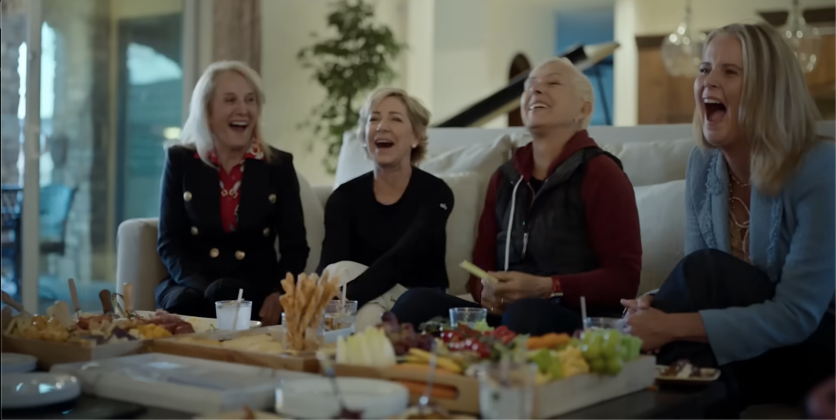
One day after its world premiere at the Tribeca Film Festival, the Netflix documentary Chris & Martina: The Final Set has drawn immediate attention not just for its archive of 80 career meetings across one of sport's greatest rivalries, but for a more intimate reason: cameras followed Chris Evert to chemotherapy appointments and filmed her son shaving the last of her hair after treatment began — footage that no journalist or broadcaster had captured during either of her two ovarian cancer diagnoses. The 96-minute film, directed by two-time Emmy Award winner Rebecca Gitlitz, arrives on Netflix on June 26, 2026. The world premiere took place Wednesday, June 10, at Tribeca's 25th-anniversary festival in New York City.
For a reader who knows Evert and Navratilova only as rival icons, the documentary's central argument may come as a surprise: five decades of competition across 80 matches on every surface did not fully close the distance between them. Cancer did. That realization — that the most sustained rivalry in tennis history required illness to become a genuine friendship — is what separates The Final Set from a conventional career retrospective and gives it staying power well beyond the sports audience.
Evert-Navratilova Rivalry: By the Numbers
The statistical foundation of the Evert-Navratilova rivalry is almost incomprehensible in its density. They met 80 times between 1973 and 1988. Of those 80 meetings, 60 came in finals and 14 in Grand Slam finals. Navratilova leads the overall head-to-head 43–37. From November 1975 through August 1987, either Evert or Navratilova held the No. 1 ranking in 592 of 615 weeks — a combined dominance of women's tennis that no other pair of rivals has approached before or since.
Both retired with 18 Grand Slam singles titles. Navratilova's nine Wimbledon titles are the most by any player in the Open Era. Evert's seven French Open singles titles are a women's record. The rivalry is widely regarded as the greatest in tennis history.
The film opens where it all began: the final of the 1975 French Open at Roland Garros, where Evert, then 20 and seeded first, defeated Navratilova, then 18, by a score of 2–6, 6–2, 6–1. The contrasts that day were immediate and stark. Evert was the composed Florida baseline specialist, precise and unrattable. Navratilova — athletic, left-handed, and weeks away from defecting from communist Czechoslovakia at the US Open that September — played with an aggression and risk appetite that Evert's meticulous groundstrokes would contain that afternoon, but not for long.
"Chris was the enemy," Navratilova says in the documentary, "and she's the one I had to beat to get to No. 1."
From Cold War to Locker Room: How the Rivalry Evolved
In the rivalry's first phase, Evert held the upper hand, winning nine of their first ten meetings. The recognition she received from fans and media was proportional.
"In the beginning, it was fine for me to be friends with her, because I was better than her," Evert, now 71, says in the film.
That dynamic shifted as Navratilova transformed her conditioning and game. She became obsessive about fitness, refined her serve-and-volley approach to a level no player of the era could match, and pulled even in their rivalry — then pulled ahead. For most of the 1980s, Navratilova was the dominant player in the world. Evert's response was to evolve her own game in ways she readily acknowledges were driven by what her rival forced her to become. "Would I have won more if Chris hadn't been in the way? Probably," Navratilova says in the film. "But even at the time I knew I was better for having her around."
What the film captures, through archival footage and new interviews, is how their relationship cycled through phases — from friendly doubles partners (they won the 1975 French Open doubles title together) to icy adversaries to a cautious mutual respect — while the tennis itself reached heights that redefined what women's professional tennis could become.
What Cancer Changed Between Them
The documentary's most searching passages cover territory that no archive could have supplied: the health crises both women faced in overlapping real time.
Evert was first diagnosed with stage 1 ovarian cancer in December 2021, following a preventive hysterectomy that revealed a malignant tumor in her fallopian tube — a discovery triggered in part by the ovarian cancer death of her younger sister Jeanne in 2020 and a subsequently reclassified BRCA1 gene variant in the family. Evert reached remission within a year.
Then, on January 2, 2023, Navratilova announced a simultaneous diagnosis of stage 1 throat cancer (HPV-related) and stage 1 breast cancer, discovered after she noticed an enlarged lymph node at the WTA Finals in Fort Worth, Texas, in November 2022 — her third cancer diagnosis after an earlier breast finding in 2010.
Director Gitlitz had begun working on the film around that time. But in December 2023, with production underway, Evert's cancer returned: cells in the same pelvic region, requiring another round of robotic surgery and chemotherapy. Rather than pull back, Evert allowed cameras into her treatment — to doctor consultations, to the chemotherapy chair, and to the moment her son shaved what remained of her hair. It is that footage that gives the second half of The Final Set its documentary weight.
"The second time really hit home how precious every moment is, how precious life is," Evert says in the film.
Navratilova, reflecting on what shared illness had reconfigured between them, put it plainly: "There's no competition of whose cancer was worse. We're in the same boat."
The film presents this not as a coda to the rivalry but as its logical conclusion — that the competitor's identity, which both women had organized their lives around for 15 years, could not survive the equalizing reality of illness. It is the single most important thing the documentary offers that no archive or box score can.
Who Made the Film, and Why It Earned Its Tribeca Slot
Gitlitz, who has previously directed documentaries on Pat Summit, LeBron James, Peyton Manning, and Princess Diana, structured The Final Set as a rally — cutting between present and past, between Florida and Prague, between the rivalrous distance of two competitors and the closeness two cancer patients discovered. She began work on the project roughly two and a half years ago, after Navratilova's double diagnosis made the documentary's emotional arc available in a way it had not been before.
The film features interviews with Mary Carillo, seven-time Grand Slam champion John McEnroe, former World No. 3 Pam Shriver, and journalist Sally Jenkins. Jon Wertheim of Sports Illustrated, who served as executive producer, noted that the pairing makes intuitive sense: of all the people alive, Navratilova came closest to knowing what Evert was going through — and vice versa. That recognition of shared vulnerability, Wertheim said, is what ultimately transformed the rivalry into something deeper than sport alone had ever managed.
Chris & Martina: The Final Set is 96 minutes and was produced by Jenna Ricker. It premieres on Netflix globally on June 26, 2026.
Frequently Asked Questions
When does Chris & Martina: The Final Set premiere on Netflix?
The documentary premieres on Netflix on June 26, 2026, and will be available to stream globally on the platform. It had its world premiere at the Tribeca Film Festival on June 10, 2026, as part of the festival's 25th-anniversary documentary lineup.
What cancers did Chris Evert and Martina Navratilova have?
Evert was diagnosed with stage 1 ovarian cancer in December 2021, reached remission in early 2023, and then experienced a recurrence in December 2023 that required a second round of chemotherapy. Navratilova announced in January 2023 that she had been diagnosed with both stage 1 throat cancer — caused by HPV — and stage 1 breast cancer simultaneously, her third cancer diagnosis after an earlier breast finding in 2010.
How many times did Evert and Navratilova play each other?
They met 80 times between 1973 and 1988. Navratilova leads the head-to-head 43–37. Sixty of their meetings came in finals, and 14 were Grand Slam finals. From November 1975 through August 1987, one of the two held the No. 1 world ranking in 592 of 615 weeks.
Why did cancer change their relationship when decades of competition could not?
The documentary's central argument is that the competitor's identity — the frame through which both women had understood each other as opponents for 15 years — dissolved in the face of illness in a way it never had on court. Cancer removed the asymmetry of wins and losses and replaced it with shared vulnerability, shared treatment, and shared uncertainty about the future. Navratilova says in the film there was no longer any competition between them at all. Both women have credited their mutual support during treatment as the foundation of the deep friendship they now share.
ⓒ 2026 TECHTIMES.com All rights reserved. Do not reproduce without permission.


