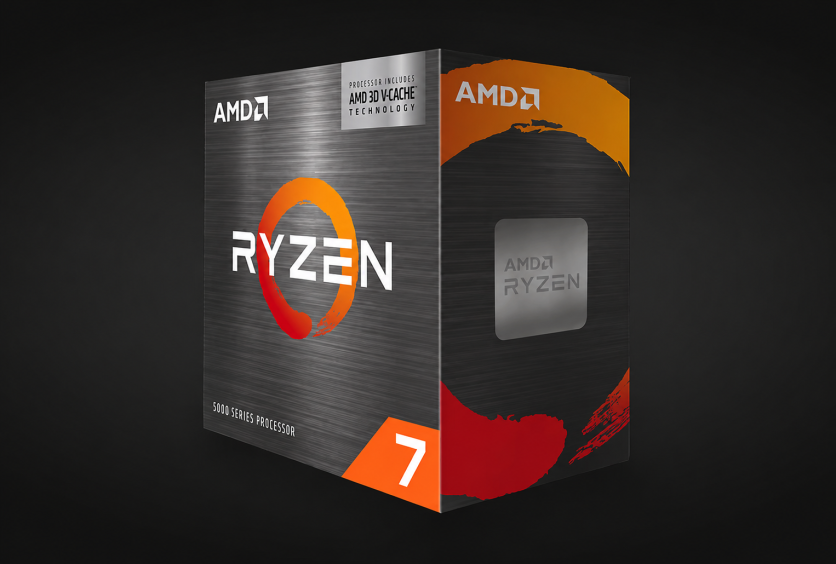
In two weeks, PC builders will be able to buy a factory-new boxed copy of a CPU that first launched in April 2022. AMD's Ryzen 7 5800X3D 10th Anniversary Edition goes on sale June 25 at $349, and the new Ryzen 7 7700X3D for AM5 is scheduled to follow on July 16 at $329. Both are eight-core gaming processors with stacked 3D V-Cache priced under $350, and AMD announced them at Computex 2026 as a direct answer to crisis-priced DDR5 memory, billing the older chip's comeback as the "return of the king."
The decision facing buyers is unusual: which chip to choose, or whether to buy at all, depends less on the silicon than on the memory already sitting in your PC. It also signals something larger about the 2026 market. AMD is now designing product launches around memory economics rather than architecture generations, because for millions of DDR4 owners, the smartest upgrade is the one that lets them skip DDR5 entirely.
Anniversary Edition Keeps 2022 Specs: Eight Zen 3 Cores, 96MB Stacked L3, $100 Price Cut
The revived chip celebrates ten years of the AM4 socket, which debuted in 2016, and its specs are unchanged from 2022: eight Zen 3 cores, 16 threads, a 4.5 GHz maximum boost, 100 MB of combined cache (96 MB of it L3), a 105 W TDP, and a locked multiplier. New are the anniversary packaging and a bundled Carbice Ice Pad, a carbon-nanotube thermal pad previously sold only through CyberPowerPC's build configurator. There is no cooler in the box, and at $349 the chip costs $100 less than its original $449 launch price.
The Ryzen 7 7700X3D is the newer hardware: a downclocked Ryzen 7 7800X3D with the same eight Zen 4 cores, 104 MB of total cache, and 120 W TDP, but a base clock cut from 4.2 GHz to 4.0 GHz and a boost ceiling of 4.5 GHz instead of 5.0 GHz. Its $329 price undercuts the 7800X3D's original $449 by $120, while that chip's street price hovers around $370.
DDR4 Cost Math: $349 Drop-In AM4 Upgrade Avoids $375 DDR5 Memory Tax
Neither launch is nostalgia. With AI datacenters absorbing DRAM wafer capacity, the cheapest 32GB DDR5 kits in the US have hovered near $375, while 32 GB of DDR4 still sells for roughly half that, around $199 at its lowest. A DDR4 owner who wants a current-generation platform must buy an AM5 motherboard plus DDR5 before spending anything on a processor; at mid-2026 prices the memory alone can cost more than the CPU. Dropping a 5800X3D into an existing AM4 board costs $349, total.
Demand for exactly that move broke the used market first. Discontinued 5800X3D chips were fetching up to $800 on resale, nearly double the original MSRP and more than a brand-new Ryzen 7 9800X3D, before AMD committed to a fresh production run.
TSMC SoIC Hybrid Bonding Stacks 64MB SRAM Atop Zen 3 Cores: Cache Beats Clock Speed in Games
The reason a four-year-old design stays competitive is structural. 3D V-Cache bonds a 64 MB SRAM die directly on top of the compute chiplet's existing 32 MB of L3 using TSMC SoIC hybrid bonding, a copper-to-copper process that skips solder microbumps, packs connections at a 9-micrometer pitch, and moves data between the two dies at 2 TB/s. Games hammer the CPU with scattered, latency-sensitive data such as physics, AI routines, and draw calls; when that working set fits in a 96 MB L3 pool, the cores avoid slow round-trips to main memory. That is why X3D chips beat higher-clocked processors in frame rates, and why DDR4's slower speeds barely hurt them: the oversized cache shields the cores from the memory bus.
The same mechanism explains the tradeoffs. The stacked SRAM limits voltage and thermal headroom, which is why the 5800X3D's multiplier stays locked, and why AMD positions structural silicon over the cores to keep cooling even. It also explains the 7700X3D's value proposition: with X3D parts, large clock gaps produce small gaming differences because cache, not frequency, does the heavy lifting, so the chip should land close to the 7800X3D despite its 500 MHz boost deficit.
Is Ryzen 7 5800X3D Still Worth Buying in 2026?
AMD's own numbers, from internal testing across 30-plus games at 1080p High settings, claim the 5800X3D averages 115% higher gaming performance than the Ryzen 7 2700X, 47% higher than the 3700X, and 16% higher than the 5800X. Against Intel, AMD claims the chip is 10% faster on average than a Core i9-14900K when both run DDR4-3600 at 1080p. Tom's Hardware notes the caveat: these are vendor figures, and on DDR5 platforms even a Core i9-13900K outruns the 5800X3D in its benchmark hierarchy. Treat the claims as directional until independent reviews of the new batch land.
Buy 5800X3D for AM4, 7700X3D for New AM5 Builds: Waiting Risks $800 Resale Repeat
The decision tree is unusually clean. Owners of AM4 boards running Ryzen 1000 through 5000-series non-X3D chips with DDR4 they intend to keep get the clearest win: one $349 part, no new RAM, no new board. PCWorld's verdict is that the price is not a spectacular deal at $20 below a 7800X3D, but a sound one for squeezing final value from AM4. Anyone already on a 5800X3D or 5700X3D should skip it; the silicon is identical.
Builders starting fresh should absorb the DDR5 tax and take the 7700X3D, because AMD also extended AM5 platform support through 2029, up from its earlier 2027 pledge, meaning a board bought now should accept future Zen generations via BIOS updates. Two flanking options deserve a look before July 16: AMD's $230 Ryzen 5 7600X3D delivers about 95% of a 7800X3D's gaming performance, and Intel's Core Ultra 7 270K Plus at the same $329 trails X3D chips by roughly 10% in games while more than doubling their application throughput, per Tom's Hardware testing.
Waiting is the weakest play. Analysts expect memory prices to keep climbing into 2027, and the last time 5800X3D supply dried up, the market answered with $800 listings, not discounts.
Re-Engineering Behind Revival: Original TSMC Stacking Process No Longer Exists
AMD says the relaunch was not a matter of restarting an idle production line. The first-generation die-stacking process TSMC used in 2022 was retired when AMD moved to second-generation V-Cache, so engineers had to requalify the design on the newer stacking method, validate fresh sample silicon, and repeat reliability testing. David McAfee, corporate vice president and general manager of AMD's client channel business, called it "a whole body of engineering work" and said plainly: "It's not as simple as bringing back the 5800X3D."
That effort, spent reviving a chip AMD discontinued in 2024, is the clearest signal yet of where the PC market stands. As PCWorld put it, AM4 refuses to die, and when new platforms cost more than buyers will bear, the winning product strategy is the one that lets ten-year-old motherboards fight on. Until June 25, the only question is which side of the DDR4-DDR5 divide your money is on.
Read more: Computex 2026 Sets 45-Year Attendance Record: Agentic AI Buildout Replaces PC Hardware Show
Frequently Asked Questions
When does the Ryzen 7 5800X3D 10th Anniversary Edition go on sale?
It goes on sale June 25, 2026, at a suggested retail price of $349. The box includes a Carbice Ice Pad carbon-nanotube thermal pad but no CPU cooler, so budget for cooling if you do not already have it.
What is the difference between the Ryzen 7 7700X3D and the 7800X3D?
Both have eight Zen 4 cores, 16 threads, 104 MB of total cache, and a 120 W TDP. The 7700X3D runs a 4.0 GHz base and 4.5 GHz boost versus 4.2 GHz and 5.0 GHz on the 7800X3D, and launches July 16, 2026, at $329, about $120 below the 7800X3D's original price.
Do I need a new motherboard or RAM for the 5800X3D Anniversary Edition?
No. It drops into existing AM4 motherboards and works with the DDR4 memory already installed, though older boards may need a BIOS update first. Avoiding a new board and crisis-priced DDR5 is the entire point of the revival.
Why is AMD re-releasing a four-year-old CPU in 2026?
DDR5 prices have roughly quadrupled since mid-2025 because AI datacenters are consuming DRAM wafer capacity, making full platform upgrades unaffordable for many gamers. AMD re-engineered the 5800X3D for a newer TSMC stacking process so the large AM4 installed base can upgrade performance without touching memory or motherboards, a product decision driven by memory economics rather than a new architecture.
ⓒ 2026 TECHTIMES.com All rights reserved. Do not reproduce without permission.


