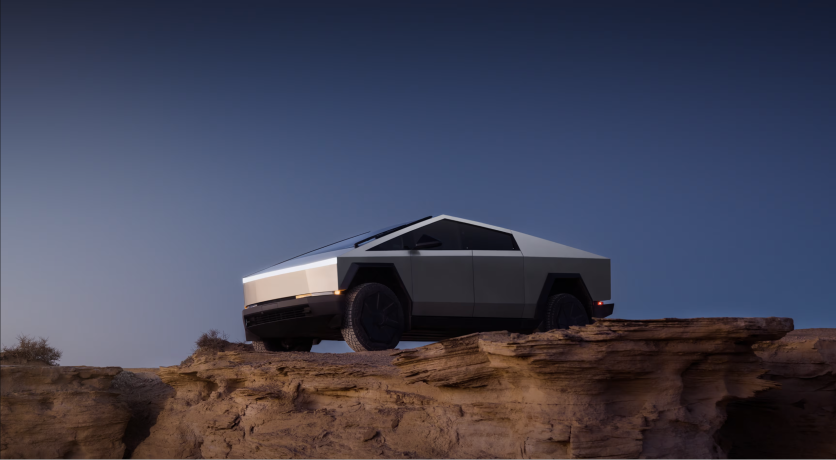
Tesla began pushing software update 2026.14.6.10 to its fleet on June 12, 2026, and Cybertruck owners are receiving a feature they have waited roughly 20 months to get: Actually Smart Summon, the parking-lot autonomous navigation system that drives the vehicle to the owner's location using the Tesla mobile app, is now live on the stainless-steel truck for the first time. The update also delivers the most significant structural upgrade to the FSD stack in months — a ground-up rewrite of the AI compiler using MLIR, the same compiler infrastructure that powers ML workloads for TensorFlow and AMD Ryzen AI hardware, producing a 20% reduction in the neural network's reaction time and accelerating Tesla's internal model iteration speed.
Software version 2026.14.6.10 bundles FSD (Supervised) v14.3.4. For Cybertruck owners specifically, the package delivers both Actually Smart Summon — known in Tesla circles by its acronym ASS — and the simpler Dumb Summon, which moves the truck straight forward or backward via phone without autonomous navigation. For the wider AI4-hardware fleet, the update adds a parking-plan preview interface that shows upcoming parking options on the map overlay and tells drivers where the system intends to park before it commits.
Why Cybertruck Waited 20 Months for Smart Summon
Actually Smart Summon launched for Tesla's sedan and SUV lineup in September 2024. The Cybertruck sat out of that launch and every subsequent ASS update for a technically substantive reason: the truck's hardware introduces an autonomous-control problem that does not exist in any other vehicle Tesla makes.
The Cybertruck is the only vehicle in Tesla's lineup to use a full steer-by-wire system — a design in which no mechanical steering column connects the steering wheel to the front wheels. Instead, sensors capture steering input and transmit it via a redundant Ethernet loop to electric actuators at the rack. The ratio between steering wheel angle and front-wheel response is variable and software-defined, not fixed by a mechanical linkage. At low speeds, the ratio is tuned for tight maneuverability; at highway speeds, it desensitizes to resist overcorrection.
That variability is not the only complication. The Cybertruck also features active rear-wheel steering: at low speeds, the rear wheels turn in the opposite direction from the front wheels, tightening the turning radius and giving a truck of the Cybertruck's size the footprint behavior of a much smaller vehicle. At high speeds, the rear wheels steer in the same direction as the front wheels to improve stability.
For a human driver, these systems are largely invisible. For an autonomous parking-lot navigation model, they mean that the neural network must learn to coordinate four independently controlled wheels — each operating on a different axis of the software-defined steering system — rather than the two-axis problem that governs every other Tesla model. Any deviation in the low-speed control surface translates directly to obstacle-clearance errors during the precise, low-margin maneuvers that ASS performs: reversing out of angled stalls, executing tight turns around corners, arriving cleanly at a pickup point.
Unified Model Was the Key: One Network for Summon, FSD, and Robotaxi
The architectural shift that made the Cybertruck port possible was not v14.3.4 itself — it was v14.3.2, released on April 23, 2026. That update unified ASS, highway FSD, and the Austin Robotaxi service into a single shared end-to-end neural network. Before v14.3.2, those three systems ran on separate model branches, each trained on different data, each requiring independent maintenance.
The unification means that training data cross-pollinates in real time. When Tesla's roughly 20 unsupervised Austin Robotaxi vehicles encounter an edge case — a partially-obstructed intersection, an unexpected pedestrian path — and the system learns to handle it, that learning immediately improves the weights governing consumer ASS maneuvers, and vice versa. Engineers also reduce overhead: rather than patching three model branches, updates to the single shared model improve all three capabilities simultaneously.
For the Cybertruck, the unified model appears to have cleared the path in a specific way. Once Tesla had accumulated sufficient real-world data from Cybertruck's four-wheel coordination behavior on highway FSD, and from the wider fleet's ASS encounters, the shared model had the context it needed to be adapted for ASS on a steer-by-wire, four-wheel-steering platform. The v14.3.4 release notes confirm that the unified model is now active on Cybertruck for the first time.
MLIR: Tesla Rewrites the Compiler That Runs Its Neural Network
Beyond the feature additions, v14.3.4's most structurally significant change is invisible to drivers: Tesla rewrote the AI compiler and runtime that transforms the FSD neural network's high-level model architecture into the optimized machine code that actually runs on the car's onboard computer. The rewrite was done from scratch using MLIR — Multi-Level Intermediate Representation — an open-source compiler framework developed as a sub-project of the LLVM project. Originally created to address compilation challenges for modern ML workloads, MLIR today underpins TensorFlow's XLA compiler at Google and AMD's Ryzen AI compilation pipeline, among others.
MLIR's core advantage for a system like FSD is its support for multiple levels of abstraction in a single compiler pipeline. Rather than forcing the neural network's operations through a single fixed-level representation, MLIR allows Tesla's compiler team to express computations at the level most appropriate for optimization — from graph-level neural network operations down to hardware-specific machine code — without losing the high-level semantic information that enables the most aggressive performance optimizations. The result, according to the official release notes, is a 20% improvement in reaction time: the gap between the car's cameras capturing a scene and the model issuing a steering or braking command.
The reaction-time gain matters because FSD operates at the edge of driver expectations. A 20% reduction in inference latency means the system responds to a pedestrian stepping off a curb, or a parking gate beginning to close, measurably faster than before. The second benefit the release notes cite — improved model iteration speed — is the longer-term payoff: because MLIR produces optimized code faster than Tesla's previous ad-hoc compiler, the engineering team can test a new model architecture, evaluate it, and ship a corrected version in a shorter cycle. That acceleration compounds across every subsequent OTA release.
One Limitation: Cybertruck ASS Tops Out at 6 mph
There is one early-adopter catch that Cybertruck owners should note. When FSD v14.3.3 shipped last month, it raised ASS's maximum operating speed from 6 mph to 8 mph — a roughly 33% increase that testers said made low-speed parking-lot maneuvers look significantly more natural and human-like. That specific speed increase is absent from the v14.3.4 Cybertruck release notes. The Cybertruck's ASS, in its debut version, is therefore capped at 6 mph — the original fleet limit — while the rest of Tesla's lineup runs at 8 mph.
This is consistent with how Tesla has historically validated new platform integrations: accumulate real-world miles, then incrementally unlock capabilities once sufficient data confirms safety margins. The speed gap between Cybertruck's debut ASS and the fleet standard is expected to close in a future update as the truck's ASS accumulates real-world miles on its distinct steering platform.
The regulatory backdrop for ASS generally is clear. The National Highway Traffic Safety Administration opened an investigation into ASS low-speed crashes in January 2025, covering 2.6 million vehicles. By April 3, 2026, the agency closed that investigation: of the 159 reported incidents, all involved minor property damage, and none resulted in injuries or fatalities. The closure came via OTA remediation — the same delivery mechanism that brings v14.3.4 to the fleet today.
Parking Plan Preview and UI Changes Come Fleet-Wide
Beyond the Cybertruck headline, v14.3.4 delivers UI updates to the full AI4-equipped fleet. Parking options now appear on the map overlay when approaching a destination, and a new on-screen prompt tells the driver precisely where FSD intends to park before committing. The approach mirrors the transparency philosophy of commercial robotaxi services, where riders can see a vehicle's intended path before it executes.
The update also refines behavioral tendencies identified in earlier versions: unnecessary lane biasing and minor tailgating behaviors have been mitigated, parking spot selection is more decisive, and the parking location pin now appears on the map as a "P" icon, giving drivers a visual confirmation of where the system is targeting before they need to look away from the road.
👉 Read more: 318160 Tesla Robotaxi vs Waymo Austin Fleet
Fleet Parity and the Robotaxi Road Ahead
The Cybertruck's ASS addition closes the most visible remaining gap in Tesla's fleet-wide ADAS feature parity. That matters in the context of Tesla's broader autonomous-vehicle strategy. With the Austin Robotaxi service now covering the full metro area and Tesla expanding to additional cities, consistent software capability across every platform in the fleet is a prerequisite for the unified training data pipeline that improves all systems simultaneously.
A Cybertruck that could not summon itself was a gap in that story — its platform-specific characteristics were underrepresented in the shared model's training data. As of today's rollout, that gap is closed, and the truck begins contributing its own steer-by-wire, four-wheel-steering edge cases to the same model that governs every Tesla FSD interaction, from a consumer calling their car in a parking lot to a driverless Model Y picking up passengers in Austin.
Frequently Asked Questions
What does Actually Smart Summon do on the Cybertruck?
Actually Smart Summon allows Cybertruck owners to use the Tesla mobile app to call their truck to their location in a parking lot, or to send the truck autonomously to a parking spot, without the driver being in the vehicle. The feature, available on Tesla's sedan and SUV lineup since September 2024, arrives on the Cybertruck for the first time with the v14.3.4 update shipping June 12, 2026. Dumb Summon, a simpler version that moves the truck straight forward or backward without autonomous navigation, is also included.
What's new in Tesla FSD v14.3.4?
FSD v14.3.4 delivers Actually Smart Summon and Dumb Summon for the Cybertruck, a new parking-plan preview interface for the full AI4 fleet, a ground-up rewrite of the AI compiler and runtime using the MLIR framework that cuts neural network reaction time by 20%, upgraded reinforcement learning training for the vision encoder, and behavioral refinements including reduced lane biasing and more decisive parking spot selection.
How fast does Tesla Smart Summon go on the Cybertruck?
In its debut version on the Cybertruck, Actually Smart Summon is capped at approximately 6 mph — the original fleet maximum from the September 2024 launch. The rest of Tesla's lineup received an 8 mph increase with v14.3.3 last month, but that specific change is not reflected in the Cybertruck's v14.3.4 release notes. Tesla has historically unlocked speed limits incrementally as platform-specific data accumulates, so the Cybertruck's cap is expected to increase in a future update.
Why did the Cybertruck take 20 months longer than other Teslas to get Smart Summon?
The Cybertruck's complete steer-by-wire system, paired with active rear-wheel steering, creates a more complex low-speed control problem than any other vehicle in Tesla's lineup. At low speeds, the rear wheels turn opposite to the front wheels, and the steering ratio between wheel input and front-wheel response is variable rather than fixed by a mechanical linkage. Tesla's FSD neural network had to learn to coordinate four independently controlled wheels within the truck's obstacle-clearance margins before ASS could operate safely. The architectural shift in v14.3.2 — unifying the ASS, FSD, and Robotaxi models into a single shared network — accumulated the cross-platform data needed to enable the port.
ⓒ 2026 TECHTIMES.com All rights reserved. Do not reproduce without permission.


