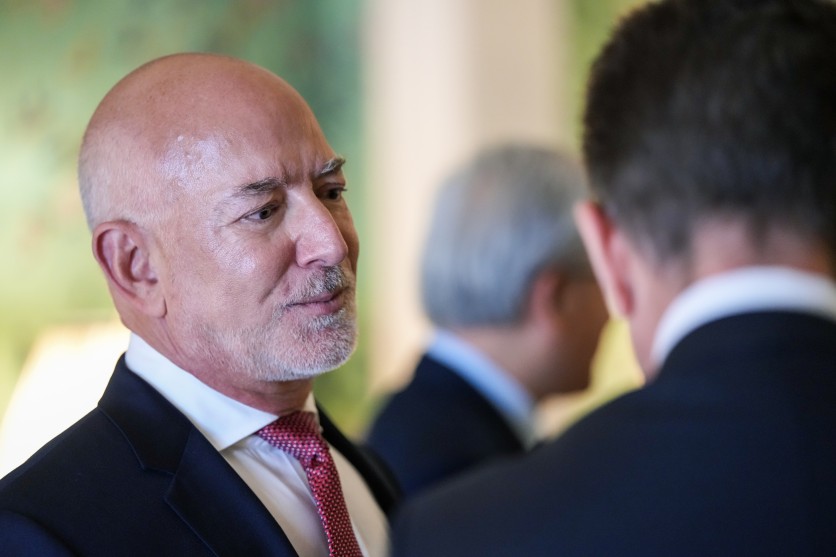
Jeff Bezos's secretive industrial-AI startup Prometheus has raised $12 billion in a Series B round at a valuation of roughly $41 billion, one of the largest single bets ever placed on so-called physical AI. The company, co-led by Bezos and Stanford scientist Vik Bajaj, announced the round on Thursday, June 11, 2026, and the two co-CEOs appeared together publicly for the first time in a CNBC interview at the startup's San Francisco headquarters.
The new capital came from Bezos himself plus a roster of heavyweight financial institutions: JPMorgan, BlackRock, Goldman Sachs, DST Global, and Arch Venture Partners, according to Axios. It is the second major raise for a company that launched late last year with $6.2 billion in initial financing, pushing total funding past $18 billion in roughly seven months.
For readers, the story is not just the dollar figure. Prometheus is building what Bezos calls an "artificial general engineer," AI software meant to compress the slow, expensive cycle of designing and manufacturing physical objects, from jet engines and chips to bridges and drug compounds. If it works, it could reshape how the physical economy invents things, and it stands as a direct counter-thesis to the idea that AI's next frontier is purely digital.
What exactly did Prometheus raise, and who backed it?
The Series B totals $12 billion at a valuation of roughly $41 billion, GeekWire reported from the CNBC interview conducted by David Faber. Bezos was the largest backer of the company's $6.2 billion Series A, and he confirmed he participated in the new round as well.
"This is a capital-intensive startup, there's no question about that," Bezos said, citing the cost of compute and of building the specialized training data the company needs. Asked about an eventual IPO, he said it is "too early to think about that."
The company, which has quietly dropped "Project" from its name, employs about 150 people, based in San Francisco with teams in London and Zurich. It has recruited talent from OpenAI, Google DeepMind, and Nvidia. The co-CEOs declined to give a product timeline, saying only that early rollouts are coming.
Notably, Prometheus has no corporate ties to Amazon or Blue Origin. Bezos remains Amazon's executive chairman and largest individual shareholder, and he funds Blue Origin largely by selling Amazon stock. This time, outside investors are chipping in. Prometheus, Bezos has said, "deserves a dedicated team that is obsessed with this one thing."
What is an "artificial general engineer," and how is it different from a chatbot?
This is where the story gets technically interesting. A large language model like ChatGPT predicts the next token in a stream of text. It is trained on the public internet and optimized to produce plausible language. An "artificial general engineer," as Prometheus frames it, is a different kind of system, one that must reason about the physical world, where the ground truth is set by physics, materials science, and manufacturing constraints, not by what reads well.
Bajaj used the example of a jet engine, which he called one of the most technically sophisticated and creative acts humans accomplish. Designing, prototyping, and manufacturing one can take teams of engineers a decade or more. "What has changed in the last few years is the ability to formulate even something as complicated as that, from design to manufacturing, as an end-to-end AI problem," Bajaj said, per TechCrunch.
Treating engineering as an end-to-end AI problem is far harder than text generation. It requires models trained on physics simulations, computational fluid dynamics, finite-element stress analysis, materials data, and real manufacturing tolerances, much of which does not exist as clean, labeled, scrapeable data. That is why Bezos repeatedly stresses "specialized training data" and "compute" as the two big cost drivers, and why he indicated a large portion of the capital will go toward the company's enormous compute needs. The hard part is generating or simulating data that reflects how a part actually behaves when built, then closing the loop so the model learns from physical outcomes rather than from text.
Why does compressing the design cycle matter?
The promise is speed. If an AI can run millions of simulated design iterations, check them against physical constraints, and propose manufacturable solutions, the invention cycle could shrink from years to months. That is the bet investors are underwriting at $41 billion.
It also explains why Bezos is reportedly exploring an affiliated fund, said to be as large as $100 billion, to buy manufacturing companies. He told CNBC that Prometheus may buy parts of companies that could benefit from its technology and help them improve their manufacturing processes, turning the AI from a tool into an operating advantage across real factories.
Is this part of a bigger "physical AI" trend?
Yes. At $41 billion, Prometheus is among the most richly valued AI startups ever funded and one of the largest single bets on physical AI. Venture capitalists have been pouring money into the sector, which founders argue is more defensible than pure software because, as TechCrunch put it, the physical world creates moats that code alone cannot. Building a working jet-engine designer requires proprietary data, simulation infrastructure, and manufacturing relationships that are hard to replicate.
The round lands during a fevered stretch for AI financing, days before the SpaceX IPO. Bezos said he would be "watching along with the rest of you."
What does Bezos say about jobs?
Bezos pushed back on fears that automating engineering will destroy jobs. He argued AI's productivity gains will instead create what he calls "labor scarcity," a world where demand for human workers outpaces supply.
"Significant productivity in the economy is going to raise the standard of living," he said. "People who today have two-earner households, they'll become one-earner households. Maybe some people who are working overtime will stop working overtime." The framing is striking given that Amazon, under CEO Andy Jassy, has laid off tens of thousands of workers over the past year as it accelerates its own automation push.
On why the founders chose to speak now after months of secrecy, Bezos was blunt: the story was "kind of leaking out," and "if you let that just be a complete void, they'll fill it with nonsense." He described his own arc from founding investor in late 2024 to full-time co-CEO, his first chief-executive role since stepping down from Amazon in 2021. "It is a grind, but it's a good grind," he said.
With $18 billion raised, roughly 150 employees, and a goal of building an artificial general engineer, Prometheus is making a multibillion-dollar wager that the next great AI breakthrough will be measured in jet engines and drug molecules, not words. Whether the technology can deliver, and on what timeline, remains the open question.
Frequently Asked Questions
How much did Prometheus raise, and at what valuation?
Prometheus raised $12 billion in a Series B round at a valuation of roughly $41 billion, announced June 11, 2026. Combined with its $6.2 billion launch round late last year, total funding now tops $18 billion.
Who is behind Prometheus, and who invested?
The company is co-led by Jeff Bezos and Stanford scientist Vik Bajaj, a Verily co-founder. Investors in the Series B include JPMorgan, BlackRock, Goldman Sachs, DST Global, Arch Venture Partners, and Bezos himself.
What is an "artificial general engineer"?
It is Prometheus's term for AI that designs and helps manufacture complex physical products, from jet engines to drug compounds, by treating the full design-to-manufacturing pipeline as an end-to-end AI problem, rather than generating text like a chatbot.
Does Prometheus have ties to Amazon or Blue Origin?
No. Bezos has said the venture has no corporate ties to either and "deserves a dedicated team that is obsessed with this one thing." It has about 150 employees across San Francisco, London, and Zurich.
ⓒ 2026 TECHTIMES.com All rights reserved. Do not reproduce without permission.


