A peer-reviewed rebuttal published Friday in the Monthly Notices of the Royal Astronomical Society has formally resolved one of cosmology's most disruptive recent controversies: the universe is still expanding at an accelerating rate, dark energy still exists, and the measurements that earned three physicists the Nobel Prize are still correct.
The new paper — led by Dr. Phil Wiseman of the University of Southampton and co-authored by Nobel laureates Professor Adam Riess and Professor Brian Schmidt — identifies two specific methodological errors in a 2025 study by Junhyuk Son and colleagues at Yonsei University in Seoul that had claimed dark energy was weakening and cosmic expansion was slowing down. When both errors are corrected, the evidence for an accelerating universe returns fully intact.
"The previous and well accepted measurements were, in fact, fine and our current understanding of the fate of the universe remains robust," Wiseman said. "Thankfully we have averted this crisis, but the mystery about why the universe is still accelerating in size remains."
What the 2025 Study Claimed
In November 2025, the Yonsei University team published findings in the same journal arguing that Type Ia supernovae — the stellar explosions used as cosmic distance markers — grow systematically brighter as the universe ages. If true, that brightness shift would cause astronomers to falsely conclude that the universe was accelerating when it was actually slowing down. The paper's authors described the effect as an uncorrected "progenitor age bias," and claimed it was large enough to overturn nearly three decades of cosmological consensus.
The study generated wide coverage and genuine alarm among cosmologists. Lead researcher Professor Young-Wook Lee of Yonsei University described it as potentially marking "a major paradigm shift in cosmology since the discovery of dark energy 27 years ago."
How Type Ia Supernova Cosmology Actually Works
To understand why the 2025 study was wrong, it helps to understand the measurement pipeline it mishandled.
Type Ia supernovae occur when a white dwarf star in a binary system draws material from a companion until it crosses the Chandrasekhar mass limit — roughly 1.4 times the mass of the Sun — at which point it ignites in a runaway thermonuclear explosion. Because the triggering mass is always approximately the same, the explosions produce consistent peak brightness. Astronomers use this consistency to turn each Type Ia supernova into a "standard candle": by comparing how bright it appears from Earth against how bright it actually is, they can calculate exactly how far away it is.
That calculation gives cosmologists a precise map of how quickly the universe was expanding at different points in history. When Riess and Schmidt's teams applied this method in 1998 using roughly 50 supernovae, they found that distant supernovae were dimmer than expected — meaning they were farther away than a decelerating universe would predict. The universe, they concluded, was not slowing down. It was speeding up. The discovery earned Riess, Schmidt, and Saul Perlmutter the 2011 Nobel Prize in Physics.
But Type Ia supernovae are not perfectly identical. Over the past two decades, cosmologists have established that their brightness correlates with the mass of the galaxy they explode in — a well-documented but poorly understood relationship known as the "host galaxy mass step." Standard modern analyses of supernova cosmology apply a host-mass correction to adjust for this correlation, ensuring that the systematic brightness difference between supernovae in massive galaxies and those in lighter galaxies does not bias distance measurements.
Two Errors That Collapsed a Cosmological Controversy
The Wiseman et al. paper found that the 2025 Yonsei study made two critical mistakes when it claimed to identify a new age-related bias.
The first error was conceptual. The Son et al. analysis treated the age of a host galaxy as equivalent to the age of the star that eventually exploded as a supernova. These are not the same thing. A white dwarf progenitor is always younger than the galaxy that surrounds it — galaxies contain stellar populations of many different ages — and the relationship between galaxy age and progenitor age itself changes with redshift. Using the galaxy's age as a proxy for the exploding star's age introduced a systematic distortion into every distance estimate in the analysis.
The second error was procedural. The Yonsei team did not apply the standard host-galaxy mass correction routinely used in modern supernova cosmology. Because galaxy mass and galaxy age are highly correlated, the mass correction already applied in standard analyses accounts for most of the age-related variation the 2025 paper claimed to have found. Once that correction was applied to the Yonsei data, the paper found no remaining dependence of standardized supernova brightness on host age.
Once both corrections were applied, the purported age bias vanished. The evidence for cosmic acceleration was fully restored.
Professor Adam Riess said the supernovae hold up firmly once calibrated correctly. "Extraordinary claims require especially careful testing. What we find is that when we calibrate these supernovae, accounting for different host environments and populations, the evidence for cosmic acceleration remains remarkably consistent."
What This Episode Reveals About Supernova Science
Professor Mark Sullivan, also of the University of Southampton, emphasized that the episode, however alarming in the press, was scientifically productive. "This is how progress is made," he said. "Although this idea did not turn out correct, it has opened up new ways of thinking about how supernovae explode and how we can measure dark energy more accurately."
Co-author Dr. Brodie Popovic noted that the controversy provided an opportunity to stress-test the assumptions underpinning the standard cosmological pipeline. "We've recently been really focused on astrophysics of the explosions and how they impact cosmology. This was a good opportunity to go back and go over all of our assumptions — it turns out, yes, we do understand this stuff and we're accounting for it in our cosmology measurement."
What the episode does not resolve — and what cosmologists are candid about — is the deeper question the host-mass correction raises. The empirical relationship between supernova brightness and host galaxy mass is well established and universally applied. But the physical mechanism behind it remains unclear. Astronomers are not certain whether the correlation is driven by galaxy age, metallicity, star formation history, or some combination of all three. The correction works in practice, but the field is still working out exactly why.
What Dark Energy Is, and Why Its Mystery Remains
The ΛCDM model — Lambda Cold Dark Matter — is the standard framework of modern cosmology. It holds that roughly 68 percent of the universe's total mass-energy consists of dark energy, represented mathematically by the cosmological constant (Lambda) in Einstein's field equations. Dark matter accounts for approximately 27 percent, and ordinary matter — everything visible, from stars to galaxies to people — makes up the remaining 5 percent.
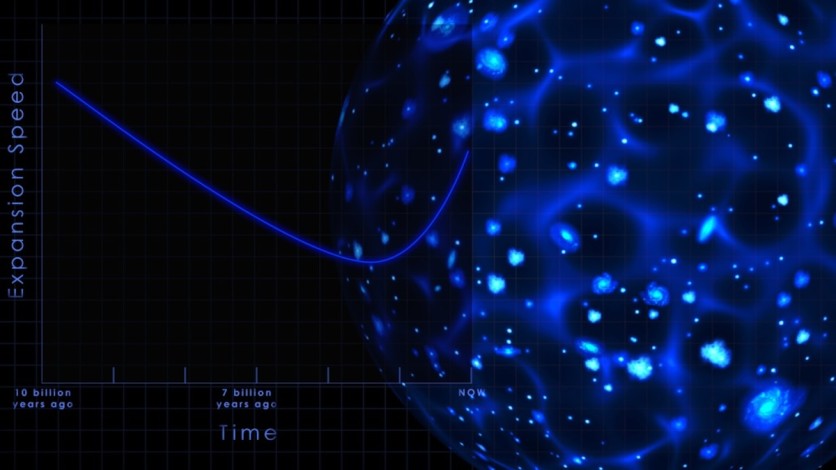
The Wiseman et al. paper means cosmologists do not need to revise the 1998 discovery that earned Riess, Schmidt, and Perlmutter their Nobel Prize. The universe began accelerating its expansion roughly five billion years ago. Nothing in the evidence suggests that has changed.
What remains entirely unresolved is why. Dark energy is the label cosmologists use for whatever is causing the acceleration; it is not an explanation. Physicists do not know whether it is a true cosmological constant — a fixed energy density inherent to empty space — or a dynamic quantity that changes over time. A separate mathematical challenge published in the Proceedings of the Royal Society A in May 2026 by Blake Temple of the University of California, Davis, argued that the acceleration might arise from instabilities in the Einstein-Euler equations without requiring dark energy at all. That argument is unrelated to the Son et al. supernova controversy and remains under active scientific debate.
"By proving our measurements are correct," Wiseman said, "we can get back to trying to understand what dark energy actually is, rather than wondering if it exists at all."
Frequently Asked Questions
Is the universe still expanding and accelerating?
Yes. The paper published Friday in the Monthly Notices of the Royal Astronomical Society, authored by Dr. Phil Wiseman and Nobel laureates Adam Riess and Brian Schmidt, confirms that the evidence for cosmic acceleration remains intact when standard methodological corrections are properly applied. The universe began speeding up its expansion roughly five billion years ago, and no credible evidence indicates that has changed.
What two errors did the 2025 South Korean study make?
The Son et al. paper from Yonsei University made two methodological mistakes. First, it treated the age of a host galaxy as equivalent to the age of the star that exploded as a supernova — a conflation that does not hold, since progenitor stars are always younger than the galaxies that contain them. Second, the analysis failed to apply the standard host-galaxy mass correction, a routine adjustment in modern supernova cosmology that accounts for the known correlation between supernova brightness and host galaxy stellar mass. When both corrections are applied, the evidence for cosmic acceleration returns fully.
How do scientists use supernovae to measure the universe's expansion?
Type Ia supernovae occur when white dwarf stars reach a fixed mass threshold and explode with consistent peak brightness, making them reliable distance markers across cosmic scales. By comparing a supernova's actual brightness to how bright it appears from Earth, astronomers calculate its distance. Comparing distances at different redshifts maps out the universe's expansion history. This technique — refined with corrections for light-curve shape, color, and host galaxy mass — revealed in 1998 that the expansion is accelerating, a discovery that earned Riess, Schmidt, and Perlmutter the Nobel Prize in Physics.
Why does the mystery about dark energy remain even after this result?
The Wiseman et al. paper confirms that cosmic acceleration is real and that current measurements of it are reliable — but it does not explain what is causing the acceleration. Dark energy is the name given to the unknown force responsible, but physicists do not yet know whether it is a fixed property of empty space — a cosmological constant — or a dynamic field that evolves over time. Separate, ongoing research programs are exploring both possibilities, and a May 2026 mathematical challenge from UC Davis argues the acceleration may arise from the Einstein-Euler equations themselves without requiring dark energy at all.
ⓒ 2026 TECHTIMES.com All rights reserved. Do not reproduce without permission.


