
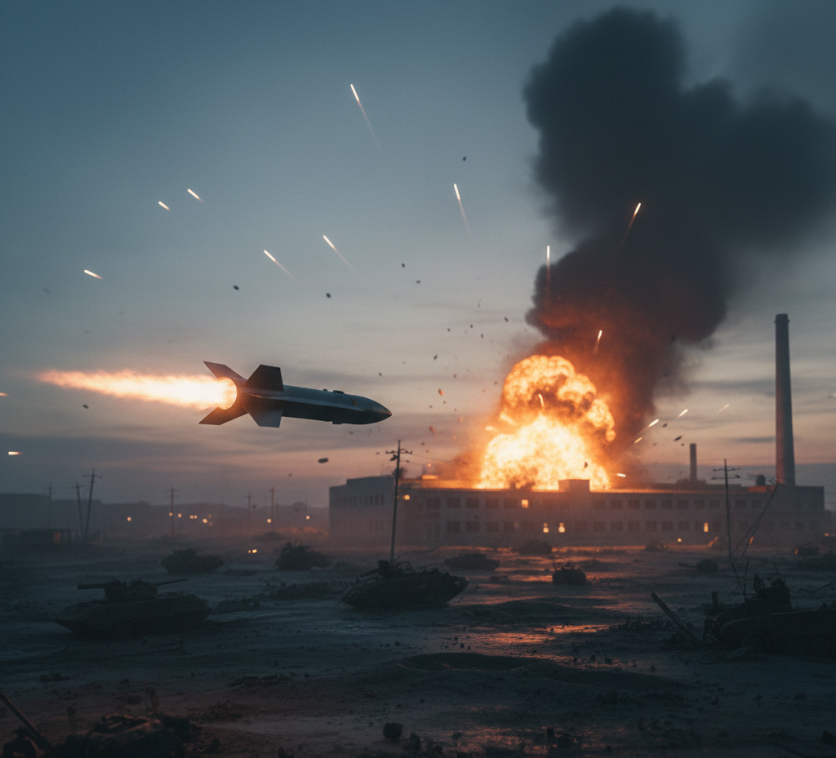
After analysing growing trends in the defence market, Sidney Dean, writing for European Security & Defence, observes that the conflict in Ukraine and the return of war amongst world powers has led to increased demand for long-range rocket artillery that can strike targets at a distance of 70km+, "suitable to neutralising high-value, time-critical targets at extended range." Although referring to land forces, the reality shows this statement also applies to the entire joint spectrum...
Indeed, growing demand for long-range, "stand-off" capabilities also covers air and naval combat, and includes deep precision strikes (DPS) targeting high-value targets (HVT) in enemy territory. Arms manufacturers are thus increasing efforts to meet the needs of armed forces: to destroy enemy capabilities within the theatre of war, as inexpensively as possible, whilst minimizing risks to expensive platforms/vectors confronting increasingly sophisticated air defence (multi-layered, electronic warfare, short/medium-ranged defence missiles and anti-access systems). But also, as the Ukrainian war demonstrates, when neither side can break through the front line, to allow them to fire far outside that area to regain an edge.
Munitions Reaching Farther
Researchers from Istituto Affari Internazionali (IAI) observe that, long-range fire capabilities "are a crucial instrument in land warfare as they are able to carry out a number of essential tasks on the battlefields without having to come within range of most enemy artillery: suppression of enemy fires, striking enemy high-value targets; breaking up enemy force concentrations; and providing fire support to enable manoeuvre."
President Zelensky has repeatedly asked Western powers, with more or less success, for such capabilities (American Tomahawks, German Taurus, and more SCALP/Storm Shadows, even in limited quantities) because of the strategic implications of their deployments in terms of co-belligerence. Nonetheless, the imperative to give Ukraine significant reach has resulted in regular deliveries of HIMARS multiple rocket launchers capable of firing ATACMS with ranges of 160-300 km, depending on the version. This has enabled Ukraine to force Russia to push back command and control centres, logistics hubs, and weapons storage. These experiences have convinced defence decision-makers that today's effectors and munitions must reach farther—especially in European countries that currently lack such capabilities and envision a potential Russian attack. Between products coming to market and innovations under development, the European Defence Technological and Industrial Base is multiplying offers across all engagement domains.
...By Sea
At the end of September, Britain's Royal Navy announced the completed first test fire of its updated Naval Strike Missile (NSM), designed to destroy enemy vessels at a range of 160km. Luke Pollard, UK Minister for Defence Readiness and Industry, said, "The NSM is one of the most advanced missiles in our naval arsenal. It will give the Royal Navy and our allies an edge against our enemies." Also used by Norwegian, Polish, and US navies, the NSM is made by Norwegian Kongsberg Defence & Aerospace and is an "interim" capability until the STRATUS programme (formerly FC/ASW) comes to fruition.
The UK and France launched the initiative in 2022 (Italy later joined), commissioning MBDA to develop missiles to replace the Harpoon anti-ship missile, Exocet, and Storm Shadow cruise missiles. At DSEI 2025, the company revealed it was entering the development phase of the programme and displayed models for the stealthy STRATUS-LO (low observable) and STRATUS-RS (rapid strike) missiles. By 2030, the complementary missiles should provide countries with "a versatile capability mix that can conduct deep-strike missions, engage warships, suppress and destroy enemy air defences, and neutralize high-value targets" from the sea or air (and possibly by land).
...By Air
From an air-launched land-attack perspective, STRATUS will replace the Storm Shadow (SCALP in French) missiles equipping fighter jets that recently made headlines in Ukraine and in India last May when Indian Armed Forces conducted a precision strike campaign "designed to neutralize militant strongholds without breaching Pakistani airspace—an approach meant to minimize escalation while delivering strategic punishment." The strikes also used HAMMER bombs (Safran Electronics & Defense) that use modular guidance and propulsion kits for accuracy and long-range. These were recently redesigned to increase range from 70km to 150-200km following feedback from the French Air and Space Force that 70km "is no longer considered sufficient to keep its own aircraft outside the effective zone of modern enemy air defenses."
As hostilities between India and Pakistan demonstrated, air dominance is also being pursued in the perspective of air-to-air engagements, through farther-reaching beyond-visual-range (BVR) air-to-air missiles (AAMs) designed to destroy high-value aerial assets (fighters, electronic warfare platforms, tankers, etc). The Pakistan Air Force used PL15 BVR missiles, whose export version reaches 145 km, whilst India deployed European-made Meteor missiles with a range of 200km.
...By Land
Although the media often focuses on drones, a key lesson learned from Ukraine is that artillery remains king in high-intensity battles. This observation has profoundly renewed Western military leaders' interest in a capability they largely ignored during expeditionary operations over the past 30 years, whilst extensively relying on air supremacy.
Since 2024, the US has pursued further-reaching, self-propelled 155mm howitzers. The War Zone says, "Extending the range of howitzers has the two-fold effect of expanding the area they can hit from wherever they might be deployed and, by extension, helping to keep them further away from enemy artillery units and other potential threats." After successful use in Ukraine, Caesar Mk2 howitzers, made by German/French KNDS, are said to be a top contender, but South Korea's Hanwha Aerospace will test a new variant of its K9 Thunder self-propelled howitzer in 2026 with a 58-caliber gun barrel (most are 52), almost doubling its range. Hanwha explains, "The longer-range system is intended to meet growing demand for high-mobility, long-range artillery as modern armies adapt to faster, more networked combat environments."
Deep Strikes: European Priority
Washington's vacillation over delivering Tomahawk missiles to Ukraine highlights the relevance of including deep strike capabilities as one of the seven priorities in the European Defence White Paper (March 2025), and has prompted Europe's leaders to mobilise. In October, Emmanuel Chiva, Chief Executive of France's Defence Procurement Agency (DGA), met Swedish delegates, including Defence Minister Pål Jonson and Mikael Granholm, Director of the Defence Material Administration. They agreed to increase cooperation on common defence, including DPS through the European Long-Range Strike Approach (ELSA). ELSA began in 2024 with Poland, France, Germany, and Italy (Sweden, the UK, and the Netherlands joined after) with Guido Crosetto, Italy's Defence Minister, saying, "Today's initiative lays the foundations for long-term integrated cooperation between our nations to strengthen European defence and deterrence capabilities by developing the sector's industrial base."
Amongst the "best athlete" project proposals for ELSA is MBDA's Land Cruise Missile (LCM) system, which offers a fully European alternative to the famous Tomahawks. Evolved from the battle-tested Naval Cruise Missile (NCM/MdCN), the 1000km+ LCM model was displayed at the 2025 Paris Air Show, with test firing planned for 2027/2028. Being able to have the same ammunition fired from land and sea (like the LCM/NCM) could offer both operational advantages (consistency of multidirectional strikes) and acquisition and maintenance economies for the acquiring country or group of countries. This is true for all defence equipment, but particularly useful when choosing arms filling priority capability gaps.
Europe's DTIB either already offers or is currently developing industrial solutions for all segments of the long-range market, amongst which DPS is a priority. Upon joining ELSA, Pål Jonson, Sweden's Defence Minister, said, "We joined this project a few weeks ago. Now our ambition is deepened interaction between our government agencies, but also the industry as well, as it depends on our partners and the other countries." Given the current geopolitical urgency,the joint acquisition of rapidly available sovereign capabilities is crucial and now depends on constant political involvement that overrides national political instability.
ⓒ 2026 TECHTIMES.com All rights reserved. Do not reproduce without permission.


