

At CES 2026, Xtand avoided the usual playbook of static displays and spec-heavy signage. Instead, its North Hall booth functioned more like a live testing lab. Attendees weren't just watching demos—they were stepping onto treadmills, dropping into squats, and running through lunges while wearing the company's Intelligent Patella Strap.
The effect was immediate. Movement attracts attention, and Xtand's booth stayed active throughout the day as people queued up to try the device. Media and creators gathered to film real-time reactions, while passersby lingered longer than planned, trying to understand how a knee support could actively respond to motion rather than simply apply constant compression.
The launch event itself reinforced that idea. Opening remarks led into a keynote by Prof. Yu Sun, a robotics and biomechanics expert, who framed the product within a broader shift in wearable technology. His talk focused on the limitations of traditional knee supports—passive devices that resist movement—and the growing role of intelligent systems that interpret intent, load, and motion as they happen.

From Keynote Theory to Real-World Movement
That conceptual framing translated directly onto the show floor. The Intelligent Patella Strap uses motion recognition to continuously monitor knee movement and adjust internal air pressure dynamically. Support increases during moments of strain or instability and relaxes when it's no longer needed.
What stood out during demos wasn't just that the system worked, but how little it interfered with natural motion. Testers moved normally—no exaggerated posture, no visible stiffness—even during deeper squats or faster treadmill walking. Several attendees commented that the strap felt "invisible" compared to traditional braces.
The constant activity created a feedback loop: movement drew crowds, crowds prompted questions, and questions led to more demos. Xtand's team spent much of the day explaining how quickly the strap responds to changes in motion and why adaptive support can be more comfortable over long wear than static compression.
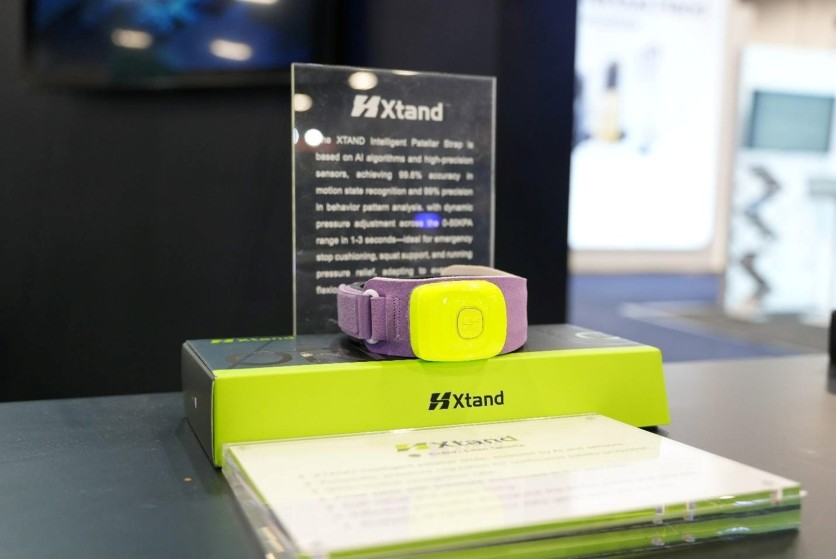
What the Intelligent Patella Strap Is — and Isn't
Rather than positioning the strap as a futuristic gimmick, Xtand emphasized practical use cases: everyday movement, training, and extended wear. The demos helped clarify what the product is designed to do—and what it deliberately avoids.
What the Intelligent Patella Strap does:
- Continuously monitors knee movement using AI-based motion recognition
- Adjusts internal air pressure dynamically instead of applying a constant force
- Responds within seconds as movement patterns change
- Maintains a lightweight, low-profile form factor suitable for long wear
What it doesn't try to be:
- A rigid medical brace
- A bulky wearable that restricts movement
- A "set-it-and-forget-it" compression strap
- A replacement for natural strength or mobility

That distinction mattered at CES, where many wearables promise transformation without clearly fitting into daily life. Xtand's approach felt narrower but more grounded: support the knee when needed, stay out of the way when not. By the end of the launch window, the booth's steady traffic suggested the message resonated. In a crowded wearable tech landscape, Xtand's CES showing offered a reminder that sometimes the fastest way to explain a product isn't a slide deck—it's a treadmill.
ⓒ 2026 TECHTIMES.com All rights reserved. Do not reproduce without permission.


