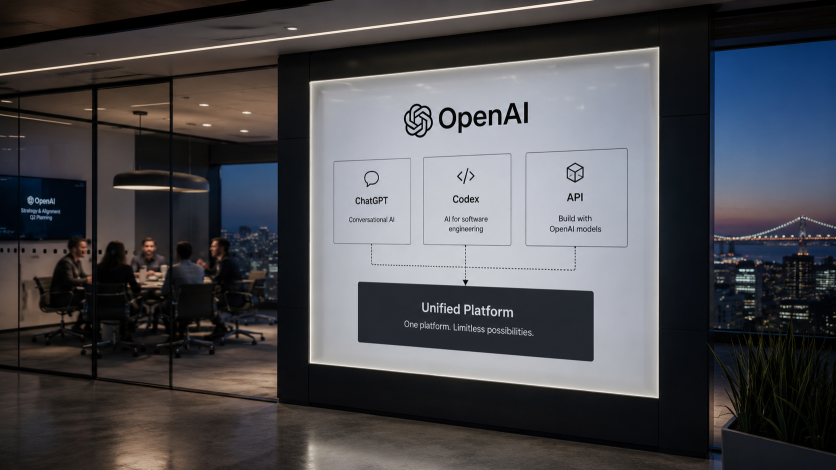
OpenAI told employees on Friday that co-founder and president Greg Brockman will permanently lead all product strategy, merging ChatGPT, Codex, and the developer API into one organization — a structural overhaul timed three days before Google I/O 2026 opens on May 19 and framed explicitly around a prospective initial public offering that analysts expect before the end of the year. The move affects how 900 million weekly ChatGPT users will interact with OpenAI's tools and determines whether the millions of developers building on the Codex and API platforms face a stable or disruptive transition.
OpenAI Converts Three Separate Businesses Into One
In a memo seen by WIRED, Brockman wrote that OpenAI was "consolidating our product efforts to execute with maximum focus toward the agentic future, to win across both consumer and enterprise." In a separate line quoted by The Verge, he added that the company would "invest in a single agentic platform and merge ChatGPT and Codex into one unified agentic experience for all."
Until Friday, ChatGPT, Codex, and the developer API operated as largely independent lines — each with its own leadership, roadmap, and competitive positioning. ChatGPT pursued consumer reach; Codex served developers seeking AI-assisted coding; the API monetized the broader ecosystem. Collapsing all three under one team is a structural admission that the previous arrangement had become unwieldy at the scale OpenAI now operates.
Brockman, who takes the role permanently after serving in it on an interim basis since early April, retains his existing responsibility for AI infrastructure. Thibault Sottiaux — the engineer who built Codex into one of OpenAI's fastest-growing products — now leads the combined core product and platform across consumer, enterprise, and developer surfaces. Nick Turley, who oversaw ChatGPT's expansion to its current user base since 2022, moves into a role focused on enterprise products and critical industries while continuing some involvement with ChatGPT. Details of the restructuring were confirmed to SQ Magazine.
Brockman's case for the merger is straightforward: a ChatGPT that cannot write and run code is a chat interface, and a Codex product without a consumer-facing layer is a tool that only engineers can access. Convergence, he argued internally, is already happening in practice — the reorganization formalizes it on paper.
The Super App OpenAI Has Been Building Since March
The reorganization formalizes a project that became public in March, when the Wall Street Journal reported that OpenAI was developing a desktop "super app" that would bring ChatGPT, Codex, and its Atlas web browser together into a single application. OpenAI confirmed the effort. Sottiaux later told reporters the company was "building the super app out in the open."
The mobile ChatGPT application will remain a separate product for now. The desktop application's defining feature is agentic behavior: the system would carry a built-in browser, a code-execution layer, and a conversational interface, designed to complete multi-step digital tasks — scheduling, research, code deployment, document drafting — without the user switching between separate tools. An AI system capable of operating a browser and executing code on a user's behalf raises its own set of questions around data access and authorization that OpenAI has not yet publicly addressed in detail.
The super app rollout will be gradual. Codex will expand first to cover productivity tasks beyond coding before ChatGPT and Atlas are folded in. No launch date has been announced, meaning the product the reorganization is built to deliver will not ship during the week of Google I/O.
Google Pushes Into the Same Territory Starting Tuesday
Google I/O 2026 opens May 19 with a keynote confirming agentic coding and Gemini model updates as the headlining agenda items, alongside expected Android 17 announcements. Two years ago, OpenAI unveiled GPT-4o the day before Google I/O 2024, a deliberate scheduling move that redirected industry attention. This year, OpenAI is not countering with a product launch. It is countering with an org chart.
The competitive pressure is real and documented. Anthropic's Claude Code has been gaining ground with developers, and Google's Gemini has grown its share of AI web traffic from 5.7% to 21.5% over the past twelve months, while ChatGPT's share declined from 86.7% to 64.5% over the same period, according to Similarweb data cited by CMC Markets. OpenAI's reorganization is a direct response: consolidate resources onto one battlefield rather than defend several simultaneously.
OpenAI's Thinner Bench Makes the Stakes Higher
The reorg arrives after a month of significant leadership turnover. On April 17, OpenAI lost three senior executives in a single day: Kevin Weil, who had served as chief product officer before leading the OpenAI for Science initiative; Bill Peebles, who built the Sora video generation product before OpenAI shut it down; and Srinivas Narayanan, chief technology officer of enterprise applications. Their departures followed Fidji Simo, OpenAI's CEO of Applications, taking medical leave in early April — the vacancy that put Brockman in the interim product role that is now permanent.
OpenAI has shed other senior talent over the past two years. Multiple co-founders have departed, and researchers who built ChatGPT and GPT-4 have moved to Anthropic, Meta's Superintelligence Labs, and independent startups. The consolidation of ChatGPT, Codex, and the API is, in part, a concentration of the company's most important remaining products and senior talent onto one organizational structure rather than spreading them further.
For the millions of developers currently building applications on the Codex platform, the reorganization creates genuine uncertainty. OpenAI has not announced a timeline for the product integration or specified what it will mean for existing Codex API customers. Previous OpenAI platform changes — including the deprecation of the Assistants API, the retirement of the GPT-4o API endpoint, and the shutdown of Sora — have demonstrated that the company will collapse products and endpoints when strategic priorities shift. Developers with Codex integrations have no public guarantee of continuity terms.
The IPO Case for a Unified Story
The clearest explanation for the timing is also the one most widely reported: OpenAI is targeting a public listing as early as the fourth quarter of 2026. The Wall Street Journal reported in January that OpenAI had begun informal talks with Goldman Sachs, JPMorgan, and Morgan Stanley about advising the offering, with an $852 billion post-money valuation established in its most recent funding round.
For any company approaching a public listing, two things suppress a valuation: an unclear product story and visible internal friction. A prospectus describing three separate product teams competing for compute and headcount invites analysts to discount the multiple. A prospectus describing a single agentic platform with 900 million weekly users and a unified roadmap led by a founding engineer does the opposite.
OpenAI's own CFO, Sarah Friar, has complicated that picture. According to multiple financial outlets, Friar has warned colleagues that the company may not be ready for a 2026 listing if infrastructure spending continues to outpace revenue growth, and she has not publicly committed to a specific listing date despite confirming that OpenAI is preparing to "look and feel and act like a public company." The company projects losses of $14 billion in 2026 on annualized revenue of approximately $25 billion, with profitability not expected before 2029 or 2030.
Further complicating the listing timeline, Elon Musk revised his lawsuit against OpenAI and CEO Sam Altman in April 2026 to seek the reversal of OpenAI's conversion from a nonprofit to a for-profit public benefit corporation — the legal structure on which any IPO depends. An adverse ruling would force a restructuring that analysts have not factored into current valuations.
What the Reorganization Does Not Resolve
The merger removes internal silos on paper. It does not, by itself, produce the unified agentic application the strategy depends on, resolve the developer uncertainty created by the absence of an integration timeline, or answer the governance questions that the Musk lawsuit places in front of prospective public investors.
Google will use May 19 and 20 to push Gemini deeper into Android, Chrome, and agentic coding tools — the same territory OpenAI's reorganization is meant to defend. Whether Brockman can execute faster than rivals with a thinner bench and a heavier structural weight is the question investors will be watching when the super app eventually ships.
For the 900 million people who use ChatGPT weekly, and for the developers whose products depend on Codex and the API, the practical consequences of Friday's announcement will not be visible until OpenAI publishes an integration roadmap. That roadmap does not yet exist.
ⓒ 2026 TECHTIMES.com All rights reserved. Do not reproduce without permission.


