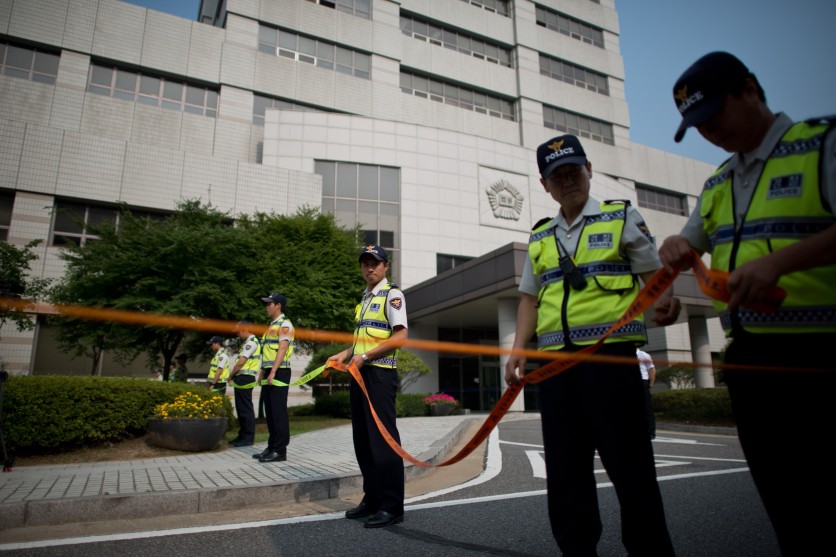
A South Korean court has narrowed the blast radius of a looming Samsung Electronics strike by legally mandating that 7,087 essential workers keep the company's semiconductor fabrication lines running through any walkout — but it has not stopped one, and the world's largest memory chipmaker is down to its last day of negotiations before up to 50,000 employees walk off the job Thursday, May 21.
The Suwon District Court's 31st Civil Division, presided over by Senior Presiding Judge Shin Woo-jung, issued the partial injunction on Monday, May 18 — the same morning Samsung and its unions sat down at the National Labor Relations Commission offices in Sejong for a second post-mediation round with NLRC chairman Park Soo-geun personally overseeing the talks. Commission chair Park, who entered the meeting room saying that the two sides were "making concessions to each other" and that there was "some possibility of an agreement," left open the possibility of presenting a formal mediation proposal if they failed to converge on their own. As of Tuesday, no deal had been announced.
Court Mandates Full Staffing for Safety Systems and Wafer Lines
The injunction order has three operative parts. First, safety and protection facilities — disaster-prevention systems, ventilation, drainage — must remain staffed and operational at normal levels throughout any strike. Second, the court recognized wafer-preservation work as essential maintenance under Article 38, Paragraph 2 of South Korea's Trade Union and Labor Relations Adjustment Act, ordering that the tasks required to prevent production-equipment damage and in-process wafer deterioration continue at pre-strike staffing levels. Third, the Samsung Electronics branch of the Korean Metal Workers' Union and branch chief Choi Seung-ho are barred from occupying company facilities, installing locks, or blocking employees from entering. Samsung separately notified the union it requires 7,087 workers to remain at their posts to meet these obligations.
The court stopped short of banning the strike. Violations carry daily fines of 100 million won (approximately $74,000) per union and 10 million won ($7,400) per day for individual leaders including Choi Seung-ho. The court declined to issue a separate occupation ban against the National Samsung Electronics Union and acting chairwoman Woo Ha-kyung, noting it found insufficient evidence that occupation by that union was imminent — but specified the absence of a separate order did not mean occupation was permitted.
Why the Ruling Matters for Chip Output — and Device Prices
Semiconductor fabrication cannot be switched on and off. Samsung's fabs run 24 hours a day, seven days a week at tightly controlled temperatures and pressures; any interruption in the chemical processes used to etch circuits onto silicon wafers risks scrapping entire production runs. By legally requiring maintenance workers and safety teams to remain on duty, the court has preserved the continuous operating environment that prevents catastrophic wafer loss — effectively placing a floor under how much production can fall.
That floor matters to anyone who has bought, or intends to buy, a laptop, phone, or PC. DRAM contract prices surged 90–95 percent quarter-over-quarter in Q1 2026, according to TrendForce, and a further 58–63 percent increase is forecast for Q2. Gartner projects PC prices will rise 17 percent and smartphone prices 13 percent by year-end compared with 2025 levels. Major manufacturers including Lenovo, Dell, HP, Acer, and Asus have already warned of price increases of 15–20 percent in the second half of 2026, with Asus projecting increases of up to 30 percent on some product lines. Buyers who act before Q3 face substantially lower prices than those who wait.
Prof. Kwon Seok-joon of Sungkyunkwan University has estimated that even a legally constrained 18-day walkout could cost Samsung between 10 trillion and 17 trillion won in direct losses, with restart stabilization adding a further two to three weeks — making the effective disruption window as long as six weeks. KB Securities analyst Kim Dong-won put the direct damage figure above 40 trillion won.
The Bonus Dispute That Got Here
The injunction arrived as South Korean Prime Minister Kim Min-seok publicly threatened to invoke emergency arbitration — a legal mechanism available under Article 76 of the Trade Union and Labor Relations Adjustment Act, used only four times since 1963. The prime minister estimated that a single day of suspended operations at Samsung's semiconductor plants would generate direct losses of up to 1 trillion won, roughly $668 million.
The dispute's roots run deeper than this negotiating cycle. Samsung paid zero performance bonuses in 2024 after its chip division posted operating losses through the memory downturn. The AI-driven recovery then produced a Q1 2026 operating profit increase of nearly eightfold — to a record 53.7 trillion won in the Device Solutions semiconductor division alone — yet workers again received no share of that windfall under the existing system. Rival SK Hynix removed its bonus ceiling in September 2025 and set aside 10 percent of annual operating profit for employee bonuses, resulting in per-employee payouts projected at 700 million won for 2026. That gap has already cost Samsung talent: union chair Choi Seung-ho confirmed roughly 200 Samsung engineers moved to SK Hynix in the four months through February 2026 alone.
The union — now representing more than 90,000 members, or more than 70 percent of Samsung's South Korean workforce — is demanding that Samsung scrap its existing performance-bonus cap, currently set at 50 percent of base salary, and commit in writing to allocating 15 percent of annual operating profit to the employee bonus pool. JPMorgan estimates the full union demand would cut Samsung's 2026 operating profit by 7–12 percent. Samsung's management proposed a 10 percent operating-profit pool alongside a one-time special award tied to the Device Solutions division reclaiming the domestic No. 1 ranking — a condition union chair Choi dismissed as "a ceiling in disguise." Samsung has insisted that locking in a fixed profit percentage is incompatible with running a diversified conglomerate through boom-and-contraction cycles.
What the Union's Critics and Supporters Say
The demands have divided academic observers. Prof. Choi Young-ki of Hallym University's business administration faculty called tying performance bonuses to a permanent collective-bargaining formula uncommon in established labor-management practice, warning it risks deepening South Korea's already severe labor-market divide between large-conglomerate workers and the broader workforce. Prof. Kim Sung-hee of Korea University cautioned that per-worker payouts at the projected levels risk generating relative deprivation among workers outside the semiconductor industry — a concern that carries weight given Samsung Electronics accounts for 12.5 percent of South Korea's GDP.
The union's case rests on structural grievance as much as compensation arithmetic. Samsung enforced a formal no-union policy for decades, and a 2019 Seoul court found Samsung's leadership had directed a systematic illegal campaign to suppress union organizing, resulting in an 18-month prison sentence for then-chairman Lee Sang-hoon. Samsung chairman Lee Jae-yong formally renounced the no-union policy in 2020. The union argues that without a written contractual formula, the company's oral commitments carry little structural weight — a position shaped directly by that history.
What Happens If Talks Fail Today
If the NLRC session concludes Tuesday without agreement, the 18-day walkout beginning Thursday, May 21, proceeds. The government can invoke emergency arbitration under Article 76 only after a strike has formally begun — meaning the initial hours of any walkout carry no legal freeze. Six major South Korean business groups have called on the government to act; Prime Minister Kim Min-seok has said all options remain on the table.
Samsung holds approximately 36 percent of global DRAM production and 28 percent of NAND output, according to TrendForce. A one-day protest in April saw memory-fab output fall 18 percent and foundry output drop 58 percent on the affected shift. The American Chamber of Commerce in Korea — whose members include Google, Apple, and Qualcomm — issued its first-ever formal statement on a Samsung labor dispute, warning that significant operational uncertainty "could place additional strain on the global memory chip market" and that competing nations stood to benefit from any procurement shift.
Prof. Song Heon-jae of the University of Seoul projects losses of approximately 1 trillion won per day from a full factory stoppage. For consumers shopping for a laptop or smartphone in the next 12 months, the window before Q3 2026 price increases closes in weeks — not months.
ⓒ 2026 TECHTIMES.com All rights reserved. Do not reproduce without permission.


