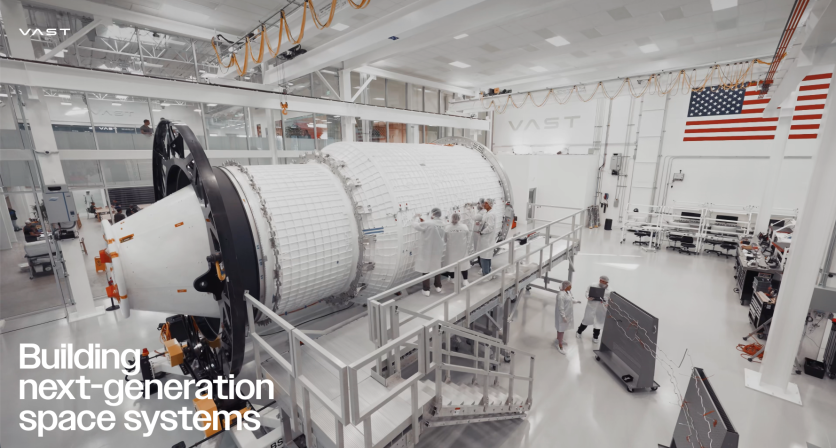
Long Beach startup Vast entered the high-power satellite bus market on May 19, 2026, with a product line it says has already landed a buyer: a confidential customer has committed to purchase four satellites and holds an option to acquire up to 200 more. The product, called Vast Satellite, offers a 15 kilowatt-class spacecraft bus initially targeting low Earth orbit missions in communications, Earth observation, national security, and orbital data centers — markets where high power and large payload capacity were previously available only from established prime contractors such as Lockheed Martin, Northrop Grumman, Airbus, and Boeing.
Space Station DNA Inside Every Bus
Vast's commercial argument rests on an unusual foundation: it claims to have been building a satellite bus for three years without calling it one. CEO Max Haot said in a press release that the Haven-1 space station program required the same core hardware — avionics, batteries, flight computers, guidance navigation and control sensors, and flight software — that a high-power satellite bus needs. "We've been working for three years on a high powered satellite bus that just has humans inside," Haot has stated in multiple interviews.
Most of those subsystems flew in November 2025 aboard Haven Demo, a technology demonstration satellite Vast launched on SpaceX's Bandwagon-4 rideshare mission. The spacecraft spent roughly three months in orbit validating avionics, power systems, and software before executing a controlled deorbit on February 4, 2026. Haot has said that, outside the chassis itself, Vast expects close to 100 percent component overlap between Haven-1 and the satellite bus.
Two major subsystems do not yet carry flight heritage: the deployable solar arrays and the electric thrusters. Haot has noted that both are already in development for Haven-2, Vast's planned successor to the International Space Station, meaning the gap is expected to close through the station program regardless of satellite sales.
Specifications for Power-Intensive Missions
The first offering in the Vast Satellite line is a flat-panel bus measuring 2.2 by 3.6 meters with a dry mass of 700 kilograms. It can accommodate payloads of at least 350 kilograms and deliver peak payload power exceeding 20 kilowatts for time-limited bursts, with orbit-average payload power between 6 and 14.5 kilowatts depending on orbit and payload configuration. The electric propulsion system uses a 10 kW krypton thruster capable of delivering more than 500 meters per second of delta-v, giving operators meaningful orbital maneuvering capability over a designed five-year mission life.
The bus supports an altitude range of 350 to 1,200 kilometers in LEO, with medium Earth orbit, geostationary orbit, and lunar configurations listed as future targets. Pointing knowledge accuracy is below 0.05 degrees at one sigma, with an optional enhanced configuration reaching below 0.005 degrees — relevant for Earth observation payloads and optical communications terminals. Standard payload interfaces include Gigabit Ethernet, RS-422 serial, and discrete input/output, with optional MIL-STD-1553 and SpaceWire available for defense customers.
NVIDIA Vera Rubin Space-1 Option Targets Orbital Data Centers
The most strategically significant option on the bus is integration of NVIDIA's Vera Rubin Space-1 compute module, designed for on-orbit inference, AI edge compute, advanced signal processing, and autonomous space operations.
The option positions Vast in a race among cloud and AI infrastructure providers extending their compute ambitions into low Earth orbit. A 15 kW bus capable of hosting data-center-class compute modules is one enabling step toward processing satellite data in orbit rather than relaying raw downlinks to ground stations — a long-standing bottleneck for Earth observation and communications payloads generating more data than ground infrastructure can absorb in real time.
Confidential Buyer, 10-Satellite First Launch Planned for Late 2027
Vast Satellite's commercial traction is the most immediately significant element of the announcement. The signed agreement with an undisclosed customer covers four satellites with an option exercisable for up to 200 more — a pipeline that, if fully exercised, would represent one of the larger single-vendor satellite procurement commitments among new entrants in the high-power bus segment. Vast plans to launch its first batch of 10 buses in late 2027, using that mission as both a commercial delivery and a production-scale demonstration.
Jim Martz, Senior Vice President of Special Projects, will lead the satellite program. Martz previously headed satellite engineering organizations at SpaceX's Starshield defense satellite effort and at Muon Space. Vast's satellite team is expected to grow to roughly 50 engineers by 2027, with dedicated production facilities targeted for mid-2027 if customer traction materializes as the company anticipates.
Flight Heritage Advantage Over New Entrants, Scale Gap Versus Legacy Primes
Vast enters a market where established primes have decades of flight heritage and secured supply chains but have historically been slow to reduce costs and cycle times for high-power platforms. Haot argued that Vast's vertically integrated manufacturing model — built to produce large, complex spacecraft for commercial space stations — gives it an advantage that smaller satellite bus manufacturers cannot easily match. "We are uniquely positioned to build large spacecraft, leveraging that investment, and in our view better positioned than small satellite companies to move into this area," he said.
The 15 kW power class is the key differentiator. Many emerging LEO bus vendors compete below 5 kW; next-generation communications, radar imaging, and orbital computing payloads increasingly demand far more. Haot described the trend plainly: "All of them, if they can afford it, can always use more power and larger spacecraft."
The company's $500 million Series A round, closed in March 2026 and led by Balerion Space Ventures with participation from IQT, Qatar Investment Authority, Mitsui, and MUFG, provides the balance sheet to sustain both the station and satellite programs simultaneously through the late-2027 launch window.
Haot positioned the satellite expansion as consistent with how successful space companies have historically scaled. "If you started looking at every single successful space company with heritage, they were all diversified," he said, citing SpaceX and Rocket Lab. "The only questions are when do you do it and what do you do." Vast's answer, delivered May 19, is that it does it now, and it builds the buses.
ⓒ 2026 TECHTIMES.com All rights reserved. Do not reproduce without permission.


