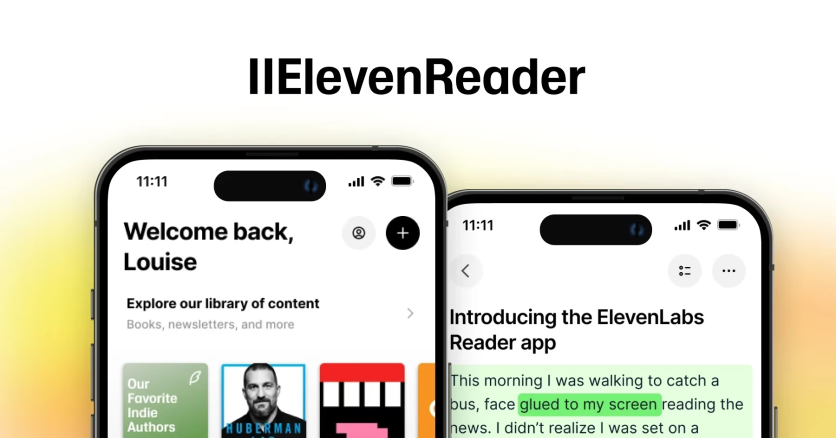
ElevenLabs, the voice AI company valued at $11 billion, has struck licensing agreements with major publishing houses covering 200,000 human-narrated audiobooks for its ElevenReader app, Bloomberg reported Thursday — one of the largest copyright-conscious catalog acquisitions yet made by a generative audio company. The deals arrive as ElevenLabs faces a fresh class action lawsuit alleging unauthorized use of voice actors' recordings and on the same day that Spotify announced its own ElevenLabs-powered audiobook creation tool, sharpening a three-way competition for the audiobook subscriber.
ElevenReader is available on iOS and Android at $11 per month — a direct competitive threat to Amazon's Audible and Spotify's audiobook tier. With 200,000 licensed human-narrated titles, ElevenReader now claims catalog depth comparable to established audiobook platforms, paired with AI-narrated streaming that its incumbent rivals have not yet matched at scale.
ElevenLabs Pays Publishers Rather Than Synthesizing Around Them
The arrangement is notably different from the path most AI audio companies have taken. Where competitors have largely relied on AI-generated narration to sidestep the cost and complexity of licensing existing recordings, ElevenLabs has negotiated direct access to pre-recorded, professionally narrated titles from established publishers.
This posture echoes the approach taken by Audible, which built its catalog over years through direct publisher agreements, but ElevenLabs is arriving simultaneously with an AI narration layer its incumbents cannot replicate on demand. The decision to pay for access to human performances, rather than synthesize around them, represents a strategic bet that legitimacy with publishers is worth the cost — particularly as ElevenLabs monitors a potential initial public offering.
The move addresses a rights question that has dogged the broader AI audio industry. Amazon faced resistance in 2009 when Kindle's text-to-speech capability drew publisher objections; ElevenLabs is taking an explicitly different path by treating existing human performances as assets to acquire rather than costs to engineer around.
Hybrid Catalog Sets ElevenReader Apart
ElevenReader already offered several content pathways before this deal. According to a February 2026 industry profile of ElevenLabs, the platform combines full catalogs of pre-recorded audiobooks with ebook titles that stream AI narration on demand. Listeners can choose from a voice marketplace that includes licensed celebrity voices such as Michael Caine and apply them to thousands of available books.
The 200,000-title publisher deal dramatically expands the human-narrated side of that equation. ElevenLabs' voice library spans 6,000 voices across 32 languages, and its ElevenProductions service offers a managed production pipeline for publishers who want catalog-scale audio at reduced cost.
Spotify Investor Day Accelerates the Competition
The timing of the Bloomberg report coincides with a significant competitive move from Spotify. At its Investor Day on May 21, Spotify announced an ElevenLabs-powered AI audiobook creation tool within its Spotify for Authors platform, set to launch in beta this June on an invite-only basis for English-language titles only. The tool will allow authors to generate AI-narrated audiobooks without exclusivity requirements, building on an existing partnership between the two companies.
Spotify's audiobook catalog has grown to 700,000 titles, with more than one million Audiobook+ subscribers and the platform on track to generate $100 million in annualized recurring revenue. That scale makes Spotify a formidable rival — and makes ElevenReader's 200,000 licensed human-narrated titles a credible opening bid rather than a conclusive answer to the catalog gap. Audible, Amazon's dominant audiobook service, hosts more than 40,000 AI-narrated titles under its "Virtual Voice" label alongside its extensive human-narrated library.
Lawsuits and Congressional Scrutiny Frame the Licensing Bet
ElevenLabs' move toward publisher licensing does not insulate the company from legal pressure over how it built its underlying voice models. On May 12, 2026, a group of journalists and voice actors — including Robin Amer, Lindsay Dorcus, Victoria Nassif, Yohance Lacour, and Alison Flowers — filed a proposed class action in Illinois federal court alleging ElevenLabs and several other major technology companies used their voices to train AI models without consent, under Illinois' Biometric Information Privacy Act.
The company settled a separate 2024 federal lawsuit brought by voice actors Karissa Vacker and Mark Boyett, who alleged their recorded performances were used without authorization to create ElevenLabs' default AI voices — the first settlement in any of the dozens of AI copyright lawsuits filed in the United States. In April 2026, Senator Maggie Hassan sent letters to ElevenLabs and three other AI voice companies demanding answers about safeguards against voice fraud.
ElevenLabs' decision to license human-narrated content signals an awareness of this legal environment. Whether it will reduce litigation risk over training-data provenance is a separate question; the pending Illinois lawsuit targets how ElevenLabs' voice models were built, not how it distributes audiobooks.
Positioned Before IPO
ElevenLabs was co-founded in 2022 by CEO Mati Staniszewski and CTO Piotr Dąbkowski. The company raised $500 million at an $11 billion valuation in February 2026 as it publicly eyes a potential IPO. With that financial runway, ElevenLabs can absorb the licensing costs that smaller AI audio startups cannot — and has a clear incentive to establish credibility with publishers and regulators before any public market debut.
For audiobook listeners, the practical question is whether $11 per month for ElevenReader — with its hybrid catalog of human and AI narration, licensed celebrity voices, and a rapidly expanding title count — competes meaningfully with Audible's $14.95 premium tier or Spotify's audiobook add-on. The catalog deal gives ElevenReader a foundation that was missing a year ago. Whether that foundation reaches Spotify's 700,000-title scale in time to matter is the race now underway.
ⓒ 2026 TECHTIMES.com All rights reserved. Do not reproduce without permission.


