For the first time, astronomers have confirmed a repeating daily weather cycle on a planet outside our solar system — and the same instrument that made the observation has revealed that a decade of prior measurements of similar worlds may have been systematically wrong.
The James Webb Space Telescope (JWST), using its NIRISS instrument and a technique called transit spectroscopy, tracked the atmosphere of WASP-94Ab, a gas giant located about 690 light-years from Earth, as it crossed in front of its host star. The result, published in the journal Science on May 21, 2026, showed something no telescope had ever resolved before: the planet's leading edge — its permanent morning side — was covered in thick clouds of vaporized magnesium silicate, the rocky mineral found in sand. By the time the trailing, evening side came into view, those clouds had completely disappeared.
Lead author Sagnick Mukherjee, a postdoctoral researcher at Arizona State University who began the work as a PhD student at UC Santa Cruz, described the finding as a genuine surprise. "It was really surprising how different the two halves of the same planet are," Mukherjee said.
Hot Jupiter WASP-94Ab: Two Planets Stitched Together
WASP-94Ab is a hot Jupiter — a gas giant that orbits perilously close to its star. At 1.72 times Jupiter's radius and roughly 45 percent of Jupiter's mass, it completes a full orbit every 3.95 days at a distance of just 5.1 million miles from its star. For comparison, Mercury never gets closer than 29 million miles to the Sun. Surface temperatures exceed 2,200 degrees Fahrenheit (1,200°C).
Like most hot Jupiters, WASP-94Ab is tidally locked. One hemisphere permanently faces its star; the other is locked in perpetual night. That arrangement produces an extreme temperature contrast: the evening limb of the planet runs roughly 450 Kelvin hotter than the morning limb. The difference is large enough, according to the paper's authors, that the chemistry and cloud cover on each side behave like two fundamentally different atmospheres stitched together at the terminator.
David Sing, the Bloomberg Distinguished Professor of Earth and Planetary Sciences at Johns Hopkins University and senior author on the research, has described clouds as "a thorn in our side" for decades of exoplanet work — "like trying to look at the planet through a foggy window." The clear evening limb of WASP-94Ab finally removed that obstruction.
How JWST Separated Morning from Evening
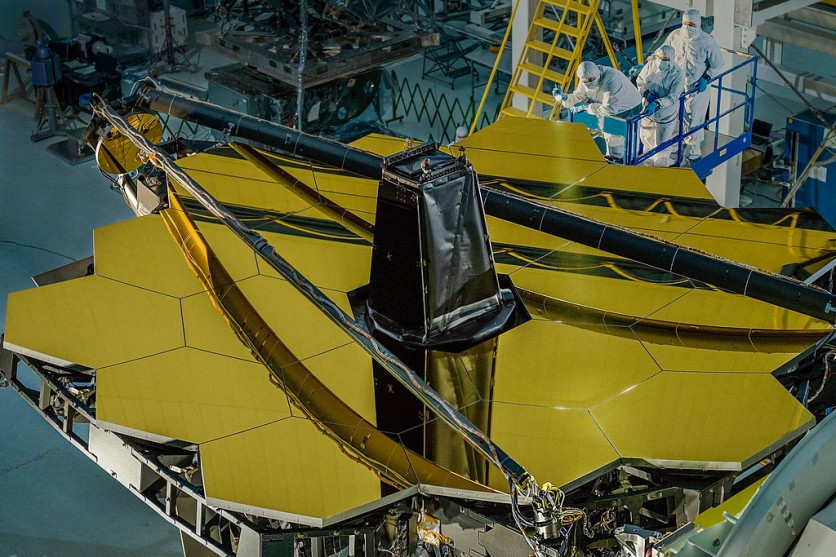
The key advance was the ability to analyze each side of the planet's atmosphere independently during transit. As WASP-94Ab crossed in front of its star, the leading edge entered the stellar disc first, filtering starlight through the morning atmosphere; the trailing edge exited last, filtering through the evening atmosphere. JWST's NIRISS instrument captured distinct spectral signatures from each limb.
The morning side showed no strong gas absorption features. Instead, it showed the sloped signature of high-altitude aerosols — a cloud-dominated spectrum. The evening side showed clear water vapor absorption and almost no aerosol signal. The statistical confidence in the difference was high: the team reported cloud absorption on the morning limb at 9-sigma significance and water absorption on the clearer evening limb at 10-sigma significance.
"With the Hubble telescope, when we used to do this type of observation, we got an average view of the whole planet with data from the clouds and the atmosphere squished together and indistinguishable," Mukherjee said. "This approach with JWST lets us localize our observations, which helped us see the cloud cycle."
The best-fit explanation for the asymmetry involves magnesium silicate clouds — fine mineral particles similar to those in sand — condensing on the cool nightside, riding powerful equatorial super-rotation winds around to the morning terminator, and then either sinking deeper into the atmosphere or evaporating as they cross into the intense heat of the permanent dayside. By evening, the skies are clear.
What Clear Skies Revealed About WASP-94Ab's True Composition
The clearing of the evening limb gave researchers an unobstructed view of the planet's actual atmospheric chemistry — and what they found corrected years of cloud-contaminated data.
Earlier measurements of WASP-94Ab's composition, made by blending both limbs together into a single averaged spectrum, had implied that the planet held oxygen and carbon abundances hundreds of times higher than Jupiter — an anomalous result that did not fit standard models of gas giant formation. Once the cloudy and clear limbs were separated, the picture changed sharply. The new study found that WASP-94Ab's atmosphere contains only about five times the oxygen and carbon abundance of Jupiter, a result much more consistent with how planetary scientists expect a hot Jupiter to form. The two estimates — blended-limb versus limb-resolved — differed at more than 4-sigma statistical significance.
The implication extends beyond this single planet. If morning clouds and evening clarity are common among hot Jupiters, then composition estimates published before JWST could separate limb signals may be systematically biased. The paper's authors specifically warn that failing to account for limb asymmetry can skew inferred metallicity, cloud properties, and other key atmospheric parameters.
Does JWST Detect Weather on Other Exoplanets?
The team did not stop at WASP-94Ab. Using it as a benchmark, they examined JWST NIRISS spectra across eight additional hot Jupiters spanning equilibrium temperatures from roughly 800 to 1,700 Kelvin. The same cloud-cycle pattern turned up on two of them: WASP-39b and WASP-17b. Both had been studied previously with the Hubble Space Telescope, but Hubble could not resolve the morning and evening limbs separately. The consistency across three planets suggests this is not an anomaly but a recurring feature of hot Jupiter atmospheric dynamics — one that had simply been undetectable until JWST's sensitivity made limb-by-limb analysis possible.
The next phase of research will look at hot Jupiters on highly eccentric orbits — worlds that swing from the habitable zone into close stellar approach and back out again. The dramatic temperature swings along those orbits could drive even more extreme weather that JWST may be able to observe directly.
How This Refines the Search for Life on Other Worlds
The findings carry implications well beyond hot Jupiters. Astronomers hunting for biosignatures — the chemical fingerprints of biology — on smaller, potentially habitable planets rely on the same transit spectroscopy technique to read atmospheric composition. If cloud coverage is strongly asymmetric between a planet's morning and evening hemispheres, any measurement that averages across the full planetary disc could produce misleading composition estimates, including false signals or masked detections.
Researchers have noted that established methods for interpreting exoplanet spectra are already known to be highly averaged representations of intricate three-dimensional atmospheric processes, and can lead to disparate interpretations even with JWST-quality data. The limb-separation technique demonstrated by Mukherjee and Sing now offers a concrete method to reduce that averaging bias, making future atmospheric readings more reliable for any planet class, not just gas giants.
Frequently Asked Questions
What is a hot Jupiter, and why does WASP-94Ab qualify?
A hot Jupiter is a gas giant that orbits very close to its host star — typically within a few million miles — completing a full orbit in days rather than years. The proximity heats the planet to thousands of degrees Fahrenheit. WASP-94Ab qualifies because it orbits just 5.1 million miles from its star every 3.95 days, reaching surface temperatures above 2,200 degrees Fahrenheit (1,200°C).
How does JWST detect weather on an exoplanet 690 light-years away?
JWST uses transit spectroscopy: as the planet crosses in front of its star, starlight filters through the planet's atmosphere at its edges. JWST's NIRISS instrument is sensitive enough to analyze each edge separately — the morning limb as the planet enters transit and the evening limb as it exits. Different chemical signatures in each edge reveal whether clouds or clear gas dominate on each side.
What is the exoplanet cloud cycle, and why does it matter for measuring planet compositions?
The cloud cycle on WASP-94Ab describes the daily buildup of mineral clouds on the morning side and their disappearance by evening, driven by the planet's extreme temperature difference between its permanent day and night hemispheres. It matters for composition measurements because clouds block the gas absorption signals astronomers use to identify atmospheric chemistry. Any measurement that blends the cloudy morning side with the clear evening side produces an inaccurate average — prior estimates for WASP-94Ab were off by a factor of more than 100 in some parameters.
Does finding a weather cycle on WASP-94Ab bring us closer to detecting life on other planets?
Not directly — WASP-94Ab is far too hot and gas-dominated to support life. But the limb-separation technique refined here directly improves how astronomers will read the atmospheres of smaller, cooler, potentially habitable planets, reducing the risk that cloud coverage on one side of a tidally locked world will contaminate or mask a biosignature signal.
ⓒ 2026 TECHTIMES.com All rights reserved. Do not reproduce without permission.


