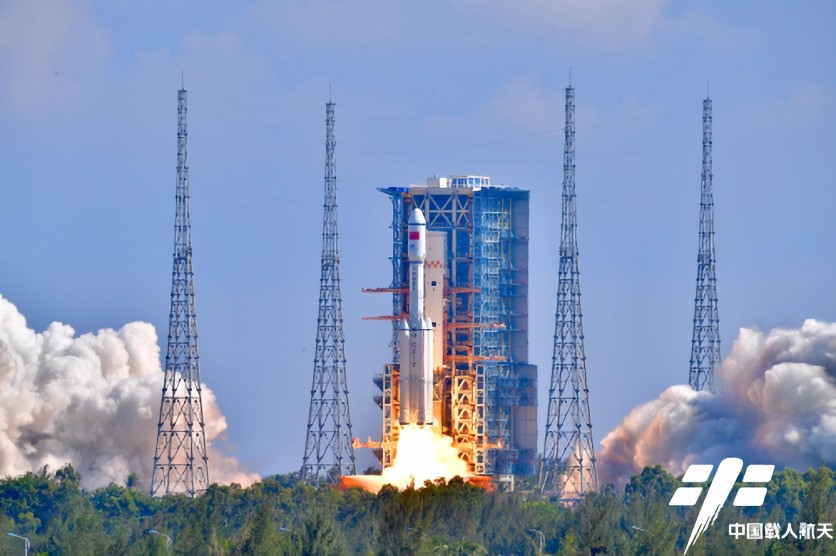
China's Tiangong space station now has six astronauts aboard following the docking of the Shenzhou 23 spacecraft early Monday morning, May 25, 2026 — a mission that marks two firsts simultaneously: the first astronaut from Hong Kong to reach orbit and China's first attempt at a continuous year-long human spaceflight. The spacecraft completed a 3.5-hour automated rendezvous and docked at Tiangong's Tianhe core module at 2:45 a.m. Beijing Time, roughly six hours after liftoff from the Jiuquan Satellite Launch Center in China's northwestern Gobi Desert.
At 5:13 a.m. Beijing Time, the departing Shenzhou 21 crew opened the hatch and welcomed the three newcomers, with both trios posing for photographs in what the China Manned Space Agency (CMSA) called the eighth in-orbit crew gathering in Chinese aerospace history. The Shenzhou 21 astronauts — Zhang Lu, Wu Fei, and Zhang Hongzhang — are scheduled to return to Earth on May 29, closing what has become China's longest human spaceflight mission to date at 204 days in orbit, a record extended by a month following an earlier spacecraft safety incident.
Hong Kong's First Astronaut Reaches Orbit
Payload specialist Lai Ka-ying, 43, is the mission's most prominent figure beyond the engineering milestones. A former superintendent in the Hong Kong Police Force with a doctorate in computer forensics from the University of Hong Kong, Lai is the first astronaut from China's Hong Kong Special Administrative Region and the country's fourth female space traveler, following Liu Yang, Wang Yaping, and Wang Haoze. She was selected during China's fourth astronaut recruitment round in 2024 after standing out from roughly 120 Hong Kong candidates across three rounds of selection. Training condensed years of preparation into just over one year, including a 72-hour sleep-deprivation test and extended desert isolation exercises.
The mission also marks the first spaceflight for pilot Zhang Zhiyuan, a former People's Liberation Army Air Force officer. Commander Zhu Yangzhu is a veteran of the Shenzhou 16 mission, making this his second trip to Tiangong. Shenzhou 23 is the 17th crewed Chinese spaceflight and the 644th launch in China's Long March carrier rocket series.
What China's First Year-Long Spaceflight Involves
One member of the Shenzhou 23 crew — the specific astronaut has not been publicly identified by CMSA — is slated to remain aboard Tiangong for approximately 12 months, a first for the Chinese program. All previous Tiangong rotations have followed a six-month schedule. CMSA spokesperson Zhang Jingbo described the distinction plainly: a year-long stay is not simply two consecutive six-month missions compressed into one. The compounded physical and psychological demands require reinforced fitness regimens, intensified compatibility training, and upgraded in-orbit medical systems.
The extended mission will serve as the foundation for what CMSA describes as a multi-system biological study of the human body in space — tracking changes across multiple organ systems to build a comprehensive data set on long-duration spaceflight effects, including radiation exposure, bone-density loss, cardiovascular change, and psychological resilience. According to Bian Qiang, an expert at China's Astronaut Center, the data will directly inform health support systems for future missions, including the country's stated goal of landing astronauts on the Moon by 2030.
More Than 100 Experiments in Six Science Categories
Beyond the endurance study, the Shenzhou 23 crew will conduct more than 100 science and technology projects across six fields: space life sciences, materials science, microgravity fluid physics, aerospace medicine, space-based cultivation, and embryonic development research. Several experiments represent category firsts.
For the first time, two consecutive generations of rice will be grown in orbit, testing whether long-term microgravity introduces heritable changes to crop genetics. In parallel, a developmental biology program using zebrafish, mouse embryos, and stem cell-derived artificial embryos will establish the first space embryonic research system bridging lower vertebrates and mammals. Separately, perovskite solar cells — a next-generation photovoltaic technology with potential applications in lunar energy systems — will undergo their first dynamic in-orbit performance testing aboard a Chinese station. Three categories of biological samples will also be placed on an external exposure platform for a five-month study on how cosmic radiation affects microbial evolution, plant genetics, and the chemical catalysts associated with the origin of life.
How Did Shenzhou 21 End Up in Orbit for Seven Months?
The longer-than-planned handover period reflects a cascade of events from late 2025. The Shenzhou 20 spacecraft sustained damage to a crew return module window — believed to be caused by a debris impact — while docked at Tiangong, leaving its three occupants temporarily without a safe ride home. Under China's human spaceflight contingency protocol, which keeps a standby rocket and spacecraft near-ready at Jiuquan, an uncrewed Shenzhou 22 was launched on November 25, 2025, to restore a viable lifeboat. The Shenzhou 20 crew used the Shenzhou 21 vehicle to return to Earth, leaving the Shenzhou 21 crew — Zhang Lu, Wu Fei, and Zhang Hongzhang — to continue their mission with Shenzhou 22 now serving as their emergency vehicle. Their stay was subsequently extended by one month to gather additional research data. Shenzhou 23's spacecraft design incorporates enhanced window protection in direct response to the debris incident. The outgoing trio will depart May 29 aboard Shenzhou 22.
China's 2030 Moon Landing: What Shenzhou 23 Data Will Feed
The year-long physiological study is a direct preparatory step for lunar and deep-space missions. China has publicly stated its goal of landing astronauts on the Moon before 2030, competing with NASA's Artemis program, which targets a crewed lunar landing in 2028. China's next-generation Mengzhou spacecraft — designed to replace the Shenzhou line for lunar crew transport — is scheduled for an uncrewed orbital test flight in late 2026. The Shenzhou 24 mission, planned for October 2026, will carry a Pakistani astronaut on a short-duration visit, made possible by the vacant seat created by the year-long crewmate's continued stay.
China has operated Tiangong as a permanently crewed outpost through unbroken three-person rotations since the station's completion in 2022, now hosting its 11th crewed flight to the station. The Shenzhou 23 launch marked the 644th flight of the Long March carrier rocket series, and China has now sent a total of 30 astronauts into space.
Frequently Asked Questions
Who is Lai Ka-ying, Hong Kong's first astronaut?
Lai Ka-ying, also known as Li Jiaying in Mandarin, is a 43-year-old former superintendent and computer forensics specialist from the Hong Kong Police Force. She holds a doctorate from the University of Hong Kong, was selected in China's fourth astronaut recruitment round in 2024, and launched aboard Shenzhou 23 on May 24, 2026, as a payload specialist — becoming the first person from Hong Kong to reach orbit and China's fourth female space traveler.
How long will a Shenzhou 23 astronaut stay in space?
One of the three Shenzhou 23 crewmates — not yet publicly named by CMSA — is scheduled to remain aboard Tiangong for approximately 12 months, a first for China's human spaceflight program. The previous record was 204 days, set by the Shenzhou 21 crew whose extended stay ends with their May 29, 2026, return.
What experiments will the Shenzhou 23 crew conduct?
The crew will carry out more than 100 science and technology projects, including the first two-generation rice cultivation in orbit to study microgravity effects on crop genetics, perovskite solar cell testing relevant to future lunar energy systems, a five-month external exposure radiation study, and a multi-species embryonic development program using zebrafish, mouse embryos, and artificial embryos.
What is China's goal for landing on the Moon?
China's official target is a crewed lunar landing before 2030. The Shenzhou 23 year-long mission will generate physiological data directly informing that program. China's next-generation Mengzhou crew spacecraft, designed for lunar transport, is scheduled for an uncrewed orbital test in late 2026, and Shenzhou 24 — due in October 2026 — will carry the program's first international astronaut, from Pakistan.
ⓒ 2026 TECHTIMES.com All rights reserved. Do not reproduce without permission.


