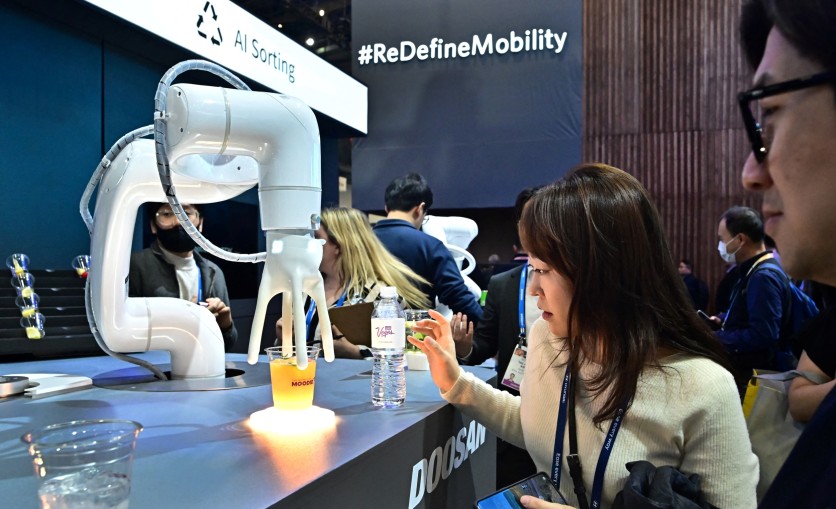
Doosan Robotics surged to the Korean Exchange's hard 30% daily limit on Monday after Nvidia CEO Jensen Huang publicly called robotics "very important" for South Korea at a private dinner in Taipei — naming a sector, not a company, and raising no specific announcement about Doosan. The stock hit 138,400 won on June 1, up 29.95%, its maximum allowed single-session gain, then added another 14.09% on Tuesday, reaching 157,900 won. At least four other Korean robotics companies also surged simultaneously, suggesting investors are pricing in a sector-wide Nvidia partnership thesis ahead of Huang's arrival in Seoul on June 4.
The rally carries a distinction investors should note: it is running ahead of any signed deal. Huang's comment at the dinner — "I believe robotics is very important for Korea. I hope Nvidia can contribute to the development of robotics in Korea as well" — cited Korea's labor constraints and AI's potential to address them, but named no specific company and announced no specific commitment. Daishin Securities analyst Lee Kyoung-min said the market was "pricing in the potential for cooperation with Nvidia in physical AI and platforms," with the October 2025 precedent — when Huang's Seoul visit also sent Korean stocks surging — reinforcing investor confidence. "The key question this time is not merely who gets to meet Jensen Huang. It's which companies can translate those relationships into recurring business within Nvidia's ecosystem," added Kim Doo-un, an analyst at Hana Securities.
What Is Nvidia's Partnership With Doosan Robotics?
The underlying commercial relationship is real and documented. On April 29, Madison Huang — Jensen Huang's daughter and Nvidia's senior director of product marketing for Omniverse and robotics — toured Doosan Robotics' Innovation Center in Bundang, Seongnam, meeting CEO Kim Min-pyo to discuss integrating Doosan's Agentic Robot Operating System with Nvidia's simulation tools and AI training frameworks, including Isaac Sim and cuMotion. The two companies outlined a roadmap: intelligent robot solutions powered by the Agentic Operating System by 2027, followed by the launch of industrial humanoid robots in 2028. "The success of physical AI depends not only on the intelligence of the AI model," Kim said, "but also on the stability of the execution platform that operates it without error in the field."
Physical AI refers to artificial intelligence embedded in machines that perceive their environment and take physical actions in it — robots that can assess their surroundings, optimize movement paths, and perform precision tasks rather than following fixed programs. Doosan Robotics manufactures collaborative robots, or cobots, designed to work alongside human workers on production lines; the company holds the highest functional-safety certification from TÜV SÜD and operates in 45 countries. Earlier this year, Doosan Robotics' engineers took first place in Nvidia's Cosmos Cookoff — a global physical AI hackathon with more than 1,600 participants — with an "Explainable Palletizer" project built on Nvidia's Cosmos Reason model.
Why Doosan Robotics Stock Specifically Surged
Doosan is the only Korean cobot maker with a publicly announced Nvidia partnership and a named joint technology roadmap. When Huang speaks about robotics and Korea in the same sentence, Doosan is the company that Korean investors most immediately associate with that theme — backed by documentation of the April visit, the shared platform roadmap, and the Cosmos Cookoff win. The April meeting between Madison Huang and CEO Kim Min-pyo received extensive coverage in Korean financial media, and Doosan Vice Chairman Park Ji-won had visited Nvidia's US headquarters in 2025 to lay groundwork on AI accelerators.
That specificity is what separated Monday's Doosan move from the broader rally. Robostar (090360.KQ) also hit its daily ceiling; Robotis (108490.KQ) gained 24.58%; Haesung Aerobotics (059270.KQ) climbed 23.56%; Angel Robotics (455900.KQ) rose 18.92%; and Rainbow Robotics (277810.KQ) added 14.81%. The cascade illustrates how Huang's comments function in Korean markets: a single sector endorsement from Nvidia's CEO moves multiple names simultaneously, regardless of whether they have individual partnership agreements. A website dubbed "Jensen Huang KR Tracker" emerged in real time showing investors which Korean stocks were associated with his expected stops, pairing itinerary reports with live price movements — while its disclaimer noted the schedule was "estimates based on reports rather than officially confirmed."
Korea as Nvidia's Physical AI Manufacturing Partner
At the Korea Partner Night dinner on June 1 — Nvidia's first such event, held at a seafood restaurant in Taipei — Huang told reporters that Korea has "immense potential in robotics technology" but is "facing a shortage of hands and feet — its labor force," and that "AI and robotics will maximise Korea's potential." He said Nvidia will "always consider investing in Korea" and named semiconductors, memory, science, robotics, and AI factories as areas where the two sides had much left to accomplish together. KB Securities analyst Jeff Kim framed the visit in broader strategic terms: "Jensen's visit to Korea has a major implication. Nvidia needs Korea."
Huang is expected to arrive in Seoul on Thursday, June 4, for meetings with the heads of major Korean conglomerates starting Friday, June 5. He is also coordinating a June 8 visit to Naver's second headquarters, the 1784 building in Bundang. An unverified report has also spread in Korean media that Doosan is arranging for Huang to throw the ceremonial first pitch at a Doosan Bears home game at Jamsil Baseball Stadium on Sunday, June 7 — the final game of a series between the Doosan Bears and the Kiwoom Heroes. Huang himself declined to confirm the appearance at the Korea Partner Night, saying "Could I really throw a first pitch well? I'm getting a bit older now." The Doosan Bears have publicly stated they received no communication about such an appearance.
Confirmed Partnership vs. Market Expectation
The divergence between Doosan Robotics and its holding company on Tuesday underscores how the market is reading the story. Doosan (000150), the holding company with interests across heavy industry, power-plant equipment, and energy, fell 11.62% to approximately 1,947,000 won on June 2 after its 17.75% gain on June 1. Investors appear to be buying the robotics theme specifically, not the Doosan Group broadly.
That distinction matters against the company's underlying financials. Doosan Robotics reported a net operating loss of approximately 16.65 billion won in its most recent quarter, with trailing twelve-month revenue of roughly $30.2 million — a modest figure relative to a multi-billion-dollar market capitalization. The company listed on the KOSPI in October 2023 and has not yet reached profitability. What the stock is pricing is the potential value of becoming a key hardware partner in Nvidia's global physical AI ecosystem — a category that did not exist as a commercial proposition two years ago. Whether that potential translates into contracted revenue before or after the current rally fades is the question Huang's Seoul meetings may begin to answer.
Frequently Asked Questions
Why did Doosan Robotics stock hit its daily limit?
Doosan Robotics shares hit the Korean Exchange's 29.95% daily gain ceiling on June 1, 2026, after Nvidia CEO Jensen Huang publicly named robotics as "very important" for Korea at a private dinner in Taipei called the Korea Partner Night. Doosan has an existing, documented partnership with Nvidia to develop an AI-driven robot platform, making it the most directly associated Korean cobot maker with Nvidia's physical AI agenda.
What is Nvidia's partnership with Doosan Robotics?
In April 2026, Doosan Robotics and Nvidia agreed to integrate Doosan's Agentic Robot Operating System with Nvidia's simulation and AI training tools, including Isaac Sim. The companies are jointly targeting the launch of intelligent robot solutions in 2027 and industrial humanoid robots in 2028, according to a joint roadmap announced when Madison Huang, Nvidia's senior director of product marketing, visited Doosan's Bundang facility.
Is Jensen Huang visiting Korea, and what does it mean for Doosan?
Jensen Huang is scheduled to arrive in South Korea on Thursday, June 4, for meetings with major Korean conglomerate leaders starting June 5. For Doosan specifically, his visit raises market hopes for a deeper commercial agreement, but no deal has been announced. Analysts caution that his prior October 2025 Korea visit also generated rallies driven largely by anticipation rather than signed contracts.
What is physical AI and why does it matter for Doosan Robotics?
Physical AI describes artificial intelligence embedded in machines that perceive their environment and act within it — robots that can adjust to real-world conditions rather than executing fixed routines. For Doosan, which manufactures collaborative robots designed to work alongside human factory workers, a physical AI partnership with Nvidia would allow its cobots to run AI models trained in Nvidia's simulation environments, enabling more adaptive and autonomous performance in industrial settings.
ⓒ 2026 TECHTIMES.com All rights reserved. Do not reproduce without permission.


