Nvidia CEO Jensen Huang landed in Seoul on June 5 and immediately announced that the company has begun hiring for its first South Korean research and development center — with job postings for physical AI and robotics engineers already live — deepening a supply-chain relationship that makes Korean memory manufacturers indispensable to every major AI GPU Nvidia ships. The four-day visit, running through June 8, is the most intensive Huang has made to Seoul, packed with conglomerate boardrooms, a celebrity esports appearance, a baseball first pitch, and a startup roundtable that signals Nvidia intends to build not just a procurement office but a permanent innovation presence in the country.
Nvidia Korea R&D Center: What It Focuses On and Why Now
Nvidia's Seoul facility — formally titled the AI Technology Center — will concentrate on three areas: physical AI research, robotics, and AI infrastructure solutions. Huang said the company is already recruiting staff and will build a dedicated physical site once headcount reaches sufficient scale. "As soon as we have enough people here, we'll build a site," he told reporters at the Gimpo Business Aviation Center. "Korea is so good at building things. I have no trouble building a beautiful site here when the time is ready." One proposed location is Saemangeum on South Korea's southwest coast, a government-backed industrial development zone being positioned for future industries including AI, robotics, hydrogen, and renewable energy. The Seoul center mirrors facilities Nvidia has established in Singapore and Taiwan, making Korea the third leg of its Asia R&D presence.
The timing is not coincidental. Nvidia completed its Vera Rubin AI accelerator platform for full production in June, confirming that Samsung Electronics, SK hynix, and Micron all passed certification to supply its sixth-generation HBM4 memory. Vera Rubin deliveries to major cloud providers including AWS, Google Cloud, Microsoft Azure, and Oracle are scheduled to begin in Q3 2026. Industry analysts estimate SK hynix holds roughly 60 to 70 percent of the allocated HBM4 volume for Vera Rubin, with Samsung at approximately 25 to 30 percent and Micron taking the remainder — though Nvidia has not published official allocation figures.
How HBM4 Solves the Memory Wall: Architecture Behind Nvidia's AI Supply Chain
The reason Huang flew to Seoul with a supply-chain coordination agenda — rather than a marketing one — comes down to a structural bottleneck in AI hardware that Korean manufacturers are uniquely positioned to resolve. GPU computing power has grown roughly 60,000-fold over the past two decades, but conventional DRAM bandwidth has improved by only about 100-fold over the same period. That gap — engineers call it the memory wall — means even the fastest processors can be starved for data if the memory system cannot keep pace.
HBM, or High Bandwidth Memory, was developed to close that gap through a fundamentally different physical architecture. Instead of placing memory chips on a circuit board beside the processor, HBM stacks multiple thin DRAM dies vertically, connecting them through thousands of parallel copper pathways called through-silicon vias (TSVs) drilled through each die. The complete stack sits adjacent to the GPU on a silicon interposer, which acts as a high-speed communication bridge that dramatically shortens the electrical path between memory and compute. A single HBM3E stack delivers approximately 1.2 terabytes per second of memory bandwidth; a conventional DDR5 module maxes out around 100 gigabytes per second.
HBM4, now entering production at all three suppliers, doubles the interface width from 1,024 bits to 2,048 bits and expands independent data channels from 16 to 32, enabling at least 2.0 terabytes per second per stack at the JEDEC baseline — with Samsung's production version reaching 3.3 terabytes per second using a 4-nanometer logic base die. The Vera Rubin NVL72 rack — Nvidia's high-density AI training configuration — aggregates that bandwidth across multiple stacks to reach 1.6 petabytes per second of total memory throughput, a figure that makes large-scale AI model training and inference viable at a level that prior architectures could not sustain.
Manufacturing this at scale requires capabilities concentrated almost exclusively in South Korea and, to a lesser extent, the United States. SK hynix uses a proprietary Mass Reflow Molded Underfill (MR-MUF) bonding process that has proven easier to ramp than Samsung's hybrid bonding approach, which eliminates solder microbumps between layers to reduce electrical resistance but has faced early yield challenges. The result: technological superiority in stacking architecture does not automatically translate into production volume — a distinction that partly explains Samsung's 25 to 30 percent Vera Rubin allocation against SK hynix's 60 to 70 percent.
Nvidia Hyundai AI Partnership: Physical AI on Korean Factory Floors
Beyond memory supply, Huang's visit reinforces a deeper industrial agreement. In October 2025, at the APEC summit in Gyeongju, Nvidia and Hyundai Motor Group announced a roughly $3 billion joint investment — made with the Korean government — to advance the country's physical AI landscape. Hyundai is deploying 50,000 Nvidia Blackwell GPUs to power an AI factory that will handle model training, validation, and deployment for in-vehicle AI, autonomous driving, smart factories, and robotics.
The technical backbone for that factory is Nvidia's Cosmos platform, a system of World Foundation Models that solve a fundamental problem in training physical AI: real-world robot training is slow, expensive, and potentially destructive. Cosmos builds digital twins of physical environments inside Nvidia's Omniverse simulation platform and generates physics-accurate synthetic training data at scale. Robots trained on Cosmos-generated scenarios can then be deployed on actual factory floors — a process engineers call Sim-to-Real transfer — without having run a single physical test cycle. This is how Hyundai Motor Group plans to use NVIDIA Omniverse and Cosmos to develop car factory digital twins and validate robot motion planning before a single arm moves on a production line.
Huang put Korea's value proposition in direct terms: the country is both a world-class manufacturing hub and a leading robotics engineering talent pool. "Korea is extraordinary in manufacturing, mechatronics and also AI," he said. "Robotics will be the next major sector here." South Korea's robot deployment density has reached 1,220 units per 10,000 workers — the highest in the world — giving Nvidia an environment where physical AI technologies can be tested and scaled on live industrial infrastructure rather than isolated prototypes.
Supply Chain Tension, Resolved: Samsung Strike Context
Huang's visit comes weeks after a labor standoff at Samsung Electronics that briefly threatened to disrupt HBM supply to the entire AI industry. Samsung's largest union — representing approximately 36,000 workers — threatened an 18-day strike starting May 21, 2026, over bonus pay. A one-day rally at Samsung's Pyeongtaek campus in April had already cut daily memory output by 18.4 percent and foundry capacity on the affected shift by 58 percent, according to the Seoul Economic Daily. A prolonged walkout could have delayed HBM4 deliveries at precisely the moment Nvidia was ramping Vera Rubin production.
The standoff was resolved before it escalated: Samsung and its union signed a tentative wage agreement on May 20, one day before the threatened walkout was set to begin, and union members ratified the deal the following week with 73.7 percent approval. For Huang, the normalization of that relationship removes the most immediate supply risk to the Vera Rubin ramp — though the episode illustrates why Nvidia's Korea strategy goes beyond procurement contracts. Huang appeared to be actively reinforcing supplier relationships through personal visits and public gestures, a pattern analysts describe as managing a structural vulnerability: SK hynix accounts for roughly 70 percent of Nvidia's US-driven HBM revenue, and any sustained disruption would hit Nvidia disproportionately hard.
Jensen Huang Seoul Visit: From Faker to First Pitches
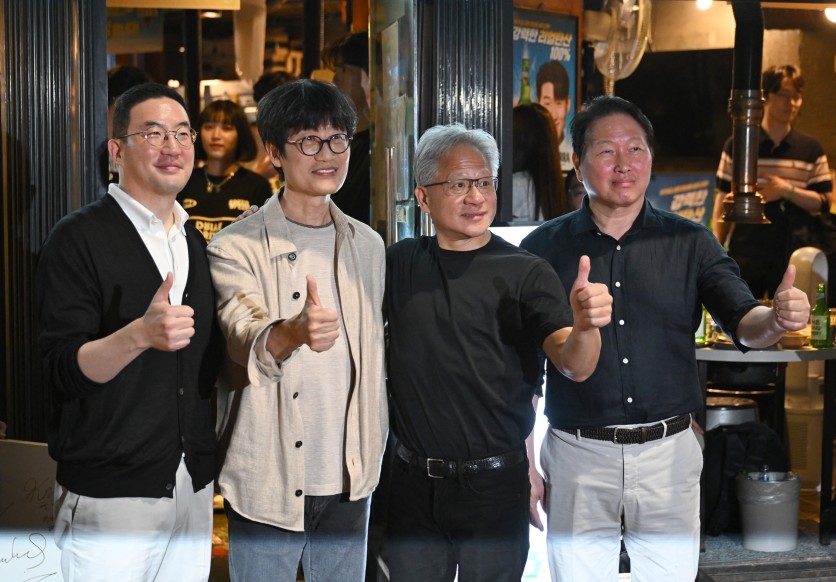
Huang's itinerary has mixed corporate diplomacy with distinctly Korean popular-culture moments. After arriving at Gimpo Business Aviation Center on June 5, he traveled to T1 Basecamp in the Mapo district, where he presented star League of Legends player Lee "Faker" Sang-hyeok — the six-time world champion — with a personally signed GeForce RTX 5090 graphics card, calling it "only one in the world." That evening, he joined SK Group Chairman Chey Tae-won, LG Group Chairman Koo Kwang-mo, and Naver founder and Chairman Lee Hae-jin for dinner at a Korean barbecue restaurant near Hongdae, with the assembled conglomerate chairs hearing Huang declare that "everyone loves HBM."
A dedicated website tracking Huang's Seoul itinerary attracted more than 70,000 visitors as Korean stock prices for Nvidia's local partners rose in real time during the visit.
The remaining days of the trip are scheduled to include individual meetings with the heads of Samsung, Hyundai Motor Group, LG, and SK on June 6; a session on June 7 with NCSoft founder Kim Taek-jin and Krafton chairman Chang Byung-gyu to discuss physical AI and AI gaming; and a private roundtable on June 8 at Seoul's Shilla Hotel with Korean AI and robotics startups — with founders from Upstage, Nota, and VesselAI among those expected to attend. Huang is also scheduled to record an appearance on the popular talk show "You Quiz on the Block" and, on June 8, throw the ceremonial first pitch at the Doosan Bears' game against the Kiwoom Heroes at Jamsil Stadium — wearing a Bears jersey bearing No. 93 for Nvidia's 1993 founding year, while Doosan Group Chairman Park Jeong-won takes the plate in No. 96 for the group's 1896 founding.
Frequently Asked Questions
What is Nvidia's R&D center in South Korea focused on?
Nvidia's Seoul facility — formally called the AI Technology Center — will focus on physical AI research, robotics, and AI infrastructure solutions. Hiring is underway, and Nvidia plans to build a dedicated physical site once the team reaches sufficient scale. The center mirrors facilities Nvidia has established in Singapore and Taiwan, making Korea the third point in its Asia R&D network.
Why is Nvidia building a research center in South Korea?
South Korea is home to Samsung Electronics and SK hynix, who together supply the majority of the high-bandwidth memory chips inside every Nvidia GPU. The country also has the world's highest industrial robot density — 1,220 units per 10,000 workers — providing a live manufacturing environment where Nvidia's physical AI and robotics platforms can be developed and deployed directly on factory floors.
How does the HBM4 supply chain work for Vera Rubin?
HBM4 stacks multiple DRAM dies vertically using through-silicon vias (TSVs), doubling the memory interface from 1,024 to 2,048 bits and delivering at least 2 terabytes per second of bandwidth per stack. Samsung, SK hynix, and Micron all passed Nvidia's certification for Vera Rubin; SK hynix holds an estimated 60 to 70 percent of the allocated volume, with Samsung at 25 to 30 percent and Micron taking the remainder.
What is Nvidia's physical AI strategy in Korea?
Nvidia is working with Hyundai Motor Group — under a roughly $3 billion joint investment with the Korean government announced in October 2025 — to deploy 50,000 Blackwell GPUs in an AI factory that will train and validate models for autonomous driving, smart manufacturing, and industrial robotics. The underlying technology is Nvidia's Cosmos platform, which uses World Foundation Models to generate physics-accurate synthetic training data inside a digital twin environment before physical deployment.
ⓒ 2026 TECHTIMES.com All rights reserved. Do not reproduce without permission.


