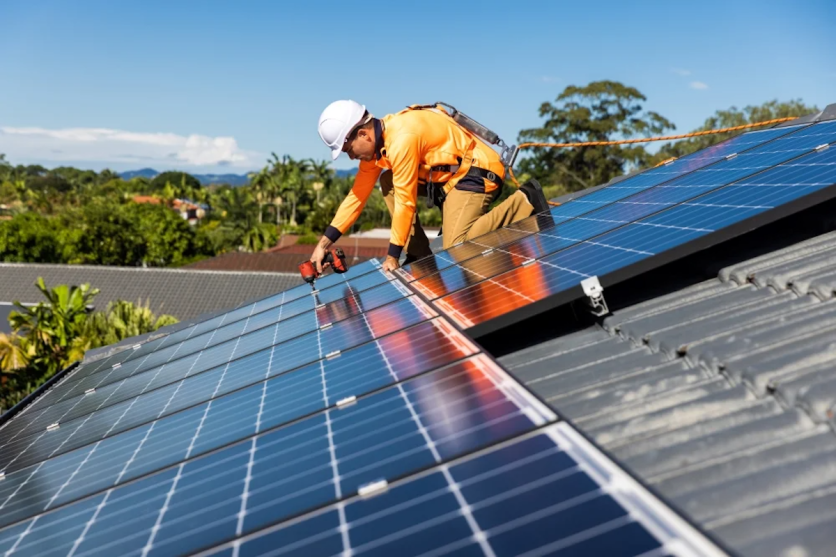
The United States crossed 6 million cumulative solar installations in the first quarter of 2026, according to a report published Tuesday by the Solar Energy Industries Association (SEIA) and Wood Mackenzie — a milestone that arrived alongside a record share of homeowners pairing their panels with batteries and a steepening contraction in the residential market driven by the expiration of the 30% federal tax credit.
Solar and battery storage together claimed 91% of all new electricity-generating capacity added to the US grid in Q1 2026, the U.S. Solar Market Insight 2026 Q2 Report found. That dominance partly reflects solar and storage's genuine speed advantage over alternatives — both can be deployed faster than gas turbines, which carry manufacturing lead times now stretching to 2028. In a grid under acute capacity pressure from AI data center load growth, that deployment speed is not a preference but an operational necessity.
Solar and Battery Storage Claim 91% of New Grid Capacity in Q1
The US solar industry added 7.8 gigawatts (GW) of capacity in the first quarter of 2026 — a period that is typically the weakest quarter for installations due to seasonal patterns, and which reflected a 27% decline from Q1 2025 and a 42% decline from the preceding quarter. Despite that sequential pullback, solar alone accounted for 60% of all new US electricity-generating capacity in Q1, with battery storage contributing the remaining 31% of the combined 91% figure.
Darren Van't Hof, interim president and CEO of SEIA, said the numbers underscore an energy-security argument that is increasingly divorced from clean energy politics. "In a world of fluctuating fuel prices, energy buyers have made it clear that they want the security, low cost, and speed of solar and storage," Van't Hof said, warning that federal permitting delays are slowing the only sector actively building new power. "Impeding the only sector that is actively building new power is a reckless gamble that will only drive electricity bills higher."
Michelle Davis, head of solar at Wood Mackenzie, offered a more constrained forecast: "We are forecasting that US solar additions will be flat over the next five years despite the need for more power supply in the US," Davis said. "We've seen a notable increase in solar procurements in utility resource planning, but current permitting bottlenecks continue to serve as near-term headwinds."
Read more: US Solar Energy Boom Hits 28 Months Running: Gas Turbine Backlog and AI Demand Outweigh Policy Cuts
AI Data Center Contracts Drive Utility-Scale Solar Up 15%
The strongest signal in the report came from the utility-scale segment, where contracting activity reached 6.3 GW in Q1 2026 — a 15% increase year-over-year — driven primarily by technology companies securing long-term power supply for AI-driven data centers. Offtake agreements in Q1 were led by data and technology firms operating primarily in Texas, which continued its position as the fastest-growing solar market in the country.
The economics of this procurement model explain why solar is capturing AI power demand rather than natural gas. Tech companies accept stable, long-term fixed power rates in exchange for supply certainty; solar and storage projects offer that stability without exposure to fuel price volatility. Gas turbines carry commodity exposure and manufacturing delivery times that have stretched to 2028 or later, making them operationally unavailable for data centers that need capacity online within two to three years.
States that voted for President Trump in the last election accounted for 74% of all solar capacity installed in Q1, with Texas, Florida, Ohio, Indiana, Michigan, Arizona, and Mississippi among the top ten states for new additions — a geographic distribution that complicates the political framing around clean energy.
How Battery Storage Makes Solar Viable at Grid Scale
The 91% share of new capacity claimed by solar and storage together rests on a specific technical architecture that did not exist at scale five years ago. At the grid level, utility-scale battery energy storage systems (BESS) use lithium iron phosphate (LFP) chemistry paired with a power conversion system (PCS) that manages bidirectional DC-to-AC energy conversion. A battery management system (BMS) monitors the state of charge of each cell string; an energy management system (EMS) running optimization algorithms determines when to charge — typically during midday solar overproduction — and when to discharge to meet evening peak demand or provide grid frequency regulation.
Battery systems can absorb and deliver both real and reactive power with sub-second response times, enabling a grid stability function that was previously reserved for spinning gas turbine reserve capacity. The result is that solar paired with four-hour LFP storage can now firm midday generation into evening delivery, the period when solar generation drops and demand peaks, without requiring a gas backup.
At the residential level, that same architecture is driving the record 45% storage attachment rate. Homeowners who install solar-plus-storage receive the system's full economics through time-of-use arbitrage — charging batteries when grid power is cheap or solar is abundant, discharging when retail rates are high — plus backup power during grid outages. For homeowners without the 30% Section 25D tax credit that expired December 31, 2025, the economics increasingly favor third-party ownership (TPO) structures such as leases and power purchase agreements (PPAs), which remain eligible for the commercial clean energy investment tax credit (Section 48E) through projects safe-harbored before July 4, 2026.
Why Residential Solar Is Falling 21% Even as Grid Installations Grow
The contrast between the utility-scale surge and the residential contraction reflects two markets governed by different economics and policy environments. Wood Mackenzie projects a 21% decline in residential solar installations across all of 2026 — a figure that compounds the loss of the Section 25D tax credit with the bankruptcy of Freedom Forever, the second-largest national residential installer, which filed for Chapter 11 in April 2026 after its financing partner Solar Mosaic collapsed in mid-2025.
Freedom Forever's failure left workers, including warehouse staff in Connecticut and elsewhere, with paychecks delayed at the time of the bankruptcy filing. Thousands of customers were left with "orphaned" solar systems whose installer no longer existed to service them. The company's collapse followed a cascade that included Sunnova, ADT Solar, and Titan Solar Power — a sustained wave of installer failures driven by higher financing costs, California's net metering policy transition, and the withdrawal of Biden-era loan guarantees.
The One Big Beautiful Bill Act, signed July 4, 2025, eliminated the 30% residential solar tax credit nine years ahead of its scheduled phase-out under the Inflation Reduction Act of 2022. Any residential system installed on or after January 1, 2026 receives no Section 25D credit. For a $25,000 system, that is $7,500 out of pocket that the federal government no longer subsidizes.
Recovery is forecast to begin in 2027, driven by third-party ownership deals and rising retail electricity rates. Safe-harbored projects — systems whose construction begins before July 4, 2026 — remain eligible for the Section 48E credit through 2030, creating a compressed but real window for residential storage-plus-solar adoption through TPO structures.
Real Constraint on Solar Growth: 2,290 GW Stuck in Interconnection Queues
The report's most significant structural finding is not the 6 million milestone but the gap between demand for solar capacity and the grid's ability to absorb it. The industry's five-year outlook calls for solar additions to remain flat at roughly 43 GW per year through 2031, a stagnation Wood Mackenzie attributes directly to permitting bottlenecks and interconnection queue timelines — not to any shortage of demand, financing, or technology.
As of the end of 2024, approximately 2,290 GW of generation and storage capacity were actively seeking grid interconnection in the United States, according to Lawrence Berkeley National Laboratory's 2025 Queued Up report. For context, the entire installed capacity of the US power fleet is roughly 1,200 GW. The interconnection queue is nearly twice the size of the infrastructure it is trying to connect to.
The Federal Energy Regulatory Commission (FERC) issued Order 2023 in mid-2023, replacing the previous serial queue process — where each project was studied individually in sequence — with a cluster-based model intended to group nearby projects and conduct coordinated impact studies. The reform is being implemented across transmission providers, but Lawrence Berkeley estimates that clearing the backlog at current completion rates could take decades. The Department of the Interior's memorandum on solar and wind development on federal land is additionally affecting roughly 30% of the early-stage solar pipeline, per the SEIA report, through permitting delays on federal acreage.
SEIA's analysis shows that 457 solar and storage projects have permits pending and are vulnerable to politically motivated delays or cancellations.
Read more: US Solar Energy Boom Hits 28 Months Running: Gas Turbine Backlog and AI Demand Outweigh Policy Cuts
What Does This Mean for Homeowners Considering Solar in 2026?
For a homeowner evaluating solar today, the SEIA report's findings point to a market in structural transition rather than stagnation. The 30% federal credit for direct purchase is gone, which meaningfully extends payback periods — adding roughly $7,500 in out-of-pocket cost on a $25,000 system. Third-party ownership structures (leases, PPAs) remain the strongest financial path for most homeowners, because the project owner, not the homeowner, claims the 48E commercial tax credit, passing savings through as reduced monthly payments.
The record 45% storage attachment rate reflects the practical reality that a battery is no longer an optional upgrade but an increasingly core part of the system's value proposition: it captures time-of-use savings, provides backup during grid outages, and positions the homeowner for net billing tariff environments that penalize excess solar generation without storage.
The installer landscape carries a new risk factor that did not exist three years ago. Multiple major national installers have filed for bankruptcy since 2022, leaving customers without warranty service and workers without earned wages. Evaluating installer financial stability — not just panel brand and price — has become a necessary part of the purchasing decision.
Frequently Asked Questions
How many solar installations are in the US?
The United States surpassed 6 million cumulative solar installations in 2026, according to SEIA and Wood Mackenzie. That total spans residential rooftops, commercial buildings, community solar projects, and utility-scale farms — and represents enough capacity to power roughly 50 million households. The industry crossed the 5 million milestone just two years earlier.
Why is residential solar declining in 2026?
The primary driver is the elimination of the 30% federal residential solar tax credit (Section 25D), which expired December 31, 2025 under the One Big Beautiful Bill Act — nine years ahead of its scheduled phase-out. For a $25,000 system, that means $7,500 in federal savings is no longer available to homeowners who purchase outright. The bankruptcy of Freedom Forever, the second-largest national installer, and financing partner failures at Mosaic and Sunnova compounded the market contraction. Wood Mackenzie projects a 21% overall decline for 2026, with recovery starting in 2027.
How does solar battery storage work at home?
A residential solar-plus-storage system pairs solar panels with a lithium iron phosphate (LFP) battery bank managed by a hybrid inverter. The inverter handles DC-to-AC conversion and controls whether solar power flows to the home, charges the battery, or goes to the grid. An energy management system (EMS) optimizes when to charge and discharge based on electricity rates and usage patterns — charging when solar production is high or grid rates are low, discharging during peak rate hours or outages. In Q1 2026, 45% of new residential solar installations included a battery, the highest share on record.
Is solar energy growing in the US despite policy rollbacks?
Yes at the utility scale; no at the residential scale. Solar and battery storage combined provided 91% of all new electricity-generating capacity added to the US grid in Q1 2026, driven by technology company data center contracts and the structural speed advantage of solar over gas turbines. The residential market, however, is contracting 21% in 2026 following the expiration of federal homeowner tax credits. The five-year forecast from Wood Mackenzie projects flat annual additions of roughly 43 GW — constrained not by demand but by interconnection queue backlogs and federal permitting delays affecting roughly 30% of the early-stage pipeline.
ⓒ 2026 TECHTIMES.com All rights reserved. Do not reproduce without permission.


