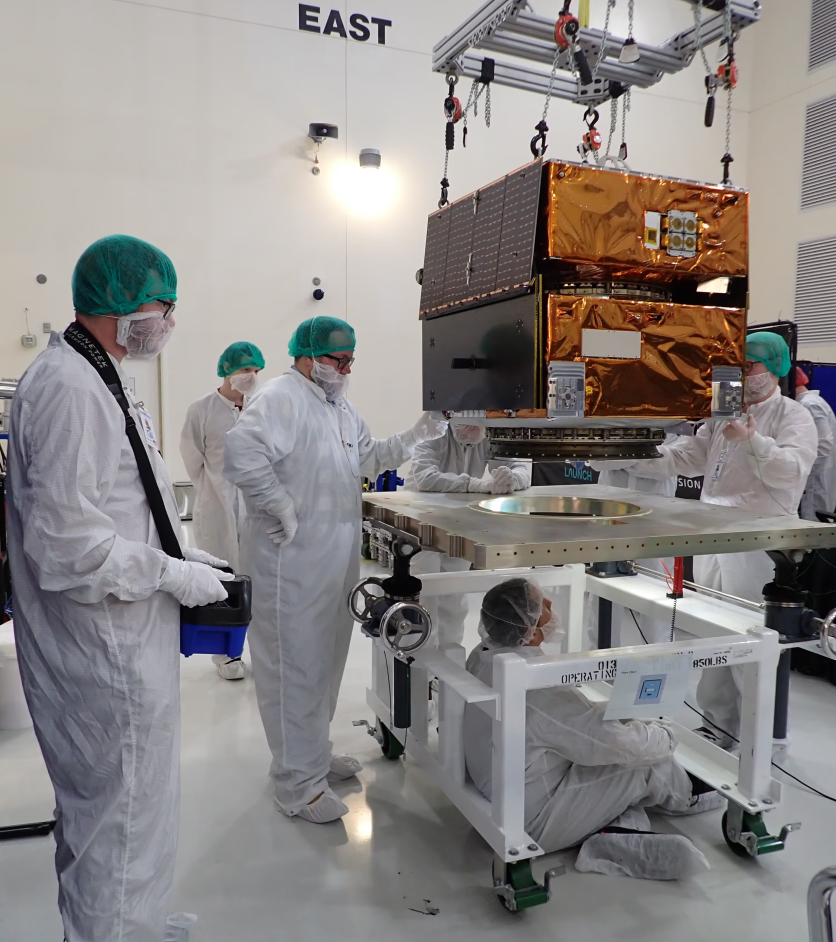
NASA's next landmark in commercial space just cleared its last major ground milestone. On June 9, engineers at NASA's Wallops Flight Facility in Virginia finished sealing Katalyst Space Technologies' LINK robotic spacecraft inside Northrop Grumman's Pegasus XL rocket. The stack now awaits transport to Kwajalein Atoll in the Marshall Islands, where it is scheduled to launch in late June on a mission no commercial operator has ever attempted: autonomously flying to a government science telescope, gripping it with robotic arms, and pushing it back into a safe orbit before atmospheric drag consumes it.
If LINK succeeds, it will be the first time a commercial spacecraft has captured an uncrewed government satellite that was never designed to be serviced — a distinction that separates this mission from every prior orbital servicing precedent. NASA has scheduled a media teleconference on June 17 at 11 a.m. ET to preview the mission with principals from Katalyst, Northrop Grumman, and the agency's Astrophysics Division.
Why Swift Cannot Save Itself
The observatory at the center of this race is the Neil Gehrels Swift Observatory, a $500 million gamma-ray burst detector that has been in continuous operation since its launch on November 20, 2004. Swift carries a wide-field Burst Alert Telescope that detects new gamma-ray bursts — the most energetic explosions in the universe — and autonomously slews its X-ray and ultraviolet optical instruments to the burst within 20–70 seconds of detection. That response time replaced what previously took roughly eight hours. At a burst-detection rate of about 100 per year over two decades, Swift has become a cornerstone alert system for the global high-energy astrophysics community, and no replacement mission is planned.
The problem is structural. When Swift was built, its engineers gave it a two-year design life in a 600-kilometer orbit with no onboard propulsion. For most of two decades, atmospheric drag at that altitude was manageable. That changed when Solar Cycle 25 reached its maximum in 2024. At solar maximum, intense X-ray and ultraviolet radiation heats the upper atmosphere, causing it to expand outward and increase drag on every object in low Earth orbit. Swift's altitude fell from 600 km to roughly 400 km — a 200-kilometer drop in a fraction of the time the prior decay took. By early 2025, NASA models projected Swift had a 50 percent chance of uncontrolled reentry by mid-2026, rising to 90 percent by year's end.
In February 2026, the Swift operations team suspended the observatory's X-ray and ultraviolet instruments and halted its automated slewing to minimize drag — buying months of additional time by reducing the spacecraft's cross-section against the atmosphere. The Burst Alert Telescope was halted in April 2026. Both were holding measures, not solutions.
How LINK Will Grip a Satellite With No Docking Port
Swift has never had a docking port, a grappling ring, or any cooperative fixture designed to receive a servicing vehicle. That fact defines LINK's engineering challenge. The spacecraft — roughly the size of a large mini-fridge, at about 1.5 meters tall and 400 kilograms — carries three robotic arms, each equipped with a small lidar sensor for precision ranging and imaging, and a mechanical gripper at the tip. During the approach phase, which Katalyst estimates will take two to three weeks after launch, LINK will execute a flyby inspection of Swift at safe standoff distances, using its lidar arrays to build a high-resolution picture of the observatory's current structural state.
The grip points LINK will target are not purpose-built docking fixtures. They are the pre-launch transportation flanges — small metal structural rims used decades ago to secure Swift during ground handling before its 2004 launch. Engineers at Katalyst studied old pre-launch photographs of the observatory and consulted with teams from NASA and Northrop Grumman to identify which flanges are most accessible, load-bearing, and unlikely to have deteriorated after 22 years of radiation and thermal cycling. The company's CEO, Ghonhee Lee, has noted that no images exist of Swift's backside from before launch — adding uncertainty that only the flyby inspection can resolve.
After attachment, LINK will fire its three hall-effect ion thrusters, fueled by xenon gas. Ion thrusters ionize xenon atoms and accelerate them through an electromagnetic field, generating thrust with high efficiency but low instantaneous force — ideal for the gradual, precise delta-v increments needed to raise an orbit without damaging a sensitive scientific instrument. The goal is to push Swift back up to approximately 600 km, the altitude at which it operated for its first two decades, extending the telescope's operational life by another decade or more.
The critical constraint is altitude. At 300 km, atmospheric drag becomes too intense for LINK's ion thrusters to overcome with available propellant. If Swift descends below that floor before LINK can execute the capture, the rescue becomes physically impossible. That hard limit shapes the entire mission timeline: every delay in launch or rendezvous narrows the window.
Why Pegasus XL Was the Only Viable Launch Vehicle
The launch vehicle choice follows directly from orbital mechanics. Swift's orbit has an inclination of 20.6 degrees — meaning it tracks a path 20.6 degrees north and south of the equator. Most small launch vehicles operated from U.S. ground facilities are constrained to orbital inclinations above roughly 27 degrees by their launch trajectories over populated land and ocean safety corridors. A rocket launched from Virginia, California, or Florida and aimed for 20.6 degrees would fly over inhabited areas.
The Pegasus XL eliminates the fixed-pad constraint entirely. Northrop Grumman's modified Lockheed L-1011 aircraft — named Stargazer — carries the rocket to approximately 40,000 feet over open ocean, then releases it. Five seconds after drop, the first of Pegasus XL's three solid rocket stages ignites, and its distinctive delta-shaped wing provides aerodynamic lift as the rocket climbs out of the atmosphere. The entire ascent to orbit takes roughly ten minutes. By staging the drop from Kwajalein Atoll near the equator, Stargazer can release Pegasus on a trajectory that matches Swift's 20.6-degree inclination without overflying any populated region. Katalyst CEO Ghonhee Lee has described Pegasus XL as "the only launch vehicle that can meet the orbit, the schedule, and the cost to achieve something unprecedented with emerging technology."
Commercial Orbital Servicing: What Came Before and Why This Is Different
Commercial orbital servicing has a short but significant history. Northrop Grumman's Mission Extension Vehicle-1 docked with Intelsat's IS-901 communications satellite on February 25, 2020, completing the first commercial satellite-to-satellite dock in history. That operation was designed around a cooperative target: a geostationary satellite with a standard engine nozzle that the MEV's grappler could latch onto directly, and a months-long transit that allowed leisurely approach and positioning.
LINK represents a categorically different problem. Swift has no cooperative docking interface. Its capture requires LiDAR-guided adaptive arm positioning calibrated to a specific structural feature identified from old photographs, executed in weeks rather than months, from a newly launched spacecraft built in under eight months. Principal investigator Kieran Wilson has described the timeline as putting the team "in an unusual situation where the schedule dictates how much risk we're willing to accept." Mission director John Van Eepoel at NASA Goddard has called it "a fast, high-risk, high-reward mission."
China demonstrated on-orbit capture capability in 2022, using its Shijian-21 spacecraft to tow a defunct Beidou navigation satellite to a higher disposal orbit. That operation involved a defunct satellite in geostationary orbit. Demonstrating rapid commercial capture of a propulsion-less but still-operational government satellite in low Earth orbit — on a weeks-long timeline with a commercially produced robot — would extend proven servicing capabilities to a fundamentally different orbit regime and spacecraft class.
The implications extend beyond any single telescope. A large share of the satellites currently in low Earth orbit — weather sensors, science observatories, communications relays — were launched without onboard propulsion or cooperative servicing interfaces. If LINK succeeds, it validates that any of those spacecraft can be rescued or repositioned, not just those built with a servicing visit in mind. Katalyst is already planning follow-on work, with a next-generation multi-mission spacecraft called Nexus targeting a 2027 launch to serve both commercial and defense satellite customers.
What Happens if LINK Succeeds — or Fails
A successful boost restores Swift to its original 600 km orbit. The Swift science team plans to resume observations after the orbit raise is complete, reactivating instruments that have been dormant since early 2026. The 21-year-old observatory would continue gamma-ray burst monitoring into the 2030s.
If LINK fails to execute the capture — whether because Swift has deteriorated beyond what the arms can grip, because the orbit falls below 300 km before rendezvous, or because a LINK system fails in flight — Swift will continue its uncontrolled descent and eventually reenter Earth's atmosphere over the ocean, with no replacement planned. NASA has characterized the attempt as inherently high-risk and worth attempting; the alternative is certain loss. Shawn Domagal-Goldman, director of NASA's Astrophysics Division, called it "a forward-leaning, risk-tolerant approach" that is "both more affordable than replacing Swift's capabilities with a new mission, and beneficial to the nation — expanding the use of satellite servicing to a new and broader class of spacecraft."
Frequently Asked Questions
What is the NASA Swift rescue mission?
NASA awarded Arizona-based Katalyst Space Technologies a $30 million contract to launch a robotic spacecraft called LINK to the Neil Gehrels Swift Observatory. Swift's orbit decayed from 600 km to roughly 400 km due to solar activity-driven atmospheric drag, and without a boost it faces uncontrolled reentry in 2026. LINK will attempt to grip the observatory with robotic arms and fire xenon ion thrusters to raise it back to its original altitude.
How will LINK spacecraft capture Swift Observatory?
LINK carries three robotic arms, each equipped with a lidar sensor for precision imaging. After a flyby inspection, LINK will grip the pre-launch transportation flanges on Swift's structure — small metal rims used during ground handling before Swift's 2004 launch — since Swift has no docking port or cooperative capture interface. Once attached, hall-effect xenon ion thrusters will execute the gradual orbit raise.
What is commercial orbital servicing, and why does this mission advance it?
Commercial orbital servicing involves sending a robotic spacecraft to refuel, repair, or reposition another satellite without human crew. Prior missions have serviced geostationary satellites with standard docking interfaces. LINK's mission would be the first time a commercial vehicle captures an uncrewed government satellite not designed for servicing — demonstrating that any satellite can potentially be rescued or repositioned, not just those with cooperative docking fixtures.
What happens if Swift falls below 300 km before LINK arrives?
At 300 km altitude, atmospheric drag exceeds what LINK's xenon ion thrusters can overcome with their available propellant. If Swift descends below that threshold before the rendezvous is complete, the rescue becomes technically infeasible and the telescope will continue to decay until reentry. This constraint makes the late-June launch timeline the article's defining urgency.
ⓒ 2026 TECHTIMES.com All rights reserved. Do not reproduce without permission.


