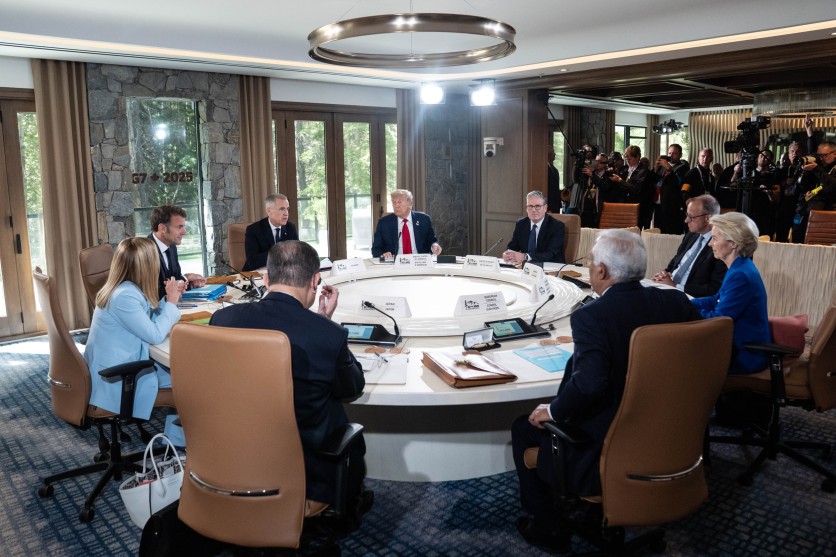
The world's most consequential economic gathering in years opens Monday in Évian-les-Bains, France, as three crises that will directly shape manufacturing costs, energy prices, and technology supply chains arrive simultaneously at the G7's doorstep. With a potential US-Iran peace agreement that could reopen the Strait of Hormuz possibly set to be signed as early as this weekend, a 15 percent universal import tariff legally expiring July 24, and a critical-minerals emergency that Europe's own data shows has already cost each of its affected economies an estimated $1.5 trillion, the 52nd Group of Seven summit carries stakes that have few recent parallels.
Speaking from the Oval Office on Thursday, President Donald Trump announced that the United States had reached what he described as a "great settlement" with Iran — "subject to the finalization of documents" — and said the Strait of Hormuz would be reopened "as soon as we have it signed." Trump said Vice President JD Vance and special envoy Steve Witkoff would represent the United States at any signing ceremony, which he suggested could happen in Europe "maybe over the weekend." South China Morning Post reported that a senior Iranian official indicated overnight that a deal is likely, with Geneva being floated as a possible signing location. Iran's foreign ministry confirmed the deal under discussion includes a memorandum of understanding as a first phase, before broader nuclear negotiations would begin within 30 to 60 days.
The conflict itself began February 28, when the United States and Israel launched military attacks on Iran. Iran retaliated by disrupting transit through the Strait of Hormuz — the waterway that carries roughly 20 million barrels of oil per day, representing about one-fifth of global petroleum consumption, according to the US Energy Information Administration. The Brookings Institution described the resulting supply disruption as the largest in the history of the global oil market. A fragile ceasefire has been in place since April 8, but shipping volumes through the strait have not recovered to pre-conflict levels.
Trump Cancels Strikes, Calls Deal Done: What Changed Thursday
RFE/RL reported that Trump's Thursday announcement came after he canceled a scheduled strike on Iran earlier that day, citing progress in talks "brought to the highest level of Iranian leadership." The administration is pursuing a 14-point framework that would require Iran to reopen the Strait of Hormuz within 30 days in exchange for a US suspension of hostilities and, according to Iranian state media, a reconstruction commitment and sanctions relief. Trump on Friday disputed Iranian accounts of the deal's terms, saying leaked documents circulating in Iranian media had "NOTHING to do with the terms that were agreed to, in writing." A signing ceremony, if it proceeds, would likely be held in Geneva, according to South China Morning Post.
A Hormuz reopening would immediately affect global maritime freight rates, tanker routing, and energy input costs for manufacturers worldwide. Oil prices rose sharply on news of Trump's announcement and fell again as Iranian officials disputed the terms, a cycle that has repeated several times during months of inconclusive negotiations.
Critical Minerals Supply Chain: What $1.5 Trillion Looks Like
For technology manufacturers, semiconductor suppliers, and the defense industry, the most structurally significant agenda item at Évian is not the Iran deal but the rare-earth crisis that has been building for years and accelerated sharply this year. The Atlantic Council, analyzing the stakes ahead of the summit, documented that Europe sources all of its heavy rare earth elements, 85 percent of its light rare earth elements, and 98 percent of its rare-earth magnets from China. When Beijing tightened export licensing for those magnets, shipments fell by three-quarters, automakers reduced production, and the Atlantic Council estimated that Europe and the United States each faced approximately $1.5 trillion in direct economic losses.
The International Energy Agency has tracked this dependency for years. Its analysis found that for 19 of the 20 most strategically important minerals, China is the leading refiner, with an average market share of 70 percent. For sintered permanent magnets — the components used in electric vehicles, wind turbines, industrial motors, data centers, and defense systems — China's share has risen to 94 percent. The Council on Foreign Relations has called this an "overwhelming dependence" that leaves US defense, aerospace, automotive, and electronics industries "at risk of Chinese coercion."
France is reportedly considering establishing a permanent secretariat to steward the critical-minerals agenda across future G7 presidencies — a move that would mark a structural upgrade from the year-by-year approach that has characterized G7 action on the issue since Canada's 2025 presidency produced the Critical Minerals Action Plan. According to Reuters reporting via Mining.com, the secretariat could be housed at the International Energy Agency or the Organisation for Economic Co-operation and Development, both based in Paris.
Macron's Last Opening Toward Beijing
In an unusual diplomatic move on Thursday, Macron chaired a video conference he called the "Global Convergence for Growth," which brought together G7 finance ministers, IMF representatives, and, in a rare appearance, Chinese Vice Premier Zhang Guoqing. The Élysée Palace confirmed Zhang participated at the invitation of the French government. Zhang's participation is significant because Beijing has long condemned the G7 as an illegitimate forum unrepresentative of the current world order and has resisted direct engagement with it. In his remarks, Zhang called for "a free and convenient trade environment" and said China would "continue to share development opportunities with other countries."
The video call came just days before EU leaders meet immediately after the G7 gathering, with China's export surge squarely on the agenda. Global Banking & Finance Review, citing Reuters, described the surge as a "second China shock" — analysts' term for a repeat of the disruption caused by China's 2000s domination of low-value industries, now playing out in electric vehicles, lithium-ion batteries, and advanced manufacturing sectors that Europe considers strategically essential.
Macron's goal was not to resolve the dispute but to demonstrate to Beijing that the G7's response would involve dialogue rather than unilateral tariffs — or, at minimum, to complicate any Chinese decision to escalate export restrictions ahead of the summit.
Section 122 Tariff Clock: July 24 Is a Hard Deadline
Less discussed outside trade policy circles but directly consequential for businesses that import goods is the approaching end of the Section 122 tariff authority. The 15 percent universal surcharge on virtually all US imports took effect February 24, when the Trump administration invoked Section 122 of the Trade Act of 1974 hours after the Supreme Court struck down the administration's prior IEEPA-based tariffs. Section 122 caps the surcharge at 15 percent and limits it to 150 days without Congressional authorization. That 150-day clock runs out at 12:01 a.m. Eastern Time on July 24, 2026 — six weeks after the summit closes.
The president cannot extend Section 122 unilaterally. Congress has not passed extension legislation, and no extension bill has cleared committee. If the authority lapses with no Congressional action and no Section 301 replacement in place, the universal surcharge disappears and landed costs for affected imports fall by 15 percent of customs value overnight. The more likely scenario, according to trade policy analysts, is that the administration uses the G7 to signal successor frameworks — coordinated Section 301 investigations targeting industrial overcapacity are already underway — and uses Évian to align G7 partners on parallel enforcement mechanisms.
Divisions the Summit Cannot Hide
Not every observer expects the summit to produce binding outcomes. G7 leaders are expected to forgo issuing a joint communiqué for the second consecutive year, according to Jiji Press reporting via Nippon.com. Instead of a comprehensive declaration, the G7 members plan to compile area-specific outcome documents on correcting global economic imbalances and strengthening supply chains for critical minerals. The absence of a unified final document would mark the second straight year the forum failed to reach consensus since Trump returned to the presidency.
Heidi Crebo-Rediker, a senior fellow at the Council on Foreign Relations, warned this week that Trump could arrive in Évian "ready to use the G7 stage to berate allies" for what he views as insufficient support following Hormuz disruptions. Xinhua reported Friday that according to a survey published by the European Council on Foreign Relations, only 11 percent of Europeans currently view the United States as an ally — down from 16 percent six months ago.
The summit runs through Wednesday, June 17. Its outcomes — whether a Hormuz deal, a critical-minerals secretariat, or a coordinated tariff successor framework — will ripple through energy markets, manufacturing supply chains, and technology procurement for years.
Frequently Asked Questions
What will be discussed at the G7 Summit in 2026?
The Évian summit's agenda focuses on four trade priorities — controlling industrial overcapacity, strengthening supply-chain resilience, modernizing the multilateral trade system, and promoting safer cross-border e-commerce — alongside the Iran conflict and the Strait of Hormuz, critical-minerals supply diversification, and macroeconomic imbalances driven by China's export surge. The summit also serves as a backdrop for a potential US-Iran peace agreement that could reopen the Hormuz strait.
What is the Strait of Hormuz deal that Trump announced?
Trump declared Thursday that the United States and Iran had largely negotiated a peace agreement under which Iran would reopen the Strait of Hormuz, the waterway that carries roughly 20 million barrels of oil per day. The deal is structured as a memorandum of understanding to be followed by broader nuclear talks. Trump said signing could happen as early as this weekend in Europe, with Vice President Vance and envoy Steve Witkoff representing the US, though Iran disputed Trump's characterization of the terms on Friday.
What happens when the Section 122 tariff expires in July 2026?
The Section 122 universal import surcharge of 15 percent expires automatically at 12:01 a.m. Eastern Time on July 24, 2026. If Congress does not pass extension legislation before that date, and if no replacement tariff authority is in place, the surcharge disappears and import costs for virtually all non-USMCA goods fall by 15 percent of customs value. The Trump administration has initiated Section 301 investigations that could form a replacement framework, but no successor tariff has been formally announced.
Why can't the G7 countries just stop relying on China for rare earths?
Diversifying away from China's rare-earth dominance is technically possible but takes years. China controls 94 percent of sintered permanent magnet production and refines 70 percent or more of most strategic minerals. Alternative mines exist in Australia, Canada, and elsewhere, but processing capacity outside China is minimal and takes a decade or more to build. The G7 has been working on supply-chain diversification since 2023, and France is pushing for a permanent secretariat at Évian to accelerate the effort.
ⓒ 2026 TECHTIMES.com All rights reserved. Do not reproduce without permission.


