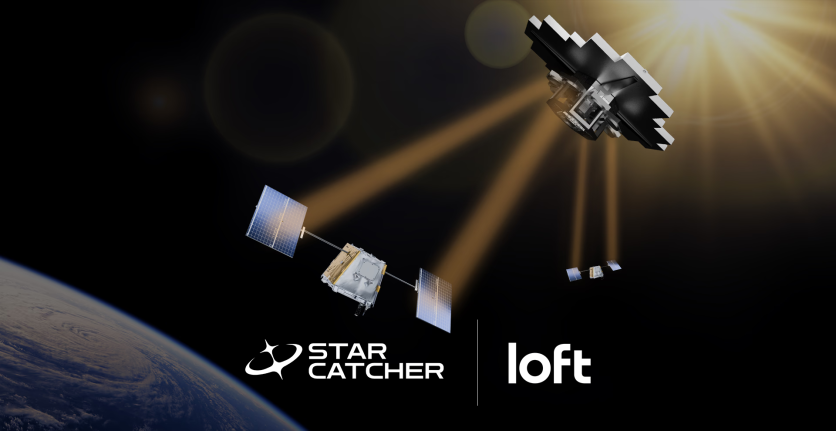
Star Catcher Industries, a Jacksonville, Florida startup founded less than two years ago, closed a $65 million oversubscribed Series A round on May 12, 2026, to build what it describes as the first commercial power grid in orbit — a constellation of satellites that harvest solar energy and beam it via optical lasers to other spacecraft, eliminating the power shortages that limit every satellite currently in service.
The raise, led by B Capital and co-led by Shield Capital and Cerberus Ventures, brings Star Catcher's total capital raised to $88 million. It comes two days after the company announced the round publicly and just months before Star Catcher's first in-space power-beaming demonstration mission, scheduled for later in 2026.
For satellite operators — from national security agencies to commercial SmallSat companies — the announcement signals a potential shift from fixed power budgets to on-demand energy in orbit. Star Catcher says it already holds $60 million in signed power purchase agreements and manages a commercial pipeline representing more than $3 billion in projected annual recurring revenue.
Every Satellite Today Runs a Power Budget. Star Catcher Wants to End That.
Spacecraft in low Earth orbit spend a significant portion of each pass in Earth's shadow, cut off from sunlight. CubeSats and SmallSats are especially constrained: their solar panel surface area is small relative to the power demands of high-resolution sensors, electric propulsion systems, and onboard computing.
"We are all just going on camping trips to space," said Andrew Rush, Star Catcher's co-founder and CEO, in comments to SpaceNews. "That's why, at Star Catcher, we're focused on building the world's first power grid in space — to eliminate that bottleneck and take us from a world of power budgets into a world of power abundance."
Star Catcher's approach uses optical power beaming — focused, conditioned solar energy directed at a client satellite's existing solar panels. The company says the system can deliver up to 10 times the power a spacecraft's panels would otherwise generate during the same orbital period, with no retrofit or custom receiver hardware required on the client side.
The company demonstrated the ground-based version of the technology at Space Florida's Launch and Landing Facility at Kennedy Space Center, transmitting energy along the former space shuttle runway to commercial off-the-shelf solar panels of the type commonly used on spacecraft. A supporting subsystem — acquisition and tracking software — was validated on a Loft Orbital satellite in late 2025.
Space Force's First General and Two Energy Investors Join the Board
The Series A adds notable names to Star Catcher's board. Retired Gen. John W. "Jay" Raymond, who served as the first Chief of Space Operations of the U.S. Space Force before joining Cerberus Capital Management as a senior managing director, will join Star Catcher's board alongside B Capital General Partner Jeff Johnson and Shield Principal David Rothzeid.
"Persistent surveillance, resilient communications, and unhindered maneuverability are all constrained today by power," Raymond said in the company's announcement. "An on-demand power grid can change that, expanding critical capabilities across commercial and national security missions."
The dual commercial and defense appeal is deliberate. Star Catcher's signed contracts span both commercial space operators and U.S. government customers. Shield Capital, a venture firm focused on national security technology, described Star Catcher as having moved from concept to flight hardware faster than almost any other frontier-tech company it tracks.
A 2026 In-Space Demonstration Will Determine the Technology's Commercial Timeline
Star Catcher plans to launch its first orbital power-beaming mission before the end of 2026. A second mission is already in development. Rush told SpaceNews that the two missions "will position us for going operational and for scaling." The company, which currently employs about 40 people, said it expects to grow substantially across engineering and operations with the new funding.
The demonstration will be the first true test of optical power beaming between spacecraft at orbital velocities — a significantly harder problem than the ground tests. Beam-pointing accuracy, efficiency losses across transmission and reception stages, and the absence of atmospheric interference all present engineering challenges that ground testing cannot fully replicate.
Star Catcher is not the only organization working toward wireless power transfer in space. Caltech's Space Solar Power Project completed its SSPD-1 mission in 2023, successfully detecting a microwave power signal beamed from orbit to receivers on the university's campus — a foundational proof of concept. The European Space Agency's SOLARIS initiative has also received ESA funding commitments for space-based solar power research. But no competitor has announced a commercially deployable constellation at this funding level or with this customer traction.
Orbital Data Centers Are the Next High-Power Target
Beyond the immediate satellite services market, Star Catcher has begun highlighting orbital data centers as a priority customer category. Data centers require large, sustained power loads — precisely the use case where Star Catcher's on-demand delivery model offers the clearest advantage over conventional solar panels alone.
"It's our view that the early adopters are the folks that have power-dense, power-intense operations and payloads," Rush said. Beyond early adopters, he argued that every spacecraft will eventually need the service — for mission extension, orbital maneuvering, or resiliency. "Fundamentally, at some point every spacecraft will need our service," he said.
Jeff Johnson of B Capital framed the orbital power market in terms familiar from the terrestrial energy transition: "There is exploding demand, limited shared infrastructure, and a generational opportunity for the company capable of building the first in-orbit grid."
Space-Based Solar Power Moves from Concept to Engineering Problem
What makes the Series A notable beyond satellite services is what wireless orbital power transfer represents at a longer horizon. Space-based solar power (SBSP) — the decades-old concept of placing photovoltaic arrays in geostationary orbit and transmitting gigawatts of clean energy to Earth around the clock — has historically been blocked by the cost of launching and assembling massive structures. Solar irradiance in geostationary orbit is consistently higher than what reaches Earth's surface after accounting for atmospheric losses and the day-night cycle, making the physics favorable even if the economics have not been.
Star Catcher's orbital relay approach works at the power levels and orbital ranges relevant to today's satellite operators, not at the gigawatt scale of a mature SBSP system. But the capability it is building — demonstrated, commercially motivated wireless power transfer in orbit — is the same foundational layer that any future large-scale SBSP system would require.
For satellite operators, the near-term question is simpler: will Star Catcher's first in-space demonstration this year perform as the ground tests suggest? If it does, the company's $3 billion pipeline could begin converting into operational contracts. If it does not, the technology will need additional development time before the commercial model holds.
ⓒ 2026 TECHTIMES.com All rights reserved. Do not reproduce without permission.


