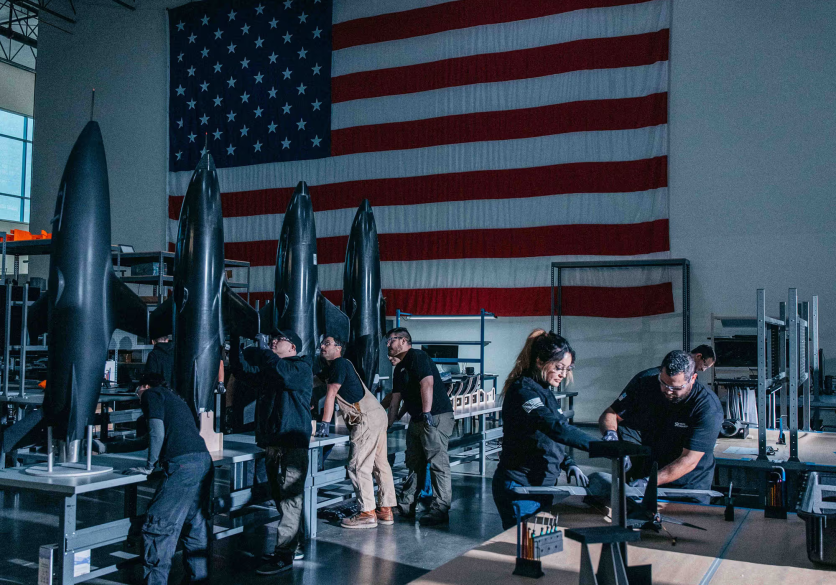
Mach Industries, the three-year-old Huntington Beach defense startup developing five autonomous weapons platforms, spent $50 million in April to acquire solid rocket motor maker Exquadrum — beating out more than eight rival bidders — and has rebranded the acquired company as Mach Energetics. The announcement, made public May 19, targets the single most constrained component in modern drone-era warfare: a domestic solid rocket motor supply that decades of industry consolidation have compressed down to two major producers.
Solid rocket motors are the self-contained propulsion units that power tactical missiles, drone interceptors, and precision munitions. For most of the past twenty years, the U.S. industrial base for making them shrank from six manufacturers to effectively two — Aerojet Rocketdyne, now part of L3Harris, and Northrop Grumman — creating a chokepoint that the Pentagon has repeatedly flagged as a national security liability. Supply chain nozzle components alone carry lead times of seven to ten months, according to defense analytics firm Govini, and a fatal explosion at propellant supplier Accurate Energetic Systems in October 2025 illustrated how fragile single-source dependency has become.
For Mach Industries founder and CEO Ethan Thornton, who dropped out of MIT at 19 to start the company, that scarcity made the acquisition structurally unavoidable. "Vertical integration is non-optional," Thornton said in a statement. "In many areas of the defense industrial base, these components are not only too expensive or lacking performance, they're simply unavailable, with lead times stretching years."
Solid Rocket Motor Supply Crunch Forced a Vertical Integration Play
Exquadrum, founded roughly 24 years ago and based in Victorville, California, built its business as a developer and manufacturer of solid rocket motor propulsion technologies, launch capabilities, divert and attitude control systems, and munitions. As part of the acquisition, all 85 Exquadrum employees are joining Mach, along with the company's intellectual property, business lines, and its 70,000-square-foot facility anchored by a nearby energetics and rocket propulsion test site. The combined company now employs roughly 350 people. Exquadrum co-founders Kevin Mahaffy and Eric Schmidt — no relation to the former Google CEO — are both taking on leadership roles within Mach Energetics and the broader organization.
The deal gives Mach direct ownership over one of the most consequential inputs across all five of its vehicle programs: Viper, a jet-powered vertical-takeoff-and-landing aircraft; Glide, a high-altitude strike glider; Stratos, an airborne surveillance platform; Dart, a low-cost counter-drone interceptor; and Pike, a long-range strike munition built for large-scale deployment. Mach says the acquisition improves unit economics across all five platforms at precisely the moment the company is moving into production — with at least three programs expected to enter manufacturing this year.
How Mach Energetics Plans to Serve the Broader Defense Market
Mach is not positioning Mach Energetics as a captive supplier serving only its own programs. According to Thornton, the new division will sell components, testing services, and subsystems to other defense firms as well, a move that signals Mach sees itself as potential infrastructure for the broader defense-tech ecosystem rather than simply a systems builder.
That ambition arrives at a moment when the Pentagon has made expanded solid rocket motor production an explicit priority. The Defense Department awarded Anduril Industries $43.7 million in Defense Production Act Title III funding in February 2026 — its second such investment in Anduril in just over a year — specifically to expand domestic solid rocket motor production capacity. The Pentagon separately committed $1 billion in a direct equity investment in L3Harris' Missile Solutions business in January 2026. Under Secretary of War for Acquisition and Sustainment Michael Duffey framed the urgency plainly: "The surge in demand for propellant-based weaponry, coupled with a narrow supplier base, has created a bottleneck in SRM production."
Defense Tech Vertical Integration: Why Startups Are Buying Instead of Building
The Mach-Exquadrum deal reflects a consolidation wave visible across the defense-tech startup class. Anduril Industries, which raised $1.5 billion in 2024 at a $14 billion valuation, has pursued vertical integration through its Arsenal manufacturing platform and supply chain acquisitions. X-Bow, Ursa Major, and Firehawk Aerospace have all moved into solid rocket motor production from the ground up. What distinguishes Mach's approach is timing: rather than building propulsion capabilities from scratch — a path Thornton described as essentially impossible for this component — the company acquired a 24-year-old firm whose engineering team and test infrastructure would have taken years to replicate internally.
That calculation is increasingly common as the defense-tech sector moves out of its prototype phase. When procurement happens at scale, the cost to produce the tenth unit, or the thousandth, becomes a variable that determines contract competitiveness. A startup that can demonstrate both technical capability and manufacturing cost discipline is a fundamentally different procurement partner than one that cannot. Mach's total fundraising now stands at nearly $200 million, including a $100 million Series B in June 2025 led by Bedrock Capital, Khosla Ventures, and Sequoia Capital at a $470 million valuation.
What the Pentagon's FY2027 Budget Request Means for Companies Like Mach
The backdrop for this acquisition is a proposed autonomous warfare budget that would represent one of the largest single-year increases in modern defense procurement history. The Pentagon's FY2027 budget request includes $54.6 billion for the Defense Autonomous Warfare Group, which absorbed the earlier Replicator initiative in late 2025. That request — up from $225.9 million in the current FY2026 budget — is not yet appropriated and will require congressional approval. But the directional signal is unambiguous: the U.S. military intends to buy autonomous weapons systems at production volumes that dwarf anything Replicator attempted.
For companies entering that market, the lesson of Replicator's limited results — hundreds of systems delivered rather than the thousands targeted by August 2025 — is instructive. The initiative struggled not just with procurement bureaucracy but with platforms that were too expensive and too slow to manufacture in the required quantity. If DAWG funding reaches anything close to requested levels, the companies positioned to benefit will be those that already control their propulsion supply chains, can demonstrate unit-cost discipline at volume, and do not depend on a two-supplier market that is already strained.
Mach spent $50 million to put itself on the right side of that threshold.
Frequently Asked Questions
What does Mach Industries do, and what is Mach Energetics?
Mach Industries is a Huntington Beach, California defense startup building five autonomous weapons platforms — including drone interceptors, surveillance aircraft, and long-range strike munitions — for the U.S. military. Mach Energetics is its new dedicated propulsion and energetics division, formed from the acquisition of solid rocket motor maker Exquadrum, which the company bought in April 2026 for $50 million.
Why does the U.S. military have a solid rocket motor shortage?
Industry consolidation over roughly 30 years reduced the number of domestic solid rocket motor manufacturers from six to two — Aerojet Rocketdyne, now part of L3Harris, and Northrop Grumman. Demand for tactical missiles, drone interceptors, and precision munitions has surged, but the supplier base has not kept pace, creating production delays and lead times on critical components that can stretch to seven to ten months.
How does defense tech vertical integration help cut weapons costs?
When a defense startup owns its own propulsion supply rather than purchasing motors from external suppliers with years-long lead times, it can design motors specifically for each platform, reduce procurement delays, iterate faster during development, and lower per-unit production costs at scale — all of which improve competitiveness for Pentagon contracts that increasingly reward cost discipline alongside technical performance.
What is the Pentagon's DAWG and why does it matter for drone startups?
The Defense Autonomous Warfare Group (DAWG) replaced the Replicator initiative in late 2025 as the Pentagon's primary vehicle for procuring autonomous weapons at scale. The Trump administration's FY2027 budget request proposes $54.6 billion for DAWG — up from $225.9 million in FY2026 — signaling intent to buy autonomous systems at volumes far exceeding anything previously attempted. Companies with demonstrated manufacturing and supply-chain capabilities are best positioned to capture those contracts.
ⓒ 2026 TECHTIMES.com All rights reserved. Do not reproduce without permission.


