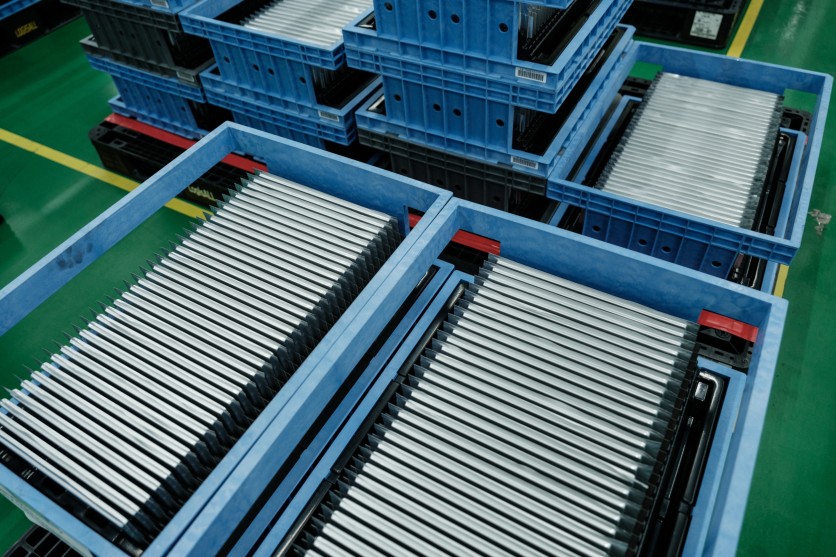
Donghwa Electrolyte, a South Korean specialty chemical maker and subsidiary of Donghwa Enterprise, signed a new ternary electrolyte supply agreement with an undisclosed global battery cell manufacturer on May 27, 2026, adding another U.S. customer to its growing client list and reinforcing the case that the Tennessee battery cluster is becoming a self-sustaining regional hub — not just an assembly point for cells made from imported chemistry.
The agreement covers nickel-manganese-cobalt (NCM) ternary electrolyte for electric vehicle batteries. The electrolyte will be produced at Donghwa's Clarksville, Tennessee facility and shipped to the customer's own U.S. production site. Donghwa declined to name the customer or disclose the contract's value, citing a non-disclosure agreement.
Kim Hyung-nam, head of sales at Donghwa Electrolyte, said the company had been "consecutively entering the North American battery supply chain" since the Tennessee plant came online, calling the wins a sign of its ability to respond to fast-shifting market demands.
Electrolyte: Battery Chemistry's Most Overlooked Bottleneck
Electrolyte is one of four core components in a lithium-ion battery, alongside the cathode, anode, and separator. It serves as the liquid medium through which lithium ions shuttle between electrodes during charging and discharging — meaning that without a local electrolyte supply, even a fully built U.S. cell plant cannot produce finished batteries.
For years, electrolyte supply ran almost entirely through Asia. China currently accounts for roughly 90 percent of global electrolyte production, making it the single most concentrated node of supply-chain vulnerability for U.S. battery manufacturers. The push to localize electrolyte production inside North America has become one of the quieter consequences of U.S. industrial policy aimed at building a domestic battery base — and a Center for Strategic and International Studies report published in April 2026 found that electrolytes stand as a "notable exception" among battery components that have successfully advanced toward domestic sourcing, even as cathode materials, foils, and separators have lagged.
Korean suppliers — longtime partners of LG Energy Solution, Samsung SDI, and SK On — have been among the most aggressive in following their cell-maker customers across the Pacific. Donghwa's consecutive contract wins since its Tennessee plant came online represent exactly that pattern.
Donghwa Electrolyte Tennessee Plant: 86,000 Metric Tons, One Active Competitor Gone
Donghwa's U.S. operation sits in Clarksville, Tennessee, in Montgomery County, roughly 45 miles north of Nashville near the Kentucky border. The facility, which required a $70 million investment and created 68 jobs paying between $55,000 and $150,000 annually, has an annual production capacity of 86,000 metric tons — the largest among Donghwa's global plants when completed in late 2024.
The location was deliberate from the start. Clarksville-area officials identified Donghwa when the plant was announced in early 2023 as a planned supplier to Ford's Blue Oval City project, to Ultium Cells — the General Motors-LG Energy Solution joint venture — and to LG Chem, all major nodes in the emerging Southeast U.S. battery cluster. EV-related projects had committed roughly $16 billion in investment and more than 12,000 jobs in Tennessee since 2017 as of the plant's 2023 announcement, figures that a 2025 Environmental Defense Fund report has since revised upward to $17.5 billion and more than 20,000 jobs.
The competitive landscape for electrolyte suppliers in Tennessee has also shifted to Donghwa's advantage. Enchem America, another South Korean electrolyte producer, abandoned plans in September 2025 for a $152.5 million Tennessee facility that would have added a competing ternary electrolyte source close to Blue Oval City — citing a shift in demand from its North American customers as the primary reason for the withdrawal. That retreat left Donghwa without a direct domestic competitor for ternary electrolyte supply in the state.
How Donghwa Secured Its LiPF6 Raw Material
To feed the Tennessee operation with non-Chinese battery chemistry inputs, Donghwa moved early to lock in its raw material supply. In January 2026, Donghwa signed an equity investment and LiPF6 supply agreement with PGT, a Pohang-based South Korean specialty chemical company. PGT produces lithium hexafluorophosphate — the lithium salt that is the most expensive and supply-constrained ingredient in standard EV battery electrolyte — through a proprietary advanced continuous synthesis process that the company says reduces raw material costs and minimizes waste.
Donghwa CEO Seung Ji-soo described the PGT partnership explicitly as a response to U.S. compliance requirements: "Under the Advanced Manufacturing Production Credit framework, which requires raw materials sourced outside China, we have stabilized our supply chain through this partnership with PGT to meet global customer demand."
LiPF6 is where electrolyte supply chains remain most exposed to a single geography. Chinese producers account for nearly 95 percent of global LiPF6 production capacity, according to a petition filed in March 2026 with the U.S. Department of Commerce and the International Trade Commission seeking antidumping and countervailing duty investigations on Chinese LiPF6 imports. That investigation — which alleged dumping margins of 145 to 200 percent — remains open as of publication.
Donghwa supplemented its Korean LiPF6 sourcing in May 2026 with a separate exclusive agreement with a Chinese producer for approximately 5,000 metric tons of annual LiPF6 capacity. The Chinese supply line gives Donghwa cost optionality but carries its own exposure: if the Commerce Department reaches an affirmative finding in the AD/CVD investigation, duties on Chinese LiPF6 would raise the cost of that supply line and could affect the economics of electrolyte production at the Tennessee plant for customers who require non-Chinese sourcing for tax credit purposes.
What Does the Tennessee Cluster Look Like Now?
The battery cluster Donghwa supplies has itself been changing chemistry. Ultium Cells, the GM-LG Energy Solution joint venture in Spring Hill, Tennessee, announced in March 2026 a pivot from nickel-based EV cells toward lithium iron phosphate cells for stationary energy storage — recalling 700 workers who had been laid off in January as EV demand softened. SK On, which assumed full ownership of the former Ford-SK joint venture's Tennessee battery plant following that partnership's dissolution, has stated its commitment to the site long-term.
The shift in Ultium's chemistry from NCM to LFP matters for Donghwa: LFP batteries use different electrolyte formulations than the NCM ternary chemistry at the heart of Donghwa's new contract. As cell makers in Tennessee diversify their chemistry mix — some lines moving toward LFP for cost, others maintaining high-nickel NCM for range — electrolyte suppliers must qualify separate formulations for each chemistry and customer. Donghwa's April 2026 designation as a holder of "national strategic technology" by South Korea's Ministry of Science and ICT — granted to only three of 38 applicants in the first 2026 review cycle, for a hybrid electrolyte additive based on multi-bond structures — signals the company is investing in the formulation depth that multi-chemistry qualification demands.
Why Battery Supply Chain Localization Matters Beyond Tennessee
The federal policy backdrop for U.S. electrolyte manufacturing has shifted materially in the past year. The One Big Beautiful Bill Act, signed in July 2025, ended the $7,500 federal consumer tax credit for new electric vehicles — a move that contributed to a roughly 36 percent decline in U.S. EV sales between the fourth quarter of 2024 and fourth quarter of 2025. The 45X Advanced Manufacturing Production Credit, which supports domestic producers of battery components including electrolyte and electrolyte salts, survived that legislation and remains in effect. Operating a U.S. electrolyte plant qualifies for 45X benefits that offshore competitors cannot access.
Market analysts already see Donghwa as a beneficiary of the U.S. government's effort to constrain Chinese battery materials. South Korean independent research firm Stunning Value Research wrote in January 2026 that Donghwa Electrolyte is "expected to experience rising exports of electrolytes and additives" because of the anticipated 2027 U.S. enforcement ban on Chinese electrolytes and additives under the Foreign Entity of Concern framework.
Andrew Gilligan, Senior Director of Commercial Strategy at Fluence, captured the broader dynamic in a January 2026 industry outlook: supply chain localization, he said, would "evolve from a competitive advantage to a competitive necessity" as customers seek domestic content compliance, reliable delivery timelines, and end-to-end quality control. For an electrolyte supplier with an operating Tennessee plant, a Korean LiPF6 raw material partner, and a string of consecutive U.S. customer wins, that shift works in Donghwa's favor.
Frequently Asked Questions
What role does electrolyte play in an EV battery?
Electrolyte is the liquid chemical medium inside a lithium-ion battery that allows lithium ions to move between the cathode and anode during charging and discharging. Without a steady local supply, battery cell plants cannot produce finished batteries regardless of how complete the rest of their manufacturing line is, making electrolyte one of the last critical links in domestic battery supply chain localization.
Why is LiPF6 such a critical material in electrolyte supply chains?
Lithium hexafluorophosphate (LiPF6) is the primary lithium salt dissolved in electrolyte solvents, and it is both the most expensive and most supply-constrained standard ingredient in EV battery electrolyte. Chinese producers currently account for roughly 95 percent of global LiPF6 production capacity, making it a key vulnerability for battery cell makers trying to meet U.S. domestic content requirements under the Foreign Entity of Concern framework.
What is the significance of Donghwa Electrolyte's Tennessee plant for US battery manufacturing?
The Clarksville plant gives U.S. battery cell makers a domestic source of NCM ternary electrolyte within the Southeast battery cluster, reducing dependence on Asian imports for a component that has historically been one of the last links in the domestic supply chain to localize. With a Korean competitor having withdrawn from a nearby Tennessee project in 2025, Donghwa currently operates without a direct domestic rival for ternary electrolyte supply in the state.
How does the US federal policy environment affect electrolyte manufacturers like Donghwa?
The 45X Advanced Manufacturing Production Credit, which survived the 2025 legislation that ended consumer EV tax credits, provides a production incentive for domestic battery component manufacturers. Electrolyte producers operating U.S. facilities can qualify for this credit, making Donghwa's Tennessee operation directly eligible for federal support that offshore competitors cannot access — and analysts expect that advantage to grow as the 2027 U.S. enforcement ban on Chinese electrolytes approaches.
ⓒ 2026 TECHTIMES.com All rights reserved. Do not reproduce without permission.


