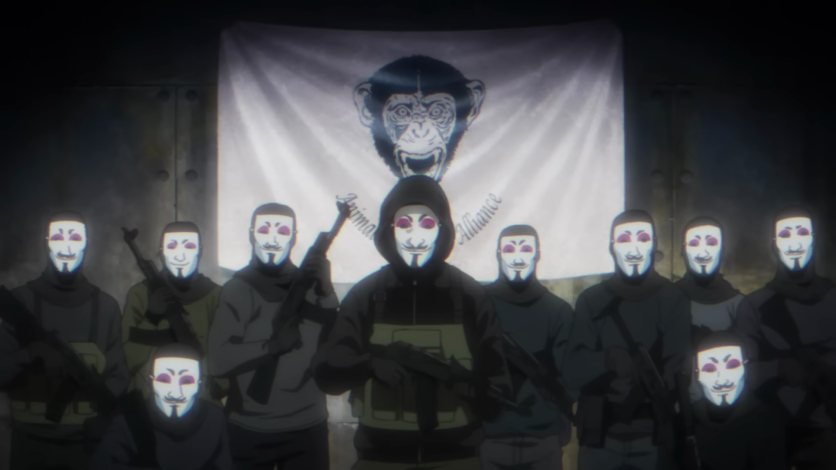
Nearly two months after its 13-episode first season concluded on April 1, 2026, The Darwin Incident — Amazon Prime Video's science-grounded anime about a genetically engineered human-chimpanzee hybrid navigating high school while eco-terrorist groups fight over his existence — remains in renewal limbo. Bellnox Films, TV Tokyo, and Kodansha have issued no Season 2 announcement, leaving unresolved a story drawn directly from real evolutionary biology, active legal personhood litigation, and a bill currently before the United States Congress that would criminalize precisely the experiment that created the show's protagonist.
The show, adapted from Shun Umezawa's award-winning manga series published in Kodansha's Monthly Afternoon, ran exclusively on Amazon Prime Video internationally after premiering on TV Tokyo on January 7, 2026. It earned widespread attention as Amazon Prime's sleeper hit of the Winter 2026 anime season — a designation rarely awarded to a debut series from an emerging studio. The source manga, in publication since June 2020, has sold over 2 million copies and won both the 15th Manga Taishō and the Excellence Award at the 25th Japan Media Arts Festival. At least five manga volumes remain unadapted, providing more than enough material for additional seasons.
The reason the renewal decision carries unusual stakes is not merely narrative. The science the show dramatizes is not speculative fantasy — it is a close extrapolation of research at the exact frontier where evolutionary biology, synthetic biology, and bioethics collide. Whether Season 2 reaches audiences determines whether those ideas get a second dramatization before a global streaming audience.
Is The Darwin Incident Getting a Season 2?
As of May 28, 2026, no renewal announcement has been made by Bellnox Films, TV Tokyo, or Kodansha, and the show has not been canceled. That ambiguous status is common in the anime industry, where studios and rights holders typically evaluate physical media sales, streaming performance, and international licensing revenue before committing to a new production cycle — a process that can take months. Comparable anime series have announced renewals anywhere from weeks to more than a year after a season finale.
Three factors favor renewal. First, the source material is both substantial and ongoing: the manga's nine published volumes give Bellnox Films five or more unadapted volumes to work with, and Umezawa continues to serialize new chapters monthly. Second, Amazon Prime Video's exclusive international deal signals a degree of platform investment that makes a renewal decision partly a streaming content strategy question, not just a traditional broadcast ratings calculation. Third, the show ranked among the most-discussed new anime of Winter 2026 by international community metrics, an audience signal that streaming platforms treat as a proxy for catalog value.
No single factor guarantees renewal. Bellnox Films is an emerging studio without an established track record of multi-season productions, and first-season anime adaptations from new studios carry higher production risk than renewals from well-capitalized incumbents. If a Season 2 announcement arrives in 2026, production on new episodes would realistically not begin until late 2026 or 2027, placing a broadcast date no earlier than 2027 and more likely 2028.
Why a Real Humanzee Faces Chromosomal Physics, Not Just Ethics
The central biological premise of The Darwin Incident — that a human-chimpanzee hybrid could be engineered into existence and raised to functional adolescence — runs into what biologists call the karyotype problem before it encounters any ethical review board. Humans carry 46 chromosomes; chimpanzees carry 48. The difference traces back to a chromosomal fusion event that occurred roughly 4 to 6 million years ago, when two ancestral primate chromosomes merged to create what is now human chromosome 2. In a standard conception scenario, the differing chromosome counts would produce chaotic meiotic pairing and almost certainly non-viable embryos — the same mechanism that makes mules sterile.
The show handles this by making Charlie the product of deliberate genetic engineering rather than natural reproduction. That is not a dodge — it is the accurate framing. The biological barrier to a humanzee is not that two genomes are incompatible in the way that oil and water are incompatible; it is that the chromosome structures require engineered reconciliation to produce viable offspring. Real-world research has demonstrated that chromosome number can be deliberately reorganized: using CRISPR-based tools, researchers fused brewer's yeast chromosomes in a series of successive steps, reducing the organism from 16 chromosomes to just 2 — demonstrating that chromosome count is a parameter a sufficiently advanced gene-editing technique can modify without eliminating cellular viability. The anime's implied science — a researcher engineering a reconciled 47-chromosome hybrid genome — sits at the far edge of extrapolation from techniques that already exist.
J.B.S. Haldane's 1922 rule adds another layer of documented biological complexity: in hybrid organisms, the heterogametic sex — in mammals, the male — is typically the one that suffers worse developmental failure. Charlie is male, which means the fictional experiment depicted in the show chose the hardest version of the problem to solve. That detail, whether intentional on Umezawa's part or not, makes the show's framing of Charlie's creation as a morally catastrophic act of reckless science more biologically precise than most readers realize.
Historical attempts to create human-ape hybrids are not limited to fiction. Soviet biologist Ilya Ivanovich Ivanov pursued experiments in the 1920s aimed at producing a human-ape hybrid through artificial insemination, a project that generated no verified success and significant ethical condemnation. Evolutionary psychologist Gordon Gallup has claimed, without documented corroboration, that a laboratory in Florida produced a live humanzee birth in the early 20th century that was euthanized within weeks after researchers confronted the ethical implications. No scientific record supports that claim. What the history establishes is that the question of whether such an experiment should be attempted has been live for more than a century — and that the answer from the scientific community has consistently been no.
CRISPR Makes Charlie's Origin Theoretically Imaginable, Not Achievable
Researchers have already created human-chimpanzee allotetraploid induced pluripotent stem cells — cells containing the full chromosome complement of both species simultaneously — demonstrating that human and chimpanzee chromosomes can co-exist in a stable cell and that the resulting cells can differentiate along multiple developmental lineages. That is not a humanzee. It is proof of concept that human and chimpanzee chromosomes sharing a nucleus is not immediately lethal at the cellular level.
The barrier the show extrapolates past is developmental scaling: going from a viable hybrid cell to a viable hybrid organism. Nuclear transfer experiments have demonstrated that cross-species cloning reliably fails before implantation in species as distantly related as humans and chimpanzees, due to mismatches between nuclear and mitochondrial genomes, imprinting incompatibilities, and species-specific factors in the egg cell. Charlie's origin requires a fictional advance that is one or two conceptual generations beyond current synthetic biology capability — not a violation of physical law, but not something today's technology can produce.
That framing is what makes the show scientifically serious rather than scientifically careless: it places its speculative leap at the correct location in the research pipeline, and it treats that leap as categorically illegal rather than a natural extension of legitimate science. The anime's worldbuilding insists that Charlie exists because someone chose to violate every constraint that actual researchers and regulatory bodies have placed on this category of experiment. That insistence is accurate.
Real Nonhuman Personhood Litigation Mirrors Charlie's Fight
The legal battle that drives The Darwin Incident's narrative — whether Charlie qualifies as a person under existing law and what rights attach to that determination — has a direct, ongoing real-world counterpart. The Nonhuman Rights Project, a legal advocacy organization that argues highly sentient animals possess sufficient cognitive complexity to warrant liberty rights, lost in the Michigan Court of Appeals on October 17, 2025. The case sought habeas corpus relief for seven chimpanzees held at the DeYoung Family Zoo in Wallace, Michigan — the same writ of habeas corpus that Charlie's supporters invoke in the show's legal storyline.
The appellate court ruled that chimpanzees are not legal persons because they cannot bear legal duties or enter into the social contract — an argument the Nonhuman Rights Project has specifically contested as importing a philosophical framework that, taken to its logical conclusion, would exclude human infants and people with severe cognitive disabilities from personhood protections. The organization filed for Michigan Supreme Court review on December 1, 2025. That case remains pending.
The Nonhuman Rights Project has now lost personhood claims on behalf of chimpanzees in four states: New York, Connecticut, California, and Michigan. Courts have consistently declined to extend habeas corpus to nonhuman animals, holding that such a fundamental redefinition of personhood must originate in legislatures rather than courts. Charlie's fictional predicament renders this legal debate tangible in a way that legal scholarship cannot: he satisfies every cognitive and linguistic criterion that personhood theorists argue should suffice, yet falls outside every existing legal category. His existence, as the show frames it, does not resolve the question — it makes it incoherent to dodge.
Congress Already Drafted the Law Charlie's Creator Would Have Broken
The experiment depicted in The Darwin Incident's origin story — the deliberate engineering of a viable human-chimpanzee hybrid from manipulated embryonic material — would face criminal prohibition under H.R. 2161, the Human-Animal Chimera Prohibition Act of 2025, introduced in the US House of Representatives on March 14, 2025. The bill, which has been referred to the Judiciary Committee, would make it a federal crime to create certain prohibited human-animal chimeras, with penalties of up to 10 years imprisonment and civil fines of at least $1 million. It is the latest in a series of bills Congress has introduced since 2016 targeting this category of research.
The bill has not become law. But its existence, alongside the active nonhuman personhood litigation and the nascent state of CRISPR-based cross-species embryo research, establishes that the regulatory and ethical fault lines The Darwin Incident dramatizes are not speculative. They are live institutional debates in which the show's premise is, in fact, the specific scenario that real legislators and courts are trying to define positions on.
Julian Koplin, a biomedical ethicist at Murdoch Children's Research Institute and Monash University, has argued that the International Society for Stem Cell Research's 2021 guidelines on human-animal chimera research fail to address the central ethical concern: that neurological chimeras — animals with human neural contributions — could develop enhanced cognitive capacities that change their moral status in ways the current regulatory framework is not designed to evaluate. Charlie represents the thought experiment at the extreme end of that concern, and the show's dramatic engine is the institutional inability to answer the question Koplin's paper identifies as unresolved.
What Season 2 Could Explore: Synthetic Biology's Next Frontier
The manga's continuing storyline moves into territory that would give a second season of The Darwin Incident access to the live edges of current synthetic biology debate. The areas most directly signaled by the manga's ongoing arc include germline editing governance — the international regulatory patchwork, or absence of one, governing heritable human genome modification — and the ethics of human-animal chimera research for organ development, a category of research that is currently regulated but not banned in most major jurisdictions.
The deeper implication of Charlie's existence, one the manga develops as it progresses, is that the same genetic techniques used to engineer a human-adjacent hybrid could theoretically be used to engineer human cognition upward. Charlie's story does not simply challenge the boundary between human and animal — it destabilizes the assumption that "human" is a fixed biological category at all. A second season working through those implications would be engaging precisely the questions that synthetic biologists, bioethicists, and courts will be actively arguing over the next several years.
Whether it gets the chance depends on decisions by Bellnox Films, TV Tokyo, Kodansha, and Amazon that have not yet been made public.
Frequently Asked Questions
Has The Darwin Incident been renewed for Season 2?
As of May 28, 2026, no Season 2 renewal has been announced by Bellnox Films, TV Tokyo, or Amazon Prime Video, and the show has not been canceled. The finale of Season 1, Episode 13 titled "Will," aired on April 1, 2026, and the renewal decision remains pending — an interval consistent with typical anime production timelines, where renewals are often announced weeks or months after a season ends.
What is a humanzee?
A humanzee is a hypothetical human-chimpanzee hybrid. The concept has a documented history of attempted real-world experiments, most notably Soviet biologist Ilya Ivanovich Ivanov's 1920s efforts to produce a human-ape hybrid through artificial insemination. No verified humanzee has ever been confirmed to exist. The primary biological barrier is karyotype incompatibility — humans carry 46 chromosomes and chimpanzees carry 48 — which would require deliberate genetic engineering to overcome, not natural reproduction.
Is The Darwin Incident based on a manga?
The anime adapts Shun Umezawa's manga of the same name, serialized in Kodansha's Monthly Afternoon magazine since June 2020, with nine volumes published in the English edition. The manga won the 15th Manga Taishō and the Excellence Award at the 25th Japan Media Arts Festival. Kodansha USA has licensed the English edition, and Season 1 of the anime covered roughly the first four volumes, leaving substantial source material for a potential second season.
Where can I watch The Darwin Incident?
Season 1 of The Darwin Incident streams exclusively on Amazon Prime Video internationally, with audio available in English, Spanish (Latin American and Spain editions), French, Italian, Portuguese, Dutch, Thai, and the original Japanese.
ⓒ 2026 TECHTIMES.com All rights reserved. Do not reproduce without permission.


