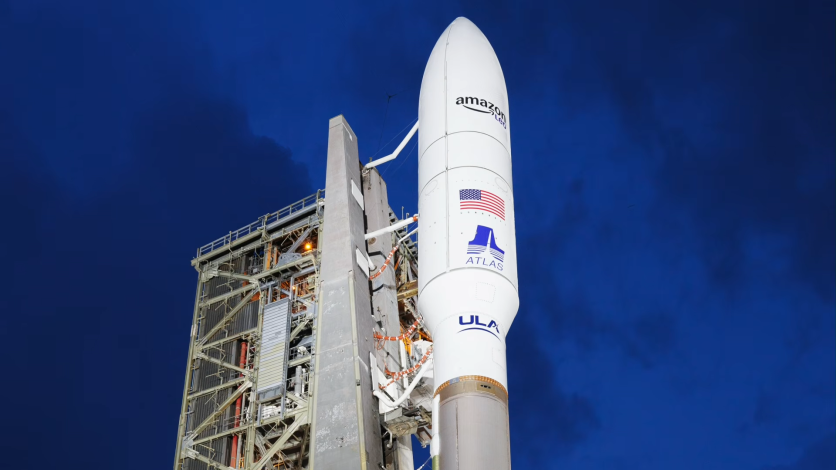
The Atlas V rocket launch successfully lifted off from Cape Canaveral Space Force Station, carrying 29 Amazon Leo satellites into orbit as part of Amazon's expanding broadband constellation. This Atlas V mission marks another step in building a large-scale satellite internet network designed to compete in the growing global connectivity market. With precise deployment and a smooth ascent, the launch highlights how commercial space operations continue to support the rapid growth of satellite-based internet systems.
This mission also reflects Amazon's ongoing effort to scale its Amazon Leo satellites network into a global service capable of delivering broadband coverage from space. As one of several planned deployments, it demonstrates steady progress in orbital expansion while reinforcing the role of the Atlas V rocket launch in supporting large commercial payloads. The event adds momentum to the broader competition shaping modern satellite internet development.
What Happened During The Launch
The Atlas V rocket launch lifted off from Launch Complex-41 at Cape Canaveral Space Force Station on May 29 at 7:53 p.m. EDT. The mission carried 29 Amazon Leo satellites intended for Amazon's expanding broadband constellation. All satellites were successfully delivered into orbit during the flight.
Satellite deployment occurred gradually, with the second stage releasing groups of satellites over about 10 minutes. The final pair separated roughly 38 minutes after liftoff, completing the planned satellite deployment sequence. This mission also marked the seventh Amazon Leo launch using the Atlas V rocket.
The Atlas V carried one of its heaviest payloads at approximately 18 tons, highlighting the rocket's lifting capability. It was the 12th Amazon Leo mission overall and the fourth completed during the year. The successful Florida launch added another commercial milestone for Cape Canaveral Space Force Station.
Read more: Blue Origin New Glenn Explosion Destroys Only Launch Pad, Freezes Amazon 24-Mission Manifest
Why This Mission Matters For Amazon Leo
This Atlas V rocket launch plays a key role in advancing Amazon's long-term plan to build a large broadband constellation. With around 300 Amazon Leo satellites already in orbit and a target exceeding 3,200, each successful deployment brings the system closer to operational scale. The steady rollout shows that Amazon continues to build momentum in the satellite internet sector, even as competition remains strong.
The mission also highlights how Amazon relies on multiple launch partners, including ULA, SpaceX, Arianespace, and Blue Origin. This distributed approach allows flexibility but also requires careful coordination across different launch systems. In this context, the Atlas V rocket launch remains one of the most important contributors to Amazon's expanding satellite network.
What To Know About The Atlas V Rocket
The Atlas V flew in its 551 configuration, one of its most powerful setups, using five solid rocket boosters and a 5-meter payload fairing. This configuration is specifically designed for heavy missions like the deployment of the Amazon Leo satellites, providing the rocket with the thrust and capacity needed for large commercial payloads. It demonstrates why the Atlas V remains a key vehicle for demanding orbital missions.
Powered by an RD-180 engine on the first stage, supported by multiple solid rocket motors, the Atlas V continues to show strong performance in precision satellite delivery. The combination of power and stability is essential for deploying multiple satellites in a single mission, especially for broadband constellation builds. The Atlas V rocket launch once again confirmed its reliability in handling complex payloads.
Why This Launch Shows Amazon's Pace Is Picking Up
The successful Atlas V rocket launch carrying 29 Amazon Leo satellites highlights the accelerating pace of Amazon's broadband constellation deployment from Cape Canaveral Space Force Station. With consistent satellite deployment and expanding orbital coverage, Amazon is steadily building toward a global network capable of delivering space-based internet services.
For readers following the Atlas V mission and Amazon Leo satellites, this launch reinforces how quickly commercial space infrastructure is evolving. Each deployment strengthens the system's foundation and brings Amazon closer to completing its large-scale broadband constellation in orbit.
ⓒ 2026 TECHTIMES.com All rights reserved. Do not reproduce without permission.


