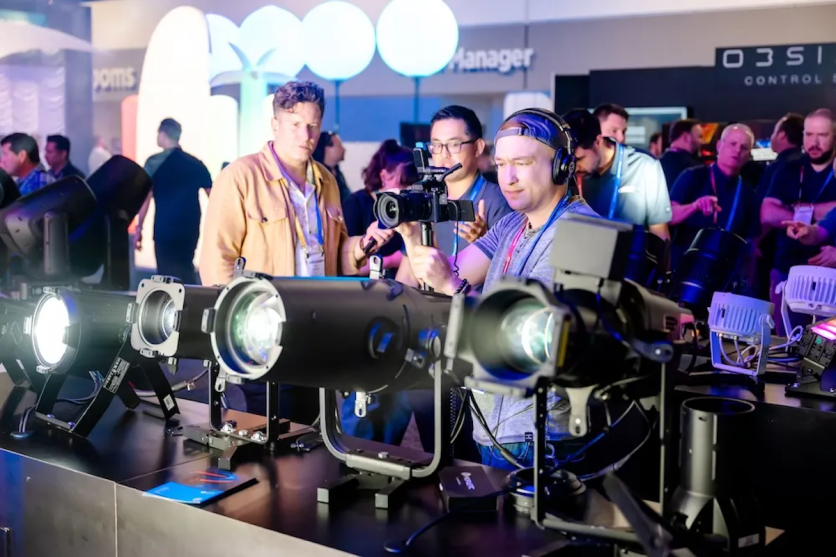
Education sessions at InfoComm 2026 opened this morning at the Las Vegas Convention Center, kicking off seven days that will determine how 30,000 audiovisual professionals, enterprise IT buyers, and systems integrators deploy artificial intelligence — not the speculative kind, but AI already running inside conference rooms, broadcast control rooms, and live-event venues. Produced by AVIXA, the Audiovisual and Integrated Experience Association, InfoComm 2026 runs June 13–19, with more than 750 exhibitors and an exhibit floor opening Wednesday through Friday in the North and Central Halls of the Las Vegas Convention Center.
The theme shaping every keynote, session, and product demonstration this week is convergence: AV and enterprise IT are no longer separate stacks, and the question driving every conversation on the show floor is not whether to deploy AI in AV systems but how fast those deployments can scale without breaking the underlying network infrastructure. Two keynotes from Microsoft and Cisco, a new free IPMX open-standards training program, and a full-day AVIXA AI Accelerator will give attendees the clearest picture yet of what that deployment looks like in practice.
What Is InfoComm and Why Does It Matter in 2026
InfoComm is North America's largest professional AV trade show, drawing systems integrators, AV consultants, broadcast engineers, corporate IT directors, and institutional technology buyers from 97 countries. The 2025 edition spanned more than 400,000 square feet with 817 exhibiting companies and nearly 31,000 verified attendees; 2026 is expected to match that scale with over 750 exhibitors confirmed. AVIXA, the show's producer, has reoriented the 2026 floor around two broad experience zones: Pro AV for Work in the Central Hall, covering conferencing, collaboration, digital signage, learning spaces, and enterprise IT; and Pro AV for Play in the North Hall, housing audio, broadcast AV, lighting, staging, and live-event production.
The significance of InfoComm in 2026 specifically is that the industry has crossed a threshold. Organizations across every vertical — corporate, healthcare, education, entertainment — spent the past two years evaluating AI tools for AV environments. This show marks the moment that evaluation phase ends and the deployment phase begins in earnest. Of the approximately 374 total sessions scheduled across the week, 46 are tagged under artificial intelligence, 75 under broadcast AV, 52 under conferencing and collaboration, and 41 under AV networking.
Saturday, June 13: Certification Courses Begin This Morning
Two intensive multi-day certification courses opened at 8:00 a.m. today and run through Monday, June 15.
CTS 1: AV Technology — newly renamed from Essentials of AV Technology — is the first half of the two-course sequence leading to the CTS (Certified Technology Specialist) credential, the AV industry's primary professional certification recognized worldwide. Led by Jeremy Elsesser, President and CEO of Level 3 Audiovisual, and Jim Spencer, Strategic Account Manager at Legrand AV, the course covers signal flow, display technology, audio fundamentals, system design basics, and industry vocabulary. It is the mandatory entry point for any AV professional pursuing AVIXA certification.
Applied Monitoring for AV Systems, running concurrently in Room W223, addresses the fragmented, vendor-siloed approach that has long undermined AV system health monitoring. Instructor Fred Loucks, founder of Hyperscale AV, leads attendees through unified monitoring strategies that shift operations from reactive to proactive — the network-level visibility that large institutions are increasingly demanding before approving new deployments. The course earns 24 CTS, CTS-D, and CTS-I renewal units.
Sunday, June 14: First Timers Orientation
Sunday features a single organized event: the First Timers Orientation, a structured introduction to the show floor, the education program, and strategies for navigating more than 400,000 square feet of Pro AV exhibits. It includes a light breakfast, an overview of the venue layout, and guidance from experienced InfoComm veterans including Patrick Angielczyk, AV Technologist at Mohawk College, and Brian Emerson, Regional Sales Manager at Barco.
Monday, June 15: Zoom Spaces Bootcamp Begins
Monday marks the start of the Zoom Spaces Bootcamp, a three-day AVIXA Pro Training program running through Wednesday, June 17. Structured as eight progressive sessions, the bootcamp covers the complete deployment lifecycle for Zoom Spaces environments: room architecture and design, network and media transport foundations, workplace experience integration, AV systems performance optimization, advanced management and analytics, complex multi-room integration, and broadcast and production workflows. Key instructors include Frank Padikkala, Senior Technical Sales Architect for Zoom Spaces, and Laurent Masia, Senior Director of Product Management at NETGEAR AV.
Monday's opening bootcamp modules cover architecture and room design principles for Zoom Spaces deployments, and the AV-over-IP network foundations specific to those environments — a combination that reflects the industry's accelerating demand for integrators who understand both the AV layer and the IP transport layer beneath it.
Tuesday, June 16: The Week's Biggest Education Day
With 81 sessions on the schedule, Tuesday is the largest single education day before the exhibit floor opens. AI programming dominates the morning.
Legrand: AI in the AV Industry — Foundations, Applications, and Impact (8:00 a.m., Room W205/W206) opens the day with a practical, introductory session designed for integrators, designers, and technology managers who need grounded knowledge of what AI actually does inside commercial AV systems. Blake Brubaker and Bob Griffin, both Technical Sales Application Engineers at Legrand, walk through machine vision, object-based programming, predictive analytics, and edge computing — the four AI capabilities most commonly being deployed in Pro AV environments right now.
The AVIXA AI Accelerator (8:30 a.m.–4:30 p.m., Room W213/W214) is the week's most intensive AI education event: a full-day, ten-speaker program that takes AV professionals from AI fundamentals through enterprise deployment strategy, including ethics, privacy, edge inference, and building an AI-driven innovation culture inside an AV organization. Priced at $399 for AVIXA members and $499 for non-members, it is the densest AI curriculum at the show.
Tuesday evening closes with InfoComm TECH ON TAP 2026 (8:00–11:00 p.m., Pool Deck at Westgate Resort, 3000 Paradise Road), the show's primary networking social event, where informal deal-making and candid peer conversations have historically produced as much business as the show floor.
Wednesday, June 17: Exhibit Floor Opens and Microsoft Takes the Stage
The main exhibit floor opens Wednesday at 9:00 a.m., and the show's energy shifts completely. Wednesday carries 134 scheduled sessions — the largest single-day count of the week — alongside the debut Media Day, a curated, invitation-only guided tour of the show's biggest product announcements for credentialed press.
Microsoft Keynote: Exploring the Future of AI-Powered Collaboration and Connected Workplaces Wednesday, June 17 | 1:30–2:30 p.m. | Vision Stage, Booth C7872
Ilya Bukshteyn, Corporate Vice President of Microsoft Teams Calling, Devices, and Premium Experiences at Microsoft, delivers the week's first main-stage keynote. Bukshteyn oversees Teams Phone, Teams Rooms, Teams Events, Mesh, and Teams Premium, and his announcement at InfoComm signals a clear shift in how Microsoft describes AI in workplace technology. The session is not about Copilot note-taking — that is last year's story. Bukshteyn's framing for InfoComm is what he calls the "agentic AI era": proactive systems that do not wait for a prompt but anticipate needs, take autonomous action, and orchestrate entire workflows across digital and physical spaces.
The distinction matters to AV integrators and enterprise IT teams. Prior-generation AI features — noise suppression, smart camera framing, meeting transcription — were enhancements layered onto existing room systems. Agentic AI represents a fundamentally different architecture: AI that reasons about context across an entire organization's meeting infrastructure, coordinates room scheduling, captures decisions, and drives follow-up actions without requiring a human to initiate each step. For the AV integrator, it means specifying room systems that can serve as nodes in an intelligent enterprise network, not just AV endpoints.
Thursday, June 18: Cisco Keynote and IPMX Training Launch
Thursday carries 121 sessions and two of the show's most anticipated events.
AVIXA Women's Breakfast (7:30–9:00 a.m.) opens the day with a keynote from Mariana Atencio — Peabody Award-winning journalist and media entrepreneur — addressing authenticity, human connection, and trust at a moment when AI-generated content has made genuine credibility scarce and valuable. Tickets are $89 for AVIXA members and $99 for non-members. Sponsors include Sony Electronics, AVI-SPL, FORTÉ, and Q-SYS.
Cisco Keynote: Connected Intelligence — Powering the Modern Workplace Thursday, June 18 | 11:00 a.m.–12:00 p.m. | Vision Stage, Booth C7872
Espen Løberg, Vice President and General Manager of Collaboration Devices at Cisco, delivers the week's second and final main-stage keynote. Løberg's session addresses a problem that enterprises have struggled with for a decade: AV and IT infrastructure that evolved in separate organizational silos, producing complex deployments, inconsistent user experiences, and almost no visibility into how workspaces actually perform. Cisco's answer is its Connected Intelligence architecture — a converged management layer that brings together collaboration platforms, devices, networks, and AI-enabled infrastructure under a single management plane. Løberg will also detail Cisco's cross-platform partnerships with NVIDIA, Microsoft, Zoom, Apple, and Samsung, positioning Connected Intelligence as interoperable with the platforms most enterprises have already deployed.
How IPMX Works and Why It Changes the AV Calculus
Thursday afternoon's AIMS session is where the week's most technically significant announcement lands. The Alliance for IP Media Solutions is launching its Official IPMX Training Series at InfoComm 2026: a free, three-level online curriculum covering IPMX foundations, systems design, and advanced networking concepts including Precision Time Protocol and SMPTE ST 2110. The program will be available from this week forward to any engineer, integrator, or end user who needs to design and deploy IPMX-based AV-over-IP systems.
IPMX — Internet Protocol Media Experience — is the open standard that is ending proprietary vendor lock-in in Pro AV infrastructure. It layers on SMPTE ST 2110, the broadcast industry's established standard for uncompressed media transport over IP, and adds AV-specific capabilities: HDCP content protection, JPEG XS compression for bandwidth-efficient delivery, and NMOS (Networked Media Open Specification) for plug-and-play device discovery and connection management. When a device is powered up on an IPMX network, its resources become immediately available to all other devices on that network — without time-consuming manual I/O configuration.
The structural significance for the AV industry: for years, proprietary AV-over-IP systems from individual manufacturers delivered interoperability only within a single vendor's ecosystem. Integrators specifying outside that ecosystem faced bridging hardware, compatibility failures, and ongoing maintenance costs. IPMX eliminates that constraint. Any IPMX-certified device from any manufacturer can interoperate with any other — which means integrators can now specify best-in-class hardware from different manufacturers without compatibility risk. Industry estimates suggest IPMX already powers 40 percent of new AV-over-IP projects.
Samuel Recine, AIMS Board Member and VP of Global Strategic Partnerships at Matrox Video, leads Thursday afternoon's AIMS session (1:30–3:00 p.m., Room W231), covering SMPTE ST 2110 and IPMX deployment across PC/IT, AV signaling, and media production environments. Andrew Starks, AIMS Board Member and Director of Product Management at Macnica, presented "How IPMX Expands Live Production Beyond Broadcast" on Tuesday, June 16, exploring how mid-sized organizations can access broadcast-quality AV-over-IP workflows at costs that were previously achievable only by major broadcast infrastructure operators.
What Agentic AI Actually Means for Pro AV Teams
The AI conversation at InfoComm 2026 spans 46 sessions, but the question threading through all of them is one that separates surface-level adoption from genuine deployment: how do you run AI reliably across thousands of rooms, endpoints, and distributed workforces without creating new management complexity?
The answer, emerging across the Microsoft and Cisco keynotes and throughout the education programming, involves three architectural requirements. First, room systems must provide sufficient audio and video quality at the hardware level — enterprise-grade microphones, digital signal processing, and capable cameras — because agentic AI features degrade or underperform when the underlying signal is poor. Second, the network must support AV-over-IP at scale, which is where IPMX adoption and SMPTE ST 2110 literacy become critical skills for integrators who want to position themselves as trusted advisors rather than commodity installers. Third, management and monitoring must shift from vendor-siloed dashboards to unified, AI-enhanced platforms that detect and resolve system health issues before they surface to the end user.
Friday's closing session, Using Agentic AI to Augment Your Project Deployment Teams (June 19), is one of the clearest signals that InfoComm 2026's AI conversation is not aspirational. Autonomous AI agents are already assisting the project management and technical coordination work of AV deployment teams at scale.
Friday, June 19: Final Day on the Floor
The exhibit hall is open Friday from 9:00 a.m. to 4:00 p.m., with 23 sessions rounding out the week. For attendees arriving for the first time on Friday, the Work and Play floor zoning makes navigation straightforward: collaboration and enterprise IT in the Central Hall, live-event and broadcast in the North Hall.
Frequently Asked Questions
What is InfoComm 2026 and who should attend?
InfoComm 2026 is North America's largest professional audiovisual trade show, produced by AVIXA and held June 13–19 at the Las Vegas Convention Center in Las Vegas, Nevada. The exhibit floor runs June 17–19. Systems integrators, AV consultants, broadcast engineers, corporate IT directors, facility managers, and institutional technology buyers are the primary audience. Anyone responsible for designing, deploying, purchasing, or operating audio, video, collaboration, digital signage, or live-event AV technology will find directly applicable content in the 374-session program.
What is IPMX and why is it important to AV professionals in 2026?
IPMX (Internet Protocol Media Experience) is an open standard for transporting professional audio and video over standard IP networks. Built on the broadcast industry's SMPTE ST 2110 framework and developed by the Alliance for IP Media Solutions, it uses NMOS for automatic device discovery and JPEG XS compression for efficient bandwidth use. Its practical significance: it ends the proprietary vendor lock-in that has characterized AV-over-IP for years, allowing integrators to mix equipment from different manufacturers without compatibility risk. AIMS is launching a free three-level IPMX training curriculum at InfoComm 2026 this week.
What is agentic AI, and how is it different from AI in Teams Rooms already?
Prior-generation AI in collaboration spaces operated reactively — it responded to audio input for noise suppression, tracked speakers with smart cameras, or transcribed meetings when prompted. Agentic AI operates proactively: it monitors context across an organization's entire meeting infrastructure, initiates actions without requiring a human prompt, and orchestrates multi-step workflows from scheduling through follow-up. Microsoft's Ilya Bukshteyn will detail this architecture in Wednesday's InfoComm keynote, describing agentic AI as "co-workers designed to help people multiply their impact" rather than features layered onto existing room systems.
Where can I follow InfoComm 2026 if I am not attending in person?
Full schedule, registration information, and exhibitor details are available at infocommshow.org. AVIXA publishes session recaps and keynote highlights through its Xchange community and press room at avixa.org. Many exhibitors broadcast product announcements and booth demonstrations through their own channels during the show week.
ⓒ 2026 TECHTIMES.com All rights reserved. Do not reproduce without permission.


