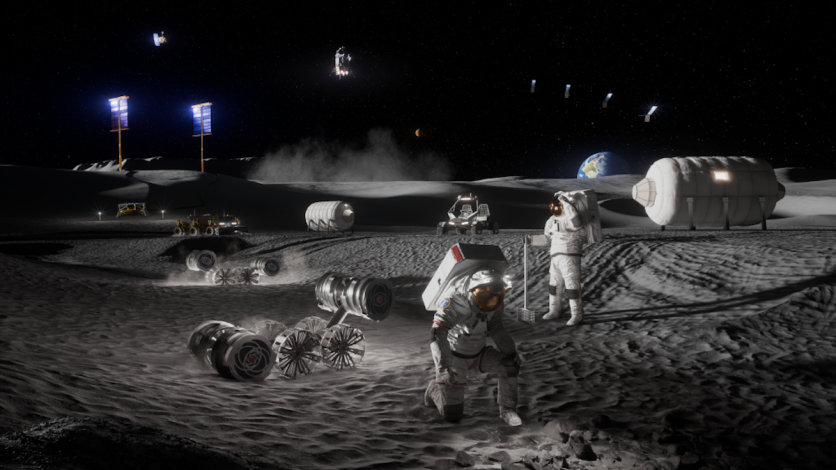
NASA Administrator Jared Isaacman stood before cameras at agency headquarters in Washington today, May 26, and confirmed the most detailed US lunar commitment since the Saturn V: a three-phase, $30 billion, 11-year architecture that will put a nuclear-powered permanent base on the rim of Shackleton Crater by 2036, with a first crewed landing locked in for early 2028. The announcement, carried live on NASA+ and the agency's YouTube channel, also named expanded commercial partners who will build the hardware to get there.
The briefing follows Artemis II's successful crewed flyby — completed April 10 after a record-setting 695,081-mile journey by Commander Reid Wiseman, Pilot Victor Glover, Mission Specialist Christina Koch, and Canadian Space Agency astronaut Jeremy Hansen — by just six weeks. Isaacman called that mission the "opening act." Today's event was the main event.
$30B Over 11 Years: What the Architecture Actually Requires
The plan Moon Base Program Executive Carlos García-Galán presented is staggering in scope. From now through 2036, it calls for 79 launches, 73 robotic and crewed landers, 10 Lunar Terrain Vehicles, 12 MoonFall hopper drones, and four pressurized habitat modules, anchored by a 20-kilowatt nuclear fission reactor. The total cost: approximately $20 billion over the first seven years, scaling to $30 billion through full operational capability by 2036.
"It is very ambitious. We are doing that deliberately," García-Galán said at the March architecture preview. "We want to understand what are the things that prevent a moon base."
Casey Dreier, chief of space policy at the Planetary Society, put a number on the skepticism: "Probably not," he said when asked whether $20 billion would be enough to build and sustain a lunar base. The roughly seven-year foundational timeline is aggressive given the technical challenges, Dreier told reporters — particularly around launch cadence. NASA has never landed more than two missions on the Moon in a single year, and Phase 1 alone calls for roughly 25 launches and 21 landings by the end of 2028.
Three Phases to Permanent Habitation
Phase 1 — Foundation (to 2028): Approximately 25 launches and 21 robotic landings deliver around 4,000 kilograms of payload to the south-polar surface. Hardware includes the first two Lunar Terrain Vehicles and the initial quartet of MoonFall autonomous drones. The phase culminates with Artemis IV — the first crewed lunar landing under the program — in early 2028.
Phase 2 — Early Habitation (2029–2032): Infrastructure scales sharply. A pressurized rover capable of supporting two crew members for extended traverses enters service. Semi-annual crew rotations begin by 2030. Roughly 27 additional launches deliver approximately 60,000 kilograms of hardware, including upgraded power stations and the first permanent habitat modules.
Phase 3 — Permanent Presence (2033–2036): The final push — roughly 29 more launches carrying 150,000 kilograms of infrastructure — establishes continuous human habitation. A nuclear fission power station comes online, and the base achieves its central operational goal: extracting water ice from Shackleton Crater's permanently shadowed cold traps for use as rocket propellant, oxygen, and potable water.
MoonFall Drones Scout South Pole Before Humans Arrive
Among today's most anticipated reveals was the status update on MoonFall — a fleet of four hopper drones inspired by NASA's Ingenuity Mars helicopter but designed for vacuum operation, using cold-gas thrusters to make propulsive hops of up to 50 kilometers across Shackleton's rugged rim. Each drone carries ten cameras; the fleet's combined 40 imaging packages will be stitched into terrain maps that mission planners will use to select landing zones and route pressurized rovers.
The project is led by Ray Baker at NASA's Jet Propulsion Laboratory. The agency's MoonFall mission page confirms that four highly mobile drones will survey the lunar south pole, exploring permanently shadowed regions where water ice concentrates. Baker told Space.com in April that NASA expected to select industry partners by June 2026, with hardware already in development and sensor tests planned for later this year. Spacecraft integration is targeted for late summer 2027, with delivery to the launch site in 2028. Unlike Ingenuity, which flew in Mars's thin atmosphere, MoonFall vehicles operate in hard vacuum — making every aspect of their flight regime a first-of-kind engineering challenge.
Why the Rim of Shackleton Crater?
The choice of the Shackleton Crater rim as the base site converges three advantages no other south-polar location offers simultaneously. High-elevation rim peaks receive near-continuous solar illumination, providing power for surface operations before the nuclear reactor comes online. The crater floor sits in permanent shadow, preserving water-ice deposits accumulated over billions of years. And the terrain along the rim provides a viable construction and landing zone — flat enough for hardware delivery, close enough to the crater's cold traps to enable practical ice extraction.
That extraction capability — in-situ resource utilization, or ISRU — is not optional in this architecture. NASA projects that converting lunar ice into hydrogen-oxygen propellant will substantially reduce the mass of propellant that must be launched from Earth, making the Moon a functioning logistics node for deep-space missions rather than only a destination.
Clive Neal, a lunar geoscientist at the University of Notre Dame, described the Moon base architecture as "a blueprint of how to make Mars a reality."
Gateway Paused: What International Partners Do Now
Today's briefing formalized the consequences of NASA's late-March decision to pause work on the Lunar Gateway orbital station and redirect resources toward the surface. European contractor Thales Alenia Space had been developing pressurized modules for Gateway; those modules are expected to be significantly modified and repurposed as surface habitat components, preserving the international investment while pivoting to the surface-first strategy.
International partners retain critical roles. The Italian Space Agency provides multi-purpose habitat modules. The Canadian Space Agency is developing an autonomous lunar utility vehicle. Japan's JAXA is building the pressurized rover that will carry two crew members on extended traverses beginning in Phase 2.
A White House directive issued earlier this year instructed NASA to solicit industry proposals for a 100-kilowatt nuclear reactor for lunar deployment by 2030 — five times the 20-kilowatt baseline in the architecture — signaling that the administration views nuclear power as central to long-duration operations. Some nuclear energy analysts have expressed skepticism about that timeline, with analyst Joseph Cirincione noting that small modular reactors are "always just around the corner — a corner you never get to turn." NASA's own architecture proceeds on the more conservative 20-kilowatt figure.
What Does the Funding Picture Look Like?
The architecture's ambition runs directly into an unresolved budget fight. The White House proposed $18.8 billion for NASA in FY2027 — a 23% cut from the enacted $24.4 billion — while simultaneously allocating $175 million for robotic missions to begin establishing the lunar base camp and seeking permission to repurpose the $2.6 billion Gateway reconciliation fund toward surface operations. Congress rejected a near-identical overall proposal for FY2026 and passed $24.4 billion instead; a bipartisan Senate authorization bill led by Senators Maria Cantwell and Ted Cruz has proposed $25.3 billion for FY2027 and explicitly authorized the lunar base.
The tension in the budget is structural: the White House is also phasing down funding for the Space Launch System after Artemis V, without a confirmed commercial replacement cleared for crewed lunar flights. The SLS is currently the only human-rated vehicle proven to reach the Moon. The Aerospace Industries Association's president Eric Fanning warned that reducing investment in proven spaceflight capabilities creates compounding risks the architecture's timeline cannot easily absorb.
How Does NASA's Moon Base Compare to What Came Before?
Apollo's six lunar landings between 1969 and 1972 demonstrated that humans could reach and walk on the Moon. What Isaacman announced today is categorically different: the transition from visiting to inhabiting. If the Phase 3 timeline holds and continuous habitation begins by 2033, the United States will have built humanity's first off-Earth industrial foothold within seven years — a surface outpost capable of generating its own propellant, sustaining a rotating crew, and serving as a staging point for deeper solar-system exploration.
The prime challenge, in García-Galán's own framing, remains cadence: delivering the sheer number of robotic missions to the south pole on the schedule the architecture requires. Phase 1 alone calls for roughly 25 launches by the end of 2028 — including commercial cargo flights, science payloads, infrastructure deliveries, and Artemis IV itself. It is a tempo of lunar operations that no agency has achieved in the 54 years since Apollo 17.
Frequently Asked Questions
What is NASA's moon base plan?
NASA's Moon Base is a three-phase, $30 billion architecture targeting a permanent, nuclear-powered outpost on the rim of Shackleton Crater at the lunar south pole by 2036. It calls for 79 total launches and 73 landers over 11 years, with continuous human habitation beginning around 2033 and in-situ water-ice extraction providing rocket propellant, oxygen, and water.
When will NASA build a moon base?
Construction begins incrementally starting in 2026 with robotic missions. The first crewed landing — Artemis IV — is targeted for early 2028. Semi-annual crew rotations begin around 2030, and the base reaches full permanent habitation capability between 2033 and 2036 under the current plan.
Where will NASA build its moon base?
NASA has selected the rim of Shackleton Crater at the lunar south pole. The site offers near-continuous solar illumination for power generation on the rim peaks, access to permanently shadowed regions on the crater floor containing water ice, and relatively flat terrain suitable for landing and construction operations.
How much will NASA's moon base cost?
NASA's Moon Base architecture is estimated at approximately $20 billion over the first seven years and $30 billion over the full 11-year build to continuous habitation. Some independent analysts, including the Planetary Society's Casey Dreier, have described even the $20 billion foundational figure as ambitious given the technical scope and launch cadence required.
ⓒ 2026 TECHTIMES.com All rights reserved. Do not reproduce without permission.


