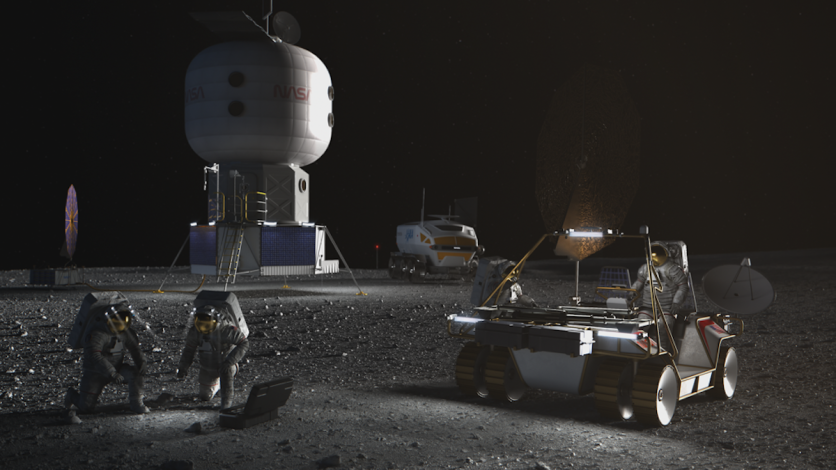
NASA on Tuesday awarded nearly $1 billion in Moon Base contracts to four commercial companies, marking the transition from architectural planning to funded hardware for humanity's first sustained lunar outpost. The awards, announced at a press conference at NASA headquarters in Washington, D.C., commit real money to specific vehicles, rovers, and reconnaissance drones — with the first mission targeting launch no earlier than fall 2026.
The announcement follows the Artemis II crewed lunar flyby completed on April 10, 2026, which brought four astronauts within 695,000 miles of the Moon's surface for the first time in more than 50 years. Administrator Jared Isaacman, who called that mission the "opening act," used Tuesday's briefing to name the hardware that will follow.
"The Moon Base will be America's and humanity's first outpost on another celestial world," Isaacman said. "We are grateful for President Trump's leadership, the bipartisan commitment from Congress, our industry and international partners, and the dedicated NASA workforce whose expertise enables us to achieve the near-impossible."
NASA Moon Base Contracts: Who Won and How Much
The largest individual awards go to two competing lunar terrain vehicle builders. Astrolab received $219 million to finalize its Crewed Lunar Vehicle, called CLV-1, which is adapted from the company's earlier FLEX architecture. Lunar Outpost received $220 million for its Pegasus rover, a lighter evolution of its Eagle prototype that incorporates General Motors and Goodyear Tire & Rubber engineering.
Both vehicles are designed to operate with or without astronauts aboard, surviving on the lunar surface for up to a decade. Each weighs just under one metric ton in stowed configuration and folds to fit inside a lander for transit. Astrolab CEO Jaret Matthews described the CLV-1 as reflecting "the adaptability of our FLEX architecture and the years of testing our team has already completed."
Getting those rovers to the Moon's surface is Blue Origin's job. NASA awarded Bezos' company an initial $188 million contract — under the Commercial Lunar Payload Services indefinite-delivery framework — with an option period worth an additional $280.4 million for two task orders. Blue Origin's Blue Moon Mark 1 lander, an uncrewed cargo vehicle already under development, will carry each rover from Earth orbit to the lunar South Pole. CEO Dave Limp wrote on X that "since the beginning, Blue Origin has been committed to Lunar Permanence."
Rounding out the awards, Firefly Aerospace received a $75 million subcontract, awarded through NASA's Jet Propulsion Laboratory, to build the carrier spacecraft for the MoonFall mission — a 2028 technology demonstration that will deploy a swarm of hopper drones over the Moon's South Pole.
What Makes Lunar Terrain Vehicles Different From Apollo Rovers
The lunar terrain vehicles represent a qualitative leap from the battery-powered buggies that Apollo astronauts drove between 1971 and 1972. Those vehicles operated exclusively when astronauts were present; the new generation must function autonomously when no crew is on the surface, be teleoperated from Earth between crewed missions, and then switch to astronaut-driven mode when a crew arrives.
Moon Base Program Executive Carlos García-Galán described them as "a mix between the Apollo Lunar Roving Vehicle and a Mars-style rover." During crewed operations, the vehicles can range up to 10 kilometers from the Human Landing System lander; they will be positioned roughly 2 kilometers away during lander descent burns to avoid damage from the plume. Over their full operational lifetimes, each vehicle is expected to cover around 400 kilometers total.
Over the next 18 months, Astrolab and Lunar Outpost will finalize designs, conduct crewed evaluations, and qualify flight units for operational readiness, with the goal of having at least one rover on the surface before the Artemis IV crewed landing, currently scheduled for early 2028.
MoonFall Drones Scout South Pole Before Astronauts Land
The $75 million MoonFall mission adds a reconnaissance dimension that no previous Moon program has attempted. Firefly's Elytra Dark spacecraft will take approximately 45 days to transit to the Moon, then de-orbit and deploy four hopper drones roughly 50 kilometers above the South Pole.
Each drone is designed to survive for one lunar day — about 14 Earth days — during which it will capture high-resolution imagery across all mission phases: deployment, landing, and surface operations. The vehicles hop rather than fly, using cold-gas thrusters in the Moon's hard vacuum, making the engineering challenge categorically different from NASA's Ingenuity Mars helicopter, which operated in a thin but real atmosphere.
García-Galán said the drones will build detailed maps of soil mechanics, terrain, and lighting conditions — data that mission planners will use to select final landing zones for pressurized rovers and habitat modules. He also described the possibility of the drones establishing a "Moon Base perimeter" around high-priority scientific or construction zones, though Isaacman was careful to frame any such concept within the Outer Space Treaty, saying the U.S. would respect other nations' lunar assets and expected reciprocal treatment.
Why NASA Targets Lunar South Pole Water Ice
The entire architecture converges on a single resource: water ice locked in the permanently shadowed craters of the lunar South Pole. Orbital missions have detected hydrogen signatures consistent with substantial ice deposits; extracting and processing that ice into hydrogen and oxygen would produce both rocket propellant and breathable air, making the South Pole a functioning logistics hub for deep-space missions rather than simply a destination.
The Shackleton Crater rim offers the combination of near-continuous solar illumination on its elevated peaks — critical for power generation before a nuclear reactor comes online — and proximity to the permanently shadowed crater floor where ice concentrates. Temperatures inside those craters drop to as low as minus 334°F (minus 203°C), cold enough to preserve ice accumulated over billions of years.
Clive Neal, a lunar geoscientist at the University of Notre Dame, described the broader Moon Base architecture as "a blueprint of how to make Mars a reality." Paul Hayne, a planetary scientist at the University of Colorado Boulder's Laboratory for Atmospheric and Space Physics, has found that much of the Moon's polar ice built up gradually over the last 1.5 billion years — making the deposits ancient but potentially abundant.
How Does NASA Plan to Fund It?
The nearly $1 billion in contracts announced Tuesday sits within a much larger financial picture that remains unresolved. Isaacman pointed to a $10 billion appropriation from the Working Families Tax Cut Act, fiscal year 2026 appropriations, and the President's FY2027 budget request as the funding sources for the program's first phase.
The FY2027 budget request, however, proposes a roughly 23% cut to NASA's overall budget — from the $24.4 billion enacted for FY2026 to $18.8 billion. Congress rejected a nearly identical proposal for FY2026 and passed the higher figure instead; House appropriators have since advanced a new bill that explicitly backs the Moon Base with strong support while funding the Human Landing System at $2.28 billion.
Casey Dreier, chief of space policy at the Planetary Society, put a number on the uncertainty: "Probably not," he said when asked whether $20 billion would be sufficient to build and sustain a lunar base over the first seven years. The timeline is "aggressive given the technical challenges," Dreier said, particularly around launch cadence — Phase 1 alone calls for roughly 25 launches and 21 landings by the end of 2028, a tempo of lunar operations that no agency has achieved in the 54 years since Apollo 17.
What Intuitive Machines' Exclusion Signals About Competition
Intuitive Machines, the Texas-based lunar specialist that made history as the first commercial company to soft-land a spacecraft intact on the Moon in February 2024, was not selected for the lunar terrain vehicle awards — and the market reacted instantly. Its shares fell 17.43% on Tuesday, closing at $34.86, on volume of 47.3 million shares, approximately 231% above its three-month average. Trading was briefly halted due to volatility.
The company's exclusion from the LTV program does not eliminate it from the broader Moon Base ecosystem. It retains multiple lander contracts under the Commercial Lunar Payload Services program, holds a backlog of approximately $1.1 billion, and posted record Q1 2026 revenue of $186.7 million — nearly triple the prior year. Moon Base III, one of the three initial missions announced Tuesday, will fly on Intuitive Machines' Nova-C Trinity lander.
The competitive dynamics of Tuesday's awards illustrate the deliberate multi-vendor strategy NASA has built into the Moon Base program: distributing hardware across multiple contractors to develop a diverse commercial lunar industry, rather than depending on a single prime contractor as the agency did during Apollo.
Frequently Asked Questions
What companies won NASA Moon Base contracts in May 2026?
NASA awarded nearly $1 billion in Moon Base contracts to four companies: Astrolab ($219 million for its CLV-1 crewed lunar rover), Lunar Outpost ($220 million for its Pegasus rover), Blue Origin ($188 million with a $280.4 million option period to deliver both rovers via its Blue Moon Mark 1 lander), and Firefly Aerospace ($75 million through JPL for the MoonFall drone carrier spacecraft).
When is NASA's first Moon Base mission launching?
Moon Base I, which will use Blue Origin's Blue Moon Mark 1 Endurance lander to deliver scientific instruments to the Shackleton Connecting Ridge near the lunar South Pole, is targeted for launch no earlier than fall 2026. Two additional missions — Moon Base II on Astrobotic's Griffin lander and Moon Base III on Intuitive Machines' Nova-C Trinity lander — are also targeted for 2026.
Why is NASA building the Moon base at the lunar South Pole?
The South Pole's permanently shadowed craters are believed to harbor substantial deposits of water ice that has accumulated over billions of years. NASA intends to mine and process that ice into drinking water, breathable oxygen, and rocket propellant — turning the Moon into a self-sustaining logistics hub for deep-space exploration and reducing the mass of supplies that must be launched from Earth.
How much will NASA's Moon Base cost?
The overall Moon Base architecture is estimated at approximately $20 billion over the first seven years, scaling to roughly $30 billion through full operational capability, targeted for the mid-2030s. The Planetary Society's Casey Dreier has publicly questioned whether $20 billion will prove sufficient given the program's technical scope and the aggressive launch cadence it requires.
ⓒ 2026 TECHTIMES.com All rights reserved. Do not reproduce without permission.


