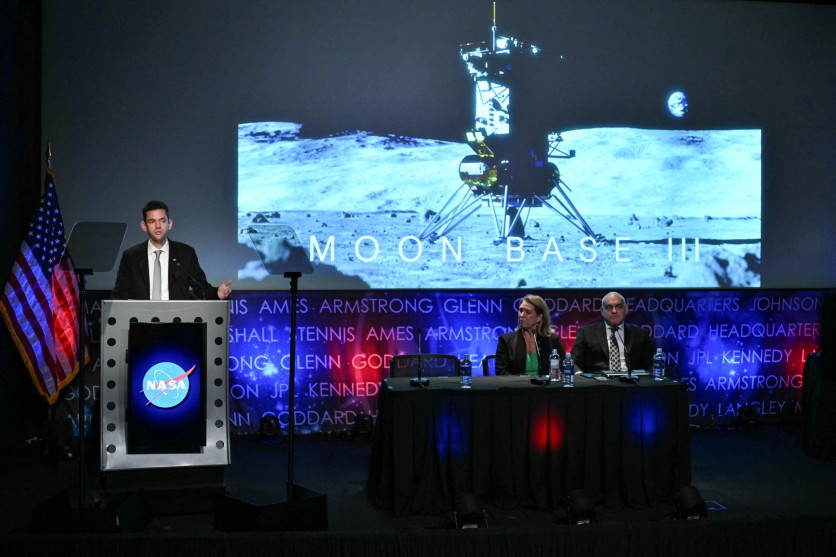
NASA committed nearly $627 million to four commercial contractors on May 26, 2026, naming three lunar missions targeted for launch before year-end and formally crossing from architecture into hardware for the first time since the Moon Base program launched in March. Three days later, the contractor holding the central delivery contract for both crewed rovers — Blue Origin — watched its New Glenn rocket explode on the launch pad during a static fire test at Cape Canaveral, destroying the launch pad and triggering an investigation into root cause. Administrator Jared Isaacman issued a statement the same evening: "We will provide information on any impacts to the Artemis and Moon Base programs as it becomes available."
The Blue Moon Mark 1 lander that will carry rovers to the South Pole is a distinct vehicle from the New Glenn rocket that exploded, and Blue Origin's lunar contracts remain in effect. But the explosion destroyed Blue Origin's only orbital launch facility at Launch Complex 36, and the investigation timeline and pad repair schedule are unknown. The Moon Base program's fall 2026 target for its first mission now has a new variable.
The announcement six weeks earlier had itself followed Artemis II's crewed lunar flyby completed on April 10, 2026 — the first humans beyond Earth orbit since Apollo. Administrator Isaacman called that mission the "opening act." The May 26 contracts were meant to be the main event. "The Moon Base will be America's and humanity's first outpost on another celestial world," Isaacman said. "This time the goal is not flags and footprints. This time the goal is to stay."
Two Rovers, One Delivery Vehicle, One Reconnaissance Drone Carrier
The four contracts divide Phase 1 hardware cleanly between builders and a transporter. Astrolab received $219 million for its Crewed Lunar Vehicle, designated CLV-1, adapted from the company's FLEX architecture. The CLV-1 can reach more than 6 mph on level terrain, handle slopes up to 20 degrees, and traverse up to 200 kilometers over its operational life. Astrolab is partnered with Axiom Space, Interlune, and Odyssey Space Research.
Lunar Outpost received $220 million for its Pegasus rover, a lighter evolution of its Eagle prototype developed with General Motors, Goodyear, and Leidos. Pegasus is rated for more than 9 mph, meets the same slope and range requirements as CLV-1, and can operate manually with a crew aboard, fully autonomously, or via teleoperation from Earth for up to a year without a crew present.
Blue Origin received $188 million in firm task orders, with an option period worth $280.4 million, to deliver both rovers to the South Pole using its Blue Moon Mark 1 lander. The option period is exercisable based on initial phase performance. "Since the beginning, Blue Origin has been committed to Lunar Permanence," CEO Dave Limp wrote on social media after the awards.
NASA's Jet Propulsion Laboratory awarded a $75 million subcontract to Firefly Aerospace to build the Elytra Dark spacecraft that will carry the MoonFall drone mission to lunar orbit. After roughly 45 days in transit, the Elytra Dark will deploy four autonomous hopper drones approximately 50 kilometers above the South Pole. Each drone is designed to operate for one lunar day — about 14 Earth days — capturing high-resolution imagery of terrain too rugged for surface landers.
Moon Base I, II and III: Three Missions Targeted for 2026
NASA named three robotic missions to make the timeline concrete — and made a deliberate naming decision in doing so. Each delivery to the lunar surface is now classified as a Moon Base mission rather than a CLPS precursor, a framing that redefines what the word "base" means before any astronaut has ever set foot at the South Pole.
Moon Base I will use Blue Origin's Blue Moon Mark 1 Endurance lander to deliver two NASA science payloads — the Stereo Cameras for Lunar Plume-Surface Studies instrument, which images how rocket plumes interact with the surface, and a Laser Retroreflective Array — to the Shackleton Connecting Ridge at the South Pole. Isaacman described it as the first privately funded lunar lander mission in history. Target launch is no earlier than fall 2026. The New Glenn explosion does not directly affect the Blue Moon Mark 1's launch vehicle, which relies on a different rocket, but Blue Origin's overall capacity and operational tempo now face a period of uncertainty.
Moon Base II will use Astrobotic's Griffin lander to deliver more than 1,100 pounds of cargo — including Astrolab's FLIP rover — to the surface later in 2026. If successful, it will be the largest commercial payload ever delivered to the Moon.
Moon Base III will fly aboard Intuitive Machines' Nova-C Trinity lander and carry Lunar Vertex, the anchor science investigation for the mission. Lunar Vertex will study lunar swirls — the unexplained bright patches on the Moon's surface — to improve understanding of how the regolith evolves under solar wind and micrometeorite bombardment. The mission also carries payloads from the European Space Agency and the Korea Astronomy and Space Science Institute.
All three timelines are described by NASA as targets, not commitments. The South Pole landing zones remain less surveyed than the Apollo equatorial sites, and lunar lander schedules have historically slipped.
Why MoonFall Launches in 2028, Not 2026
Unlike the three lander missions, MoonFall is separately targeted for 2028. Its reconnaissance purpose demands the lead time: four drones, each carrying 10 cameras for a combined 40-camera imaging array, will hop across terrain no surface lander can reach and build the maps that mission planners need to select final landing zones for Artemis astronauts. Moon Base Program Executive Carlos García-Galán said the base is eventually intended to span hundreds of square miles, with the drone perimeter marking its outer extent. Isaacman framed any such perimeter explicitly within the Outer Space Treaty, noting that the U.S. would respect other nations' lunar assets and expects reciprocal treatment.
The Gateway Decision and Its International Consequences
The May 26 contracts rest on a strategic decision made two months earlier. On March 24, 2026, NASA announced the pause of the Lunar Gateway — the lunar-orbit space station that had been the centerpiece of Artemis for years — and redirected the program toward surface infrastructure. Gateway had engaged the European Space Agency, the Japan Aerospace Exploration Agency, the Canadian Space Agency, and the UAE, with publicly disclosed contracts totaling more than $4.4 billion across all parties. ESA and the Canadian Space Agency said they were consulting member states and continuing discussions with NASA. JAXA committed to continued participation even under a renamed program.
NASA officials have framed the base as eventually spanning hundreds of square miles at the South Pole. Phase 1, running through 2028, focuses on transportation, power, and communications. Phase 2 targets semi-permanent habitat installation beginning around 2029. Phase 3, through 2036, calls for continuous crewed habitation, in-situ water ice extraction for rocket propellant, and an operational fission surface power station.
Why the South Pole: Water Ice and the Path to Mars
NASA's selection of the lunar South Pole is resource logic, not geographic preference. The permanently shadowed craters hold water ice deposits that have accumulated over billions of years. Extracting that ice and converting it into propellant, breathable oxygen, and potable water is the central technology challenge the Moon Base program exists to solve — because the same challenge will confront any crew attempting to operate on Mars. None of these problems can be meaningfully addressed through short-stay equatorial missions.
The strategic argument NASA has made for the program's entire scope is that the Moon is the only practical proving ground, at scale, for the things humans will need to do on Mars: fission surface power for sustained energy, long-duration habitats through extreme thermal cycling, and autonomous logistics chains with no real-time intervention from Earth. Isaacman pointed to a $10 billion appropriation from the Working Families Tax Cut Act — also known as the One Big Beautiful Bill — along with fiscal year 2026 appropriations and the President's FY2027 budget request, as the financial backbone for the program's early phase.
What Happens If the Budget Doesn't Hold
Phase 1 packs an aggressive timeline. Three commercial landers are supposed to reach the South Pole by year-end. Two crewed-capable rovers must be flight-qualified within roughly 18 months. MoonFall's four hopping drones must integrate with a new orbital deployment platform by 2028. Each contract is a fixed-price, milestone-based award through the Commercial Lunar Payload Services framework, which transfers cost-overrun risk to contractors rather than NASA. That structure produced Firefly's fully successful Blue Ghost landing in March 2025 — and partial failures and outright losses for other CLPS vehicles.
Casey Dreier, chief of space policy at the Planetary Society, was direct when asked whether $20 billion would be sufficient for the program's first seven years: "Probably not." The President's FY2027 budget request proposes cutting NASA's total budget roughly 23 percent, to $18.8 billion. Congress rejected a nearly identical proposal for FY2026 and appropriated $24.4 billion instead. The Phase 1 contracts announced May 26 are the architecture's strongest near-term protection against political volatility: each one is small enough to defend independently, narrow enough to deliver in a defined window, and concrete enough to justify Phase 2.
The New Glenn explosion adds a layer of operational risk that was not present five days ago. Blue Origin holds a contract to deliver both rover vehicles to the surface — a role no other contractor currently holds in this architecture. The investigation into the May 29 pad explosion, its root cause, and its timeline for resolution will determine whether the fall 2026 Moon Base I target and the 2028 rover delivery schedule remain intact or require renegotiation.
How NASA Moon Base Advances the Mars Mission
The near-term architecture — three lander missions targeted for 2026, two rovers and a drone carrier by 2028, crewed landings from 2028 onward — is designed to accumulate lunar surface capability in layers, with each phase generating the data and experience the next phase requires. That iterative structure is borrowed explicitly from the 1960s NASA playbook, which tested orbital rendezvous before lunar orbit insertion before landing. Isaacman called the approach a "Science of Survival," noting that humanity's combined Apollo-era lunar extravehicular activity time totals about 80 hours — less than two work weeks — spread across missions that ended more than 50 years ago. The Moon Base program, if it holds its schedule and its funding, will surpass that accumulated experience in its first three years, and do so in the terrain — polar, ice-bearing, thermally extreme — that most closely resembles what any Mars crew will face.
Frequently Asked Questions
Why is NASA building the Moon Base at the lunar South Pole?
The South Pole's permanently shadowed craters hold water ice deposits that accumulated over billions of years. NASA intends to extract and convert that ice into rocket propellant, breathable oxygen, and potable water — both for the Moon Base itself and as a rehearsal for the same challenge on Mars, where in-situ resource use will be essential to any crewed mission.
What companies won NASA Moon Base contracts in May 2026?
NASA awarded contracts to four companies: Astrolab ($219 million for its CLV-1 crewed rover), Lunar Outpost ($220 million for its Pegasus rover), Blue Origin ($188 million firm with a $280.4 million option period to deliver both rovers via its Blue Moon Mark 1 lander), and Firefly Aerospace ($75 million from JPL to build the MoonFall drone carrier spacecraft).
When will NASA's first Moon Base missions launch?
Moon Base I is targeted for launch no earlier than fall 2026 using Blue Origin's Blue Moon Mark 1 Endurance lander. Moon Base II and Moon Base III are also targeted for launch before the end of 2026. All three timelines are described by NASA as targets subject to change, and the investigation into the May 29 Blue Origin New Glenn explosion may affect Blue Origin's near-term operational schedule.
How does the NASA Moon Base support future Mars missions?
NASA's core rationale for the Moon Base is that the lunar South Pole is the only available location to test and validate, at operational scale, the systems a Mars crew will need: fission surface power, water ice extraction and conversion, long-duration habitats in extreme thermal environments, and autonomous logistics chains that cannot rely on real-time Earth support. The Moon Base program is designed to solve those problems over a decade before any crewed Mars mission departs.
ⓒ 2026 TECHTIMES.com All rights reserved. Do not reproduce without permission.


