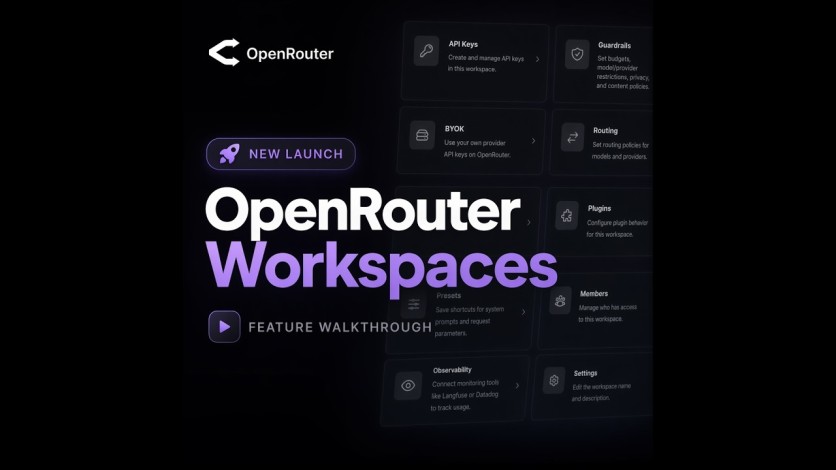
OpenRouter, the New York-based AI infrastructure startup that lets developers route a single API call across 400-plus large language models, closed a $113 million Series B on May 26, 2026 — led by CapitalG, Alphabet's independent growth fund — valuing the three-year-old company at approximately $1.3 billion. The round also drew checks from NVentures (NVIDIA's venture arm), ServiceNow Ventures, MongoDB Ventures, Snowflake Ventures, and Databricks Ventures, alongside returning investors Andreessen Horowitz and Menlo Ventures, making it one of the most strategically loaded cap tables in AI infrastructure.
The valuation more than doubled in eleven months — OpenRouter's Series A, led by Andreessen Horowitz and Menlo Ventures with Sequoia's participation, closed at an estimated $547 million post-money in June 2025, per PitchBook data. Weekly token volume grew from 5 trillion to 25 trillion over the same six-month stretch — a fivefold increase — while the platform's user base expanded to 8 million globally, ranging from solo developers to large multinationals.
The investor composition is the more revealing number. The round includes the largest cloud-data platforms (Snowflake, Databricks), the dominant AI-chip maker (NVIDIA), the leading enterprise workflow vendor (ServiceNow), and the largest open-source database company (MongoDB) — each with independent strategic reasons to want multi-model routing to succeed as a durable infrastructure layer.
What OpenRouter Does and Why Enterprises Route Through It
The product solves an operational problem that grew as the model market grew. Developers who want to call Anthropic Claude, Google Gemini, OpenAI GPT, xAI Grok, and DeepSeek's models would ordinarily manage five separate API integrations, five billing accounts, and five sets of rate limits. OpenRouter collapses that complexity: developers point their application at one endpoint, pay one bill, and let the platform handle routing, failover, and optimization across all 400-plus models it supports.
The economic incentive for customers is real. A properly designed routing layer — directing simpler queries to cheaper, faster models and reserving heavyweight reasoning models for tasks that require them — can reduce per-query inference cost by 30 to 50 percent without degrading quality for most workloads, according to analysis published by multiple engineering teams using the platform. OpenRouter's business model benefits directly as routed token volume grows; the company applies an estimated 5 percent markup on inference spend, a figure analyst firm Sacra published in early 2026.
The platform's public model-usage rankings, which break down real-time deployment by model and application, have become a widely watched signal for which models are being used in production — a dataset that reflects actual paid workloads rather than benchmark scores.
How Multi-Model AI Routing Became Enterprise Infrastructure
The growth curve that produced 25 trillion weekly tokens is not idiosyncratic. F5's 2026 State of Application Strategy Report found that 78 percent of organizations now operate their own inference services, and the average enterprise evaluates or operates seven distinct AI models simultaneously. IDC's 2026 AI and Automation FutureScape projected that by 2028, 70 percent of leading AI-driven enterprises will use multi-model routing architectures to manage workloads dynamically across providers.
"Running inference at scale is fundamentally a multimodel problem," OpenRouter CEO Alex Atallah said in the company's Series B announcement. "The era of picking a single model is over. Success now depends on continuously routing across a changing market." Atallah, who co-founded NFT marketplace OpenSea before building OpenRouter with co-founder Louis Vichy, launched the platform in 2023 after recognizing that the model market was fragmenting faster than any developer could maintain integrations.
The company said it plans to deploy the new capital toward routing intelligence, governance tooling, optimization systems, and enterprise infrastructure.
CapitalG Backs the Platform Most Likely to Divert Traffic From Gemini
The most analytically interesting entry on the investor list is the lead investor. CapitalG is Alphabet's independent growth fund — separate from Google Ventures and Google's own corporate development group — and it operates with investment mandates that are financial rather than strategic. That independence is the same logic that allowed CapitalG to previously back CrowdStrike while Google was building its own cybersecurity stack.
But the tension is still visible. OpenRouter's entire value proposition rests on model neutrality: if Gemini is the most expensive option for a given query, OpenRouter routes that query to a competitor. CapitalG, an Alphabet subsidiary, just wrote the largest check in a round that directly funds that neutrality. Two readings coexist. The first is that CapitalG concluded the multi-model routing layer will exist regardless of what Alphabet does, and an ownership stake is preferable to watching it get built by a pure competitor. The second is that Alphabet decided routing infrastructure is worth owning precisely because it sits between every AI application and every model provider — including Google's own.
Mo Jomaa, partner at CapitalG, framed the investment in infrastructure terms: "Every platform shift creates infrastructure gaps: from Cloudflare with the internet and Stripe with digital payments, to Databricks with data and AI. These infrastructure gaps create opportunities for generational businesses to solve real customer needs. OpenRouter is solving the infrastructure gap for inference in the AI era."
What CapitalG gains, beyond financial upside, is access to OpenRouter's real-time deployment data: which models are receiving production traffic, which are losing it, and which workloads are migrating between providers. That is a strategically valuable dataset regardless of where the traffic ends up.
Portkey Exits the Independent Market Before OpenRouter's Biggest Push
The most consequential competitive development around the funding round was not the round itself. On April 30, 2026 — four weeks before OpenRouter's announcement — Palo Alto Networks announced its intent to acquire Portkey, the production-grade AI gateway that had been the most visible enterprise alternative to OpenRouter, with plans to integrate it into Prisma AIRS, its AI security platform. The deal is subject to standard closing conditions and is expected to close in Palo Alto Networks' fiscal fourth quarter.
Portkey's differentiating features — deeper observability, virtual-key management, semantic routing, and automated failover with up to 99.99 percent uptime claims — were the specific capabilities OpenRouter's critics most often cited as gaps relative to a full enterprise gateway. Once the deal closes, Portkey will no longer compete as an independent product, and its buyer will be primarily a security vendor rather than a pure routing play. That shift changes the competitive map OpenRouter operates in.
What OpenRouter Still Has to Prove
Three structural risks remain that the funding round does not resolve.
The first is foundation lab disintermediation. OpenAI, Anthropic, and Google already provide their own unified model endpoints and developer APIs, and the integration overhead of calling each provider directly has decreased with every SDK update. If the labs ship native multi-model routing layers — which they have strategic incentives to do — the case for an independent router narrows.
The second is enterprise single-tenancy demand. Large enterprises in regulated industries increasingly require on-premise inference deployment or single-tenant cloud infrastructure for compliance reasons. That architecture favors LiteLLM, the dominant open-source self-hosted gateway, over OpenRouter's hosted model. The market is fragmenting along the hosted-versus-self-hosted axis, and OpenRouter's position is strongest in the hosted segment.
The third is the conflict embedded in OpenRouter's rankings product. The platform publishing real-time model-usage rankings is also the platform routing the traffic those rankings track. The data is directionally useful, but it is not neutral market-share data; readers should treat it as a signal from an interested party.
None of these risks eliminate the central thesis. Twenty-five trillion tokens per week is a genuine production-load figure, and the investor group that assembled around it — infrastructure incumbents who want their customers to access any model without vendor lock-in — reflects a considered view that multi-model routing is a durable layer in the AI stack, not a transitional workaround.
Frequently Asked Questions
What does OpenRouter do for enterprise AI users?
OpenRouter provides a single API endpoint that routes application requests across 400-plus large language models from providers including Anthropic, OpenAI, Google, NVIDIA, and DeepSeek, handling failover, cost optimization, and unified billing. Enterprise users gain the ability to swap models for different workloads without rewriting application code or managing multiple vendor contracts.
How does multi-model AI routing reduce costs?
By directing low-complexity queries — routine summarization, classification, or short-context tasks — to smaller, cheaper models, and reserving high-reasoning frontier models for tasks that require them, a properly configured routing layer can reduce average per-query inference cost by 30 to 50 percent while maintaining output quality for most production workloads.
What is CapitalG, and why did it invest in OpenRouter?
CapitalG is Alphabet's independent growth-stage venture fund, separate from GV (formerly Google Ventures) and Google's corporate development team. It invests for financial returns rather than for strategic alignment with Google's product roadmap. Its investment in OpenRouter — a platform that routes traffic to Gemini's competitors when they offer better price or performance — reflects a financial bet on multi-model routing infrastructure becoming a permanent fixture of the AI stack.
Is OpenRouter safe for enterprise data handling?
OpenRouter does not store prompts or model responses by default; logging is opt-in. Enterprise accounts can restrict routing to providers with zero-retention policies, and the platform supports EU in-region routing for European data residency requirements. Enterprises routing through any Chinese-owned model provider, including DeepSeek, remain subject to China's National Intelligence Law, which obligates Chinese companies to cooperate with government intelligence requests regardless of where data is physically processed.
ⓒ 2026 TECHTIMES.com All rights reserved. Do not reproduce without permission.


