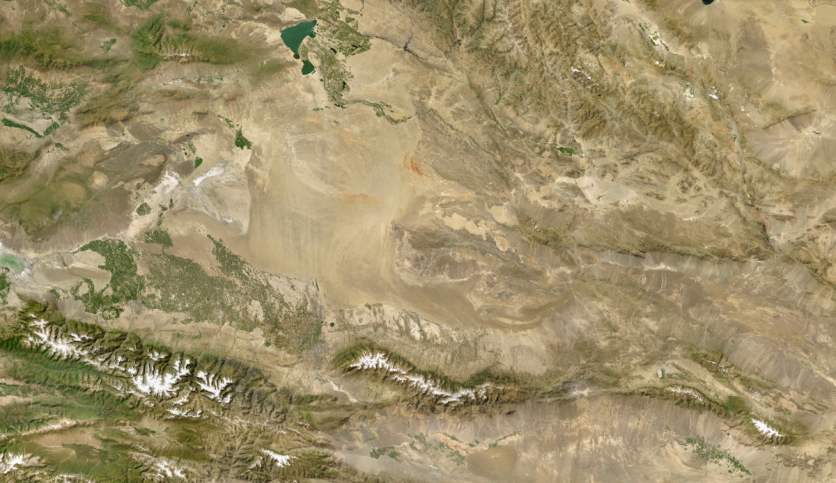
Commercial satellite imagery reviewed by Reuters and assessed by three independent security analysts has revealed, for the first time, the full extent of a vast military complex China has been constructing across thousands of square kilometers of remote northwestern desert — a sprawling network of launch pads, hardened bunkers, and command nodes designed to ensure Beijing could absorb a nuclear first strike and still retaliate against the United States.
The complex surrounds the Hami nuclear silo fields in Xinjiang province, where China's longest-range intercontinental ballistic missiles are stored. More than 80 concrete launch pads have been documented in the imagery, provided in part by Vantor, a commercial satellite imagery company. Analysts say the pads are intended to support China's expanding fleet of mobile missile launchers, air-defense batteries, and possibly electronic warfare systems — making any potential first strike against China's land-based nuclear arsenal a far harder targeting problem than it was even five years ago.
"I've never seen anything quite like it," said Hans Kristensen, director of the Nuclear Information Project at the Federation of American Scientists, who reviewed the imagery. The scale of construction, which had not been previously reported in full, represents what analysts describe as a qualitative shift in how China is protecting — not merely expanding — its nuclear deterrent.
The Reuters investigation was published today, the opening day of the International Institute for Strategic Studies Shangri-La Dialogue in Singapore, where defense ministers and military commanders from across the Indo-Pacific are gathered. One day earlier, the IISS published a strategic assessment warning that any U.S.-China conflict over Taiwan would risk nuclear escalation, and that the world stood on the cusp of a new nuclear arms race "with the Asia-Pacific at its core."
What Satellite Images Show Inside China's Nuclear Desert Complex
The satellite photographs document at least two large octagonal installations constructed in eastern Xinjiang over the past six years, both located southwest of the Hami silo fields — one roughly 140 kilometers from the silos, the other about 230 kilometers distant. The octagonal compounds contain housing for military personnel and space for large military vehicles, flanked by armored bunkers, fortified weapons-storage facilities, and both airfields and railheads that physically link them to the Hami sites.
Recent imagery shows large tents and what two analysts described as camouflaged launch sites carved directly into the desert, some equipped with air-defense missile batteries. A possible space or microwave communications facility is also under construction at the northern octagon, with satellite dishes and two large towers visible. Kristensen and Alexander Neill, an adjunct fellow at Hawaii's Pacific Forum think tank, said the conduits connecting the pads to the octagonal structures may contain fiber-optic cables for communications — a detail consistent with purpose-built command-and-control infrastructure.
Military exercises involving heavy vehicles were documented around the northern octagon throughout April and as recently as May 11, 2026.
A third octagonal installation, located south of the historic Lop Nur nuclear test site, appears less developed. Analysts at Vantor identified pockmarked earth, damaged structures, and what appear to be mock-ups of Western jet fighters — consistent with use as a military target range.
Why China Builds Defenses When US and Russia Do Not
Five security scholars interviewed by Reuters broadly agreed the infrastructure supports China's nuclear program, though significant uncertainties remain — including which specific weapons will be deployed at the launch pads and whether the octagonal compounds house truck-mounted ballistic missiles or nuclear warhead assembly facilities.
What is not in dispute, analysts say, is what the network signals strategically. The United States and Russia — whose warhead stockpiles and deployed weapons each vastly exceed Beijing's — rely primarily on sheer numbers of silos, their geographic isolation, and hardened construction to deter a first strike. Neither country has built anything approaching this kind of layered, proximate defensive network around its silo fields.
Tong Zhao, a senior fellow in nuclear policy at the Carnegie Endowment for International Peace, offered a measured assessment of the octagonal structures: "Taken together, I think there is a real possibility that the octagonal structures and the strange towers are linked to C3 — command, control, and communications — as well as maintenance and storage activities related to China's nuclear operations at the Hami ICBM silo site."
China, by contrast to the United States and Russia, appears to be compensating for a smaller arsenal through complexity and redundancy — a strategy that makes any targeting calculation against its nuclear forces significantly more difficult.
What Is China's Second-Strike Capability, and Why Does It Matter?
China's land-based nuclear missiles are already capable of reaching any city in the United States. But raw reach has never been the limiting factor in Beijing's deterrent. The limiting factor has always been survivability — whether enough of China's nuclear force would survive a well-executed American first strike to deliver an unacceptable retaliatory blow.
The Pentagon's December 2025 annual report to Congress assessed that China now possesses more than 600 operational nuclear warheads, a figure confirmed by U.S. Strategic Command in March 2026 congressional testimony. China has roughly tripled its arsenal in a decade — from approximately 200 warheads in 2015 — and the Pentagon projects it will exceed 1,000 warheads by 2030.
That growth is significant. But what the satellite images reveal is something different: a major investment not in building more weapons but in making the existing ones — and their delivery systems — harder to destroy before they can be used.
Neill described what is emerging from the satellite data in stark terms: "We can see this infrastructure is being built on a grand scale, covering thousands of square kilometers of desert beyond the silo fields. Depending on the precise capabilities, we're looking at a very considerable enhancement and diversification of China's strategic nuclear deterrent."
Kristensen said it was "hard to rule anything out" given the scale of the construction in what he described as a hostile and isolated environment.
Nuclear Arms Race Context: New START Gone, No China Agreement in Sight
The Reuters investigation lands on a day when every element of the global nuclear risk picture is in motion. The last bilateral strategic arms limitation treaty between the United States and Russia — known as New START — expired in February 2026 with no replacement in place. No treaty has ever covered China's nuclear arsenal.
President Donald Trump raised nuclear arms control directly with Chinese President Xi Jinping at their Beijing summit on May 14–15, 2026, proposing a trilateral framework that would cover U.S., Russian, and Chinese forces. The summit ended without any substantive agreement on the topic. Daniel Salisbury, a senior fellow at the IISS, confirmed there were no meaningful nuclear discussions at the meeting.
The day before the Reuters story published, the IISS warned in its pre-Shangri-La Dialogue assessment that a conflict between the United States and China over Taiwan would risk nuclear escalation because both militaries would likely target each other's command and communications hubs — the very kind of infrastructure that appears to now be hardened and dispersed across China's northwestern desert. The assessment also warned the world was approaching a new nuclear arms race, with the United States, China, and Russia all expanding forces in the absence of any binding arms control framework.
China's January 2026 nuclear white paper stated that Beijing maintains its forces "at the minimum level required for national security" and reaffirmed a "no first use" policy. But the U.S. government's most recent assessments have concluded that China is also developing a capability to launch missiles on warning of an incoming attack — before any strike could destroy the silos — and that its expanding arsenal may increasingly be intended to deter conventional conflicts, not just nuclear ones.
What Happens Next: Arms Talks Stall as Satellite Surveillance Intensifies
The broader pattern surrounding this construction is one of deliberate opacity. Beijing has declined repeated American invitations to enter nuclear arms control negotiations. The U.S. government formally accused China in February 2026 of conducting low-yield nuclear test explosions in violation of the 1996 Comprehensive Test Ban Treaty — the first direct government-to-government accusation of its kind.
The State Department's own arms control bureau told the Conference on Disarmament in Geneva in February 2026 that China had "deliberately, and without constraint, massively expanded its nuclear arsenal" and that Washington was unsure whether Beijing's stated "no first use" doctrine could be taken seriously given the scale and opacity of the buildup.
Xi is expected to visit the United States in the fall of 2026 — a visit that arms control advocates say represents a critical window for establishing basic communication frameworks if not a formal treaty. For now, the desert keeps most of its operational secrets. But commercial satellite technology is watching, and what it is documenting is altering what analysts and policymakers understand about the real-world difficulty of any nuclear confrontation with China.
Frequently Asked Questions
What did satellite images reveal about China's nuclear program in 2026?
Commercial satellite imagery reviewed by Reuters and assessed by three independent security analysts documented more than 80 concrete launch pads, at least two large octagonal installations, armored bunkers, and fiber-optic-linked command nodes built across thousands of square kilometers of remote Xinjiang desert near China's Hami ICBM silo fields. The scale of the defensive network, which had not been previously reported in full, is described by analysts as unprecedented among nuclear-armed states.
What is China's second-strike nuclear capability?
Second-strike capability refers to a nuclear-armed state's ability to absorb a first strike by an adversary and still retaliate with nuclear weapons. China's land-based missiles can already reach any U.S. city, but the newly revealed defensive network — including hardened launch pads, communications nodes, and air-defense batteries dispersed across thousands of square kilometers — is designed to make it much harder for any first strike to destroy China's ability to retaliate.
How many nuclear warheads does China have in 2026?
The Pentagon's December 2025 annual report assessed China's operational nuclear warhead stockpile at more than 600, a figure confirmed by U.S. Strategic Command in March 2026 congressional testimony. China has roughly tripled its arsenal since 2015, when it held approximately 200 warheads, and the Pentagon projects the total will exceed 1,000 by 2030.
Why has China refused nuclear arms control talks with the United States?
China has declined U.S. invitations to enter arms control negotiations, arguing that its arsenal is far smaller than American and Russian stockpiles and that constraints would entrench U.S. nuclear superiority. President Trump raised a proposed trilateral arms control framework with Xi Jinping at their May 2026 Beijing summit, but the meeting ended without any substantive nuclear agreement.
ⓒ 2026 TECHTIMES.com All rights reserved. Do not reproduce without permission.


